


SPONSORED What's This?
The AI Homework Helper That Teaches Instead of Tells
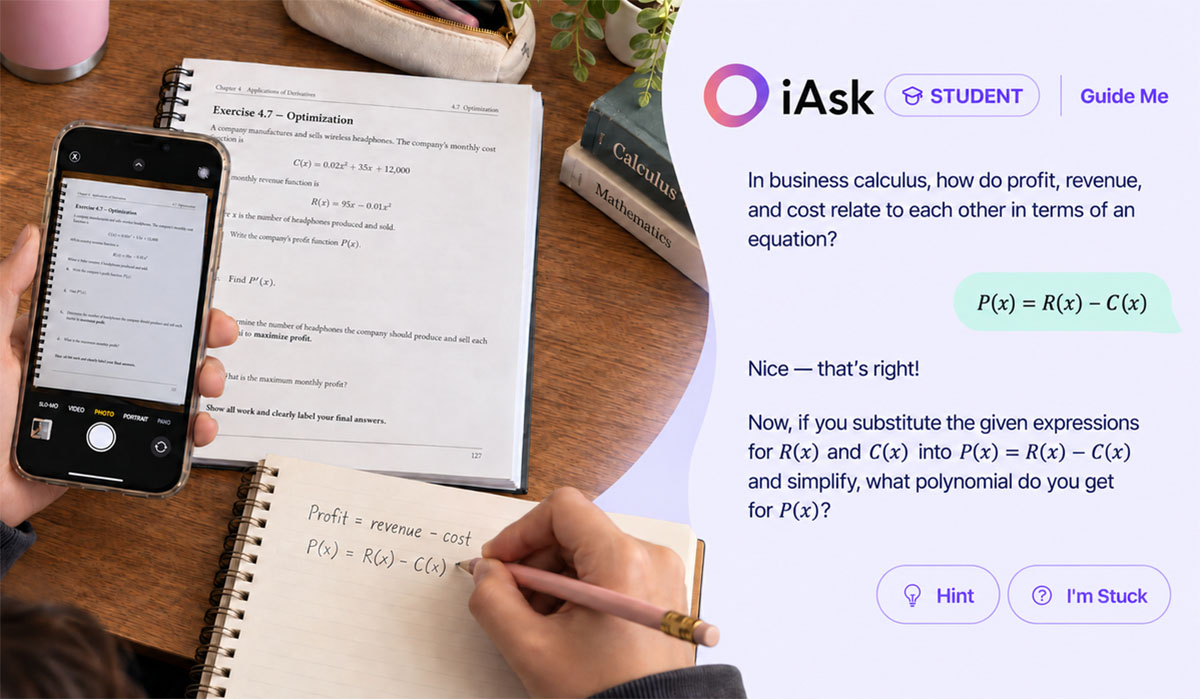
iAsk AI recently released an AI homework helper that combines photo uploads with guided questions so students can work through the reasoning one step at a time.
A calculus worksheet can give a student the cost and revenue equations without making the next step obvious. Before differentiating or entering numbers into a calculator, the student needs to decide how those quantities relate. That moment of uncertainty is where a useful homework conversation begins.
iAsk.ai gives students a way to ask AI about the problem in front of them, then work through it in Guide Me mode. A typed question or uploaded photo supplies the starting point. Follow-up questions keep the student involved in deciding what to do next.
The audience for that kind of support is already substantial. A Pew Research Center report published in February 2026 found that 54% of U.S. teens had used chatbots for schoolwork help. The survey covered 1,458 teens ages 13 to 17 in September and October 2025. It measured chatbot use broadly, rather than the results of a particular homework tool.
An AI homework helper that asks the next question
iAsk’s Guide Me mode works as an AI homework helper that breaks a problem into an exchange. In a company-supplied calculus example, it asks how profit, revenue and cost relate. The student responds with P(x) = R(x) - C(x). The system confirms that relationship, then asks the student to substitute the given expressions and simplify. Hint and I’m Stuck buttons offer ways to request more support.
The useful detail is the pause between steps. A student who knows the profit equation may still need help subtracting one polynomial from another. A follow-up question makes that difficulty easier to identify than a finished calculation alone. The example demonstrates the interaction; it does not establish an improvement in grades.
Visual Search helps students bring the original problem into that exchange. The iAsk app supports camera searches, and the web interface accepts image uploads. A photograph can preserve the graph, diagram or notation that would be awkward to describe in a text box.
The first check is whether the image has been read correctly. A missed minus sign or cropped instruction changes the problem. Asking the system to describe the relevant equations or labels gives the student a chance to correct the input before working through the explanation.
Keeping the student involved
Students report mixed experiences with AI study tools. The 2026 HEPI survey, sponsored by Kortext, found that 49% of surveyed full-time UK undergraduates believed AI had improved their student experience. Others raised concerns about fairness and skill erosion. These are students’ perceptions, not measured learning gains.
For homework, a practical routine is to request one hint, attempt the step and explain the reasoning back, within the teacher’s rules on AI use. A student can then close the tool and try a similar problem to see what they can do independently.
That is the purpose of the questions in iAsk’s guided approach: to give the learner something to work out at each stage. The next assignment offers a useful test of what they understood.