



Astronomers spotted a supernova in a spiral galaxy about 50 million light-years away, with its brightening expected to peak between now and Monday.
The Asteroid Terrestrial-impact Last Alert System, or ATLAS, detected the explosion, designated SN 2026ahvu, on Nov. 2.
Spectra taken the next day with the Keck II telescope identified it as a young Type Ia supernova, the thermonuclear explosion of a white dwarf, the dense remnant of a Sun-like star.
People were interested in these podcasts
Its brightness rose from about magnitude 17 at discovery to 13.5 within days. A lower magnitude means a brighter object.
The explosion is in NGC 1433, a barred spiral galaxy in the southern constellation Horologium. Because of the distance, the light left the galaxy about 50 million years ago. NOIRLab uses 50 million light-years as an approximate figure and notes that published estimates differ.
“Caught early and still approaching its expected maximum brightness, SN 2026ahvu gives astronomers a valuable opportunity to study a stellar explosion as it unfolds,” the National Science Foundation’s NOIRLab said.
NOIRLab ranks it among the nearest Type Ia supernovae seen since SN 2011fe in the Pinwheel Galaxy in 2011.
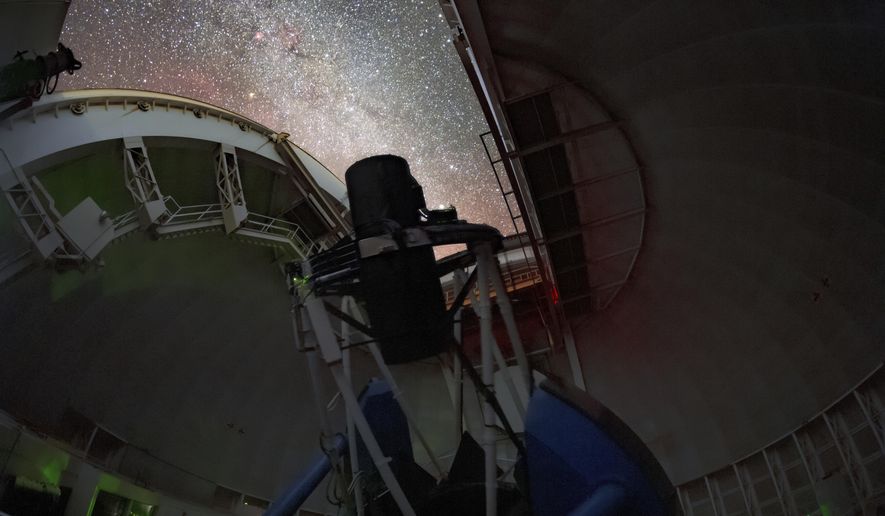
Telescopes such as the Dark Energy Camera and Gemini South are tracking it night to night. The Dark Energy Camera also imaged the galaxy before the explosion for the Dark Energy Survey from 2013 to 2019.
Type Ia supernovae peak at a predictable brightness, so astronomers use them to measure cosmic distances, and this one’s peak should narrow the estimate for NGC 1433. Observers in the Southern Hemisphere can see it with small to moderately sized amateur telescopes under favorable conditions.
In a Type Ia, a white dwarf in a binary system pulls matter from a companion star until it nears roughly 1.44 solar masses, triggering a runaway thermonuclear blast that destroys the star. Some also form when two white dwarfs merge. The explosion leaves no remnant star.
Supernovae from stars at least eight times the Sun’s mass are a different type. Their cores collapse in under a second and can leave behind a neutron star or black hole.
Contact the author

Please read our comment policy before commenting.