


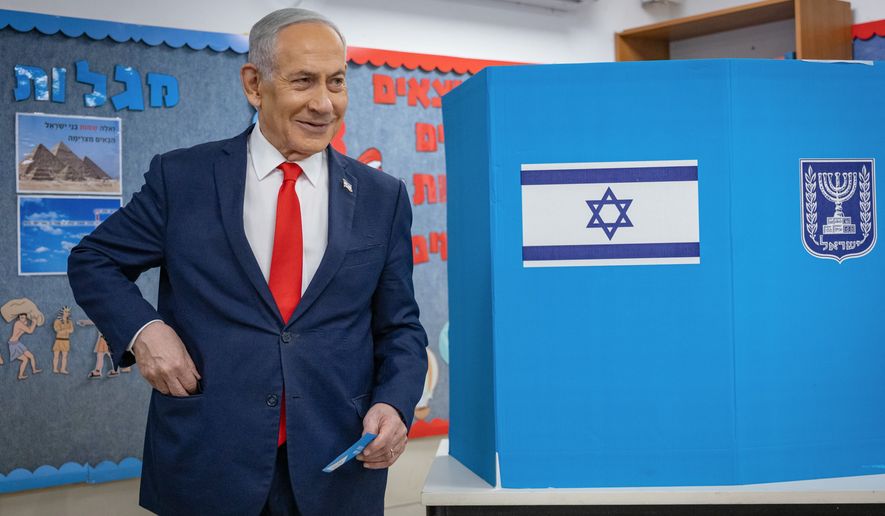

Israeli Prime Minister Benjamin Netanyahu’s Likud party won the largest share of the vote in Tuesday’s elections, but neither Mr. Netanyahu nor former Israel Defense Forces Chief of Staff Gadi Eisenkot has a clear path to forming a government.
Both men claimed victory, though assembling a governing coalition in Israel’s fragmented, multiparty parliamentary system could take weeks or might not happen at all, requiring another election.
An exit poll by the Kan public broadcaster projects Likud winning 27 seats out of the 120 in the Knesset compared with 21 for Mr. Eisenkot’s Yashar party.
People were interested in these podcasts
Still, the exit polls also showed that Mr. Eisenkot’s political bloc can secure about 51 seats in the Jewish state’s parliament, about the same as the 51 seats for the prime minister and his allied parties.
“The preliminary poll results point to complete distrust in Netanyahu and the government of Oct. 7. If these are the final results, this is a victory for the statist-Zionist majority in Israel,” Mr. Eisenkot said on social media.
“I will act immediately to realize the decision of the people, to replace the Netanyahu government, and to establish a Zionist mobilization government, at the earliest possible time,” he said.
In a speech to supporters early Wednesday, Mr. Netanyahu begged to differ, saying that Israel “must establish a strong, right-wing, nationalist government.”
To form a government, an Israeli leader needs to secure the formal support of at least 61 members of the 120-seat legislature. No single party has ever won an outright 61-seat majority in Israel’s history.
The key is that Arab-led parties are projected to win the 18 or so seats not won by the two big coalitions. Those Arab parties oppose Mr. Netanyahu but are not part of the Zionist anti-Netanyahu bloc.
A coalition with Arab parties could splinter that bloc and bring charges of treason from the right-leaning parties behind Mr. Netanyahu. The prime minister’s Wednesday speech specifically warned gainst forming a coalition with Arab parties.
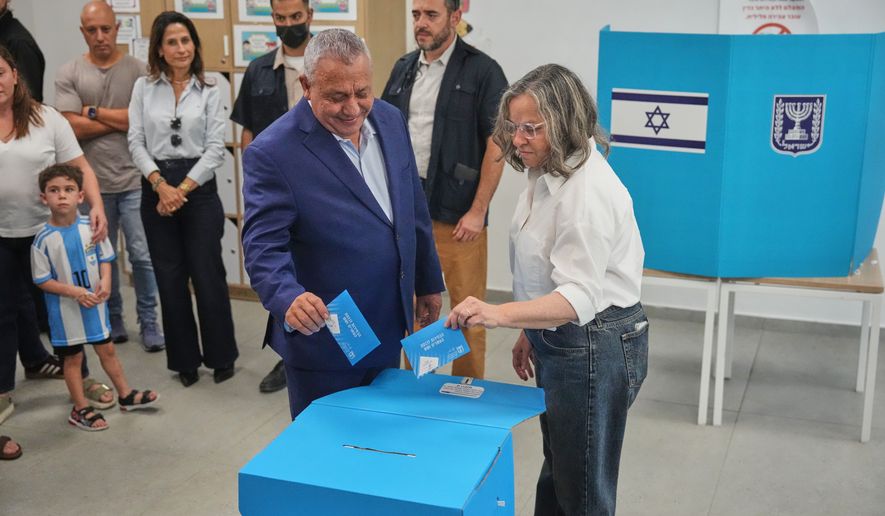
In the worst-case scenario, in which no party can cobble together a 61-seat coalition, new elections could be held early next year. A similar stalemate led to five elections between April 2019 and November 2022.
Foreign Minister Gideon Sa’ar said the celebrations from the left were premature.
“One thing seems quite clear. Likud is the largest party in Israel,” Mr. Sa’ar said on social media. “It’s always good to learn something from the past.”
Voter turnout in Tuesday’s election reached its highest level since 1999. The turnout was 77% of eligible voters.
The turnout was also strong in the Arab quarters. In the Bedouin city of Rahat in southern Israel, Ahmed al-Qassassi said he has never seen larger crowds at the polling station.
“I’ve voted dozens of times and never seen a crowd like this,” he told The Times of Israel. “This time, we are going to the polls in droves.”
Mr. Eisenkot’s Yashar party accused the prime minister and Likud of attempting to undermine confidence in the results by claiming that the elections were being stolen.
“Netanyahu is panicking and has begun making up stories and claiming that the election is being stolen. This is no accident. He is already laying the groundwork to challenge the election results,” the Yashar party said in a statement, according to The Times of Israel.
Israeli President Isaac Herzog will soon have to decide whether Mr. Netanyahu or Mr. Eisenkot gets the first chance to form the country’s next government. Under Israeli law, the president must consult the Knesset factions before making the choice.
“Netanyahu will undoubtedly point to Likud’s position as the largest individual party, while Eisenkot has an equally compelling argument in the game of parliamentary arithmetic, pointing to his larger bloc and the bigger chance of forming a government,” The Jerusalem Post reported.
Israeli authorities mobilized a nationwide security operation to protect polling stations, secure ballot transit, and guard against postelection public disorder.
About 22,000 Israeli police officers were deployed across the country — an increase of 5,000 personnel compared with the 2022 national election. The IDF also set up closures and roadblocks throughout the West Bank to deter potential terrorist attacks and settler unrest, the Post reported.
President Trump did not release a statement on election day itself, but he had earlier called on Israelis to “vote for Bibi.”
He has also taken to Truth Social to warn Israelis against choosing anyone other than Mr. Netanyahu.
“If Israel has the wrong leader, meaning anyone other than Bibi, America will have to do this job itself, and I’m not inclined to do that,” he said.
The 77-year-old leader has dominated Israeli politics for decades. He has served as prime minister for about 19 years across three separate periods. His current term began in December 2022.
“Each side needs coalition partners to reach the 61-seat majority in the Knesset to form a government, but the partners they need have conflicting agendas and might not be willing to work with each other,” Steven Simon, a senior analyst with the Quincy Institute for Responsible Statecraft, said in a statement. “Even if the center-right does defeat the far right and forms a government, Israel’s foreign and security policies are unlikely to change very much.”
Reflecting his background as a former IDF chief, Mr. Eisenkot placed national security at the center of his platform. His party’s foreign policy focuses on confronting Iran, dismantling Hamas’ rule in the Gaza Strip and containing Hezbollah in Lebanon. He has also pushed for institutional reform, universal conscription and social cohesion.
Regarding Gaza, his party’s stated approach combines replacing Hamas’ rule with maintaining an Israeli security corridor in the Palestinian enclave. Mr. Eisenkot would allow reconstruction to advance incrementally alongside partial disarmament, according to The Jerusalem Post.
In October, he pledged to destroy Hamas’ military wing and dismantle its leadership within 18 months.
The Trump administration spoke with Israeli officials about the possibility of forming a unity government that includes both Mr. Netanyahu and Mr. Eisenkot, The Washington Post reported.
A Likud official said Mr. Eisenkot, the former IDF chief, “lacks the backbone and the determination that Netanyahu has.”
“What Trump wants is a stable and reliable Israeli government that can be formed as soon as possible after the election,” the Likud official said.
Contact the author

Please read our comment policy before commenting.