


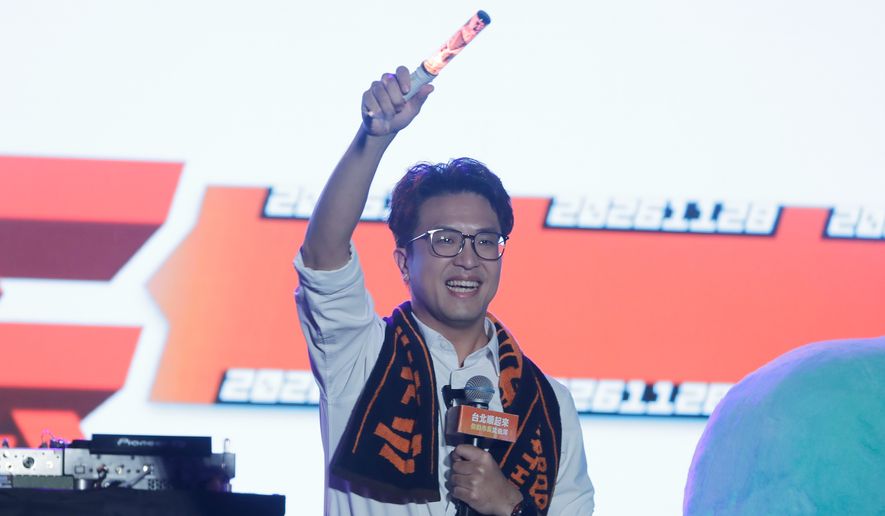

SEOUL, South Korea — For those opposed to China’s ambitions of taking control of Taiwan, Shen Pao-yang — better known as “Puma” Shen — looks like the ideal candidate in Saturday’s mayoral election for the democratic island’s capital.
His credentials in the space are impeccable: Not only has he founded civic self-defense organizations, in 2024, he was placed on a “wanted” list by China’s Taiwan Affairs Office for his alleged support of Taiwanese independence.
Mr. Shen’s bona fides raise the question of how much priority the average voter in Taipei places on the China threat issue.
People were interested in these podcasts
Mr. Shen, of the ruling Democratic Progressive Party, is taking on incumbent Chiang Wan-an of the opposition Kuomintang, or Nationalist, Party.
Island politics are deeply polarized. The DPP is a politically progressive machine, but takes a much harder line against China than the conservative KMT.
Mr. Shen, a lawyer and academic, is known as the founder of Kuma Academy, a nonprofit that trains citizens how to survive a physical catastrophe — such as a Chinese invasion. (“Kuma” means bear, and has no special relation to Mr. Shen’s nickname “Puma” — which references not a mountain lion, but his preferred brand of athletic wear.)
Mr. Shen also founded Doublethink Lab, a non-governmental organization that focuses on cognitive warfare.
Chinese President Xi Jinping has not ordered a single kinetic operation since taking power in 2013, but has overseen a vast increase in grey-zone operations.
Against Taiwan, those cognitive warfare tactics include algorithms targeting social media, grievance exploitation, the creation of AI tools that upscale campaigns and the normalization of military posturing.
In Taipei, Mr. Shen’s campaign has caused a stir, but the political race that climaxes with Saturday’s vote still looks like an uphill battle.
Domestic odds against
One of the hurdles Mr. Shen faces: He is an electoral novice running against a seasoned pro.
He entered the Legislative Yuan via proportional representation, rather than via public plebiscite, in 2024.
He is taking on a proven veteran of the island’s polarized politics: Mr. Chiang, who won Taipei City Hall in 2022, and who says he is the great-grandson of Taiwan’s founding father, the late KMT Gen. Chiang Kai-shek.
Gen. Chiang lost the civil war on the mainland to Communist Party Chairman Mao Zedong and retreated to Taiwan in 1949, founding an offshore government on the island that has held sway since.
Secondly, Taipei is known KMT terrain.
The city, with its population of 2.5 million, remains the home of many of the elite households who fled China with Gen. Chiang.
Moreover, a significant chunk of younger Taiwanese professionals from the provinces who make the capital their home, and who are natural DPP supporters, are not registered to vote in the city.
Since democratization in 1994, the KMT has won Taipei City Hall in six of eight elections.
The last time a major political gauntlet was hurled down to the KMT, it emerged triumphant.
In summer 2025, in an unprecedented political movement dubbed the “Great Recall,” activist voters — who won the backing of President Lai Ching-te — sought to oust KMT incumbents from 31 legislative seats.
Not one seat changed hands, strengthening the KMT’s confidence and proving its resilience.
And it is not as if Mr. Shen is facing a dusty old war horse.
Mr. Shen, 44, noted for his wavy hair and big grin, gives off a cool, youthful vibe, but Mr. Chiang, 47, is noted for his good, if more conventional, looks.
In a culture where education is revered, both men hold advanced degrees from U.S. graduate schools.
Not everyone is entranced with the challenger.
“Puma Shen never held any executive office before being selected legislator at large,” wrote Angelica Oung, a skeptical Taiwanese commentator on X. “Halfway through his term, he is running for Taipei mayor.”
But nobody is writing him off. Polls are split and as the days count down, Mr. Shen’s campaign appears to be bouncing from strength to strength.
“It is perceived that the DPP assumed the KMT candidate had the race in the bag, so they threw a sacrificial lamb into the fight, who can get another shot at serious races in the future,” said American Mattias Daly, a Taipei-based translator and PhD candidate at National Taiwan Normal University. “But Shen has surged from being a relative unknown to becoming a phenomenon.”
Dubbed the “Ocean Current,” the creative campaign by his supporters has generated chatter, island-wide. He has embraced it, appearing in public in nautical attire.
The campaign has leveraged popular manga artists for poster art, innovated “scavenger hunt”-style rallies, and given full play to Mr. Shen’s mastery of digital media.
He has especially shone on TV, approaching KMT-focused media and apparently winning over hostile hosts.
By contrast, Mr. Chiang ducked a TV debate with Mr. Shen in October.
Ms. Oung grudgingly acknowledged the DPP candidate’s televisual nous.
“Reporters are swooning, ‘He’s looking so presidential,’” she wrote. “Before the mayoral election, I’d never heard anyone call Shen handsome. Now he’s supposed to be a heartthrob.”
Even so, a big “if” hangs over his candidacy.
China issue vs. domestic focus
Given that Mr. Shen’s claims to fame were in the areas of civic defense and cognitive warfare, many might assume his attraction would rise among the populace as 2026 draws to a close.
U.S. intelligence and military officials have repeatedly stated their belief that Beijing has ordered its forces to be fully invasion-capable in 2027.
And since then-House Speak Nancy Pelosi visited Taiwan in 2022, infuriating Beijing, Chinese forces have repeatedly conducted ever larger naval and aerial drills, ever closer to Taiwan.
However, 2025’s “Great Recall” — premised on the KMT being soft on China — indicated that Taiwanese concerns about Beijing belligerence may be exaggerated.
Mr. Daly, a long-term American expatriate in Taipei, agrees.
“I don’t get the sense that people take the 2027 date more seriously than China’s ongoing threatening behavior,” he said. “People in in this part of the world hear the war drums beating, but it is the same old music they have been hearing for decades.”
Mr. Shen has astutely focused beyond his prior preoccupations.
Not only has he shorn his flowing locks to appear more mayoral, he has addressed city-specific issues — child welfare, education, an airport relocation — with aplomb.
Noting Mr. Shen’s “entire rebranding in the campaign,” NGO Global Taiwan wrote in a paper, “During multiple campaigning events and media appearances, he focused extensively on local issues … while downplaying his usual emphasis on defense and foreign interference.”
That does not mean foreign observers are switching off.
Aware of Beijing’s looming threat and Taiwan’s centrality to the digital economy — the island churns out the world’s most advanced logic chips — many will be watching events in Taipei on Saturday with an eagle eye.
“Taipei is a front-line city and priority target for aggressive acts by Beijing’s military forces as well as political infiltration by Beijing’s intelligence services,” said Ian Everhart, general manager of the Taiwan Freedom Project, which is closely associated with The Washington Times. “The mayor holds significant responsibilities for civil defense and preparedness, and holds a position of significant moral leadership for the nation as a whole.”
Contact the author

Please read our comment policy before commenting.