Skip to content
Advertisement
Author profile
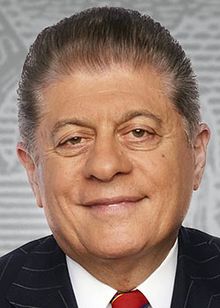
Andrew P. Napolitano

Andrew P. Napolitano

anapolitano123@washingtontimes.com

Andrew P. Napolitano, a former judge of the Superior Court of New Jersey, is an analyst for the Fox News Channel. He has written seven books on the U.S. Constitution.

Articles by Andrew P. Napolitano

President Donald Trump speaks with reporters on the South Lawn of the White House before departing, Wednesday, Oct. 23, 2019, in Washington. (AP Photo/Alex Brandon)

How Trump disparages the Constitution

Mr. Trump referred to a clause in the Constitution as "phony," and he thereby implied that he need not abide it nor enforce it, notwithstanding his oath.

October 23, 2019
Illustration on the impeachment process by Linas Garsys/The Washington Times

Is the impeachment process fair?

Impeachment is always constitutional if it originates in the House and if its basis is arguably for treason, bribery or other high crimes and misdemeanors.

October 16, 2019
FILE - In this Wednesday, July 11, 2018, file photo, President Donald Trump, left, talks with Turkey's President Recep Tayyip Erdogan, as they arrive together for a family photo at a summit of heads of state and government at NATO headquarters in Brussels. The White House says Turkey will soon invade Northern Syria, casting uncertainty on the fate of the Kurdish fighters allied with the U.S. against in a campaign against the Islamic State group. (AP Photo/Pablo Martinez Monsivais, File)

The presidency, war powers and the Constitution

President Trump's decision to withdraw the troops caused a firestorm among those in Congress who like war and those who believe that the United States should be using our military amply in the Middle East to help our friends and oppose our foes.

October 9, 2019
President Donald Trump speaks during a meeting with Finnish President Sauli Niinisto in the Oval Office of the White House, Wednesday, Oct. 2, 2019, in Washington. (AP Photo/Evan Vucci)

President Trump attacks his own presidency

The House of Representatives has begun to gather evidence in an effort to determine if President Donald Trump has committed impeachable offenses. The U.S. Constitution defines an impeachable offense as "treason, bribery, or other high crimes and misdemeanors."

October 2, 2019
President Donald Trump speaks during a meeting with Japanese Prime Minister Shinzo Abe at the InterContinental Barclay New York hotel during the United Nations General Assembly, Wednesday, Sept. 25, 2019, in New York. (AP Photo/Evan Vucci)

President Trump’s brazen acts of corruption

Last week, media outlets reported the existence of a whistleblower complaint filed with the inspector general of the intelligence community against President Donald Trump. The IC encompasses all civilian and military employees and contractors who work for the federal government gathering domestic and foreign intelligence.

September 25, 2019
Illustration on rights and privacy by Linas Garsys/The Washington Times

How the government infringes on the right to be left alone

Great Britain is currently the most watched country in the Western world -- watched, that is, by its own police forces. In London alone, the police have erected more than 420,000 surveillance cameras in public places.

September 18, 2019
Attack on Free Speech Illustration by Linas Garsys/The Washington Times

Who cares what the government thinks?

In 1791, when Congressman James Madison was drafting the first 10 amendments to the U.S. Constitution, which would become known as Bill of Rights, he insisted that the most prominent amendment among them restrain the government from interfering with the freedom of speech.

September 11, 2019
Adjudicating the Constitution Illustration by Greg Groesch/The Washington Times

The temptation of tyranny

Does the president of the United States have too much power? That question has been asked lately with respect to President Donald Trump's use of federal funds to construct 175 miles of sporadic walls along portions of the 2,000-mile common border between Texas and Mexico.

September 4, 2019
In this Monday, July 15, 2019, file photo, U.S. Rep. Ilhan Omar, D-Minn, second from left, speaks, as U.S. Reps., from left, Rashida Tlaib, D-Mich.,Ayanna Pressley, D-Mass., and Alexandria Ocasio-Cortez, D-N.Y., listen, during a news conference at the Capitol in Washington. (AP Photo/J. Scott Applewhite, File)

The limits of free speech

During the past week, President Donald Trump excited two bitter public controversies by sending and publishing two highly inappropriate and offensively incendiary tweets.

July 17, 2019
This photo made available by the U.S. National Archives shows a portion of the United States Constitution with Articles V-VII. For the past two centuries, constitutional amendments have originated in Congress, where they need the support of two-thirds of both houses, and then the approval of at least three-quarters of the states. But under a never-used second prong of Article V, amendments can originate in the states. (National Archives via AP)

The Constitution, the census and citizenship

Late last month, the U.S. Supreme Court ruled on a challenge to a question that the Commerce Department announced it would add to the 2020 census. The census itself has been mandated by the U.S. Constitution to be taken every 10 years so that representation in the House of Representatives could be fairly apportioned to reflect population changes.

July 10, 2019
This photo made available by the U.S. National Archives shows a portion of the United States Constitution with the title of Article V. For the past two centuries, constitutional amendments have originated in Congress, where they need the support of two-thirds of both houses, and then the approval of at least three-quarters of the states. But under a never-used second prong of Article V, amendments can originate in the states. (National Archives via AP) ** FILE **

Can government punish twice for the same crime?

Last week, this column discussed the unconstitutional efforts of federal prosecutors in Chicago to punish an American citizen for crimes that had not yet been committed. This week, I address the wish of federal prosecutors in Alabama to charge and to punish a man for a crime for which he had already been convicted and punished.

June 19, 2019
This photo made available by the U.S. National Archives shows a portion of the United States Constitution with Articles V-VII. For the past two centuries, constitutional amendments have originated in Congress, where they need the support of two-thirds of both houses, and then the approval of at least three-quarters of the states. But under a never-used second prong of Article V, amendments can originate in the states. (National Archives via AP)

Trashing the Constitution again

While the eyes of the political and media classes were on President Donald Trump as he commemorated the 75th anniversary of D-Day in the United Kingdom and in France last week, and then as we all watched for progress in the tariff war Mr. Trump started with Mexico, the Department of Justice was quietly trying to persuade a federal judge in Chicago to abandon first principles with respect to citizenship and sentencing.

June 12, 2019
Illustration by M. Ryder/Tribune Content Agency

Mueller stirs the pot

Last week, special counsel Robert Mueller — who had been appointed by the Department of Justice two years earlier to investigate the nature and extent of Russian attempts to influence the outcome of the 2016 presidential election and to determine, if those attempts did occur, whether the Russians had any willing American collaborators in the Trump campaign — came to the cameras and announced his resignation.

June 5, 2019