


Victory Over Communism
"Communism didn’t end with the Cold War." Washington Times National Security correspondent Bill Gertz shares his insights and analysis on threats facing the country from the Chinese Communist Party.
Listen here.
For comments or feedback, email media@washingtontimes.com using the subject line "Victory Over Communism."
Click HERE for more Washington Times podcasts.
Click HERE for more from Bill Gertz.
Recent Stories

Trump dismisses Chinese spying concerns
President Trump appeared to dismiss U.S. national security concerns over large-scale Chinese intelligence collection, espionage and cyberattacks in a recent exchange with reporters noting similar U.S. practices.

U.S. sanctions Italian far-left group for backing antifa, domestic extremists
The State Department imposed sanctions on an Italian leftist group that supplies digital support to antifa and other extremists, including a group in Oregon, according to information released by the department on domestic terrorists.

China working on AI-powered hypersonic missiles
The Chinese military is studying the use of artificial intelligence to boost the capabilities of its hypersonic missiles in defeating U.S. missile defenses, according to an Air Force think tank report.

State blasts China for building new military base on disputed reef
The State Department on Wednesday called China's construction of a new military base on a disputed South China Sea island "unacceptable" and detrimental to peace and stability.

Navy warns all sailors to be vigilant against increased threats
All Navy personnel and their families face increased dangers of attacks from terrorism, drones and online threats since the Iran war began and are being urged to tighten security, acting Navy Secretary Hung Cao said in a recent security notice.

A history of 'relentless retaliation'
America has an important tradition of applying the maxim of "relentless retaliation" when it comes to our counterterrorism operations, and it needs to follow through with this policy in the case of Iran.

Hundreds of American and allied institutes helped Chinese military labs
Hundreds of American and allied companies and universities collaborated with Chinese defense institutes engaged in developing advanced military capabilities for Beijing's military, according to an Air Force think tank report made public Monday.

Make Iran another failed Middle East state
President Trump is drawing the United States into a military quagmire in Iran, despite his campaign promise to end so-called forever wars.

Chinese military practices strikes against U.S. missile defenses, Humvees
China's army is improving attack helicopter skills against U.S. missile defenses and ground vehicles, and recently practiced live-fire missile strikes against mockups of Patriot anti-missile launchers and Army Humvees, according to an Army think tank report.

Xi challenges Trump policy, says Latin America can pick partners 'without outside interference'
Chinese President Xi Jinping this week challenged President Trump's push to re-establish the Monroe Doctrine in the Western Hemisphere -- a strategy that calls for preventing China and other foreign powers from dominating the region.

Report warns: China's AI data commercialization to boost nation's trade, intel collection, military
Communist China is commercializing and monetizing data sets in ways designed to boost both commercial trade and intelligence collection and military capabilities, according to a congressional China commission report.

White House tech strategy lists Navy submarines as top priority
American submarines are a key focus in protecting U.S. military advantages against foreign enemies, along with new national security space systems know-how, according to a recent White House strategy report.

Pentagon weighs nuclear options amid China, Russia threats
The Pentagon is conducting a review of nuclear weapons use that seeks to provide the president and military leaders with greater options for using tactical nuclear weapons in a regional conflict while preventing an escalation into global thermonuclear war, according to a senior defense policymaker.
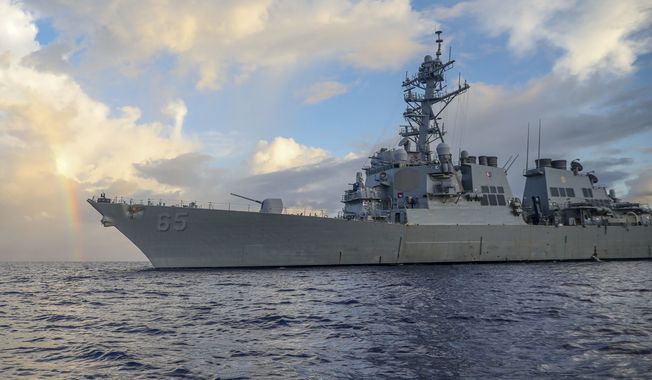
Navy destroyer stuck in South China Sea for 4 days without power
A Navy guided-missile destroyer sailing in the tension-filled South China Sea was dead in the water for four days after a system failure, according to the Navy's 7th Fleet.

U.S. leads 41 nations demanding 24-hour prelaunch missile warning after Chinese test
China's recent test of a submarine-launched ballistic missile without adequate warning prompted the U.S. and 40 countries to demand greater advance notice of such tests, the State Department said in a joint statement.

State Department criticizes Beijing-Indonesia naval maneuver as pressure on Taiwan
The State Department on Thursday called a joint Chinese naval maneuver with an Indonesian warship in waters east of Taiwan a destabilizing act, while Taipei denounced the maneuver as "dangerous."

Colby: Silence on Chinese aggression is a new strategy based on war fears
The Pentagon's senior defense policymaker on Thursday defended the lack of any mention of Chinese aggression toward the Philippines in the South China Sea or Beijing's military pressure against Taiwan in recent remarks as part of a new U.S. strategy aimed at avoiding a war with China.

General says China space weapons threat a major challenge
China's military is expanding an array of space warfare weapons that pose a major threat to American satellites and the military operations they support, a senior Space Force general said Wednesday.

State Department condemns new Chinese claim to disputed South China Sea shoal as 'destabilizing'
New Chinese government controls over a disputed South China Sea reef are a "destabilizing activity" and legal claims that Beijing is protecting a nature reserve there are questionable, the State Department said in pushing back against China's expansive regional maritime claims.
Pentagon's top policy official outlines new 'realism' approach to China
The Pentagon's new "realism" policy in the Asia-Pacific rejects moralizing and identifying regional threats, the Pentagon's chief policymaker said in a major speech Monday that omitted references to China's nefarious activities and regional aggression.