


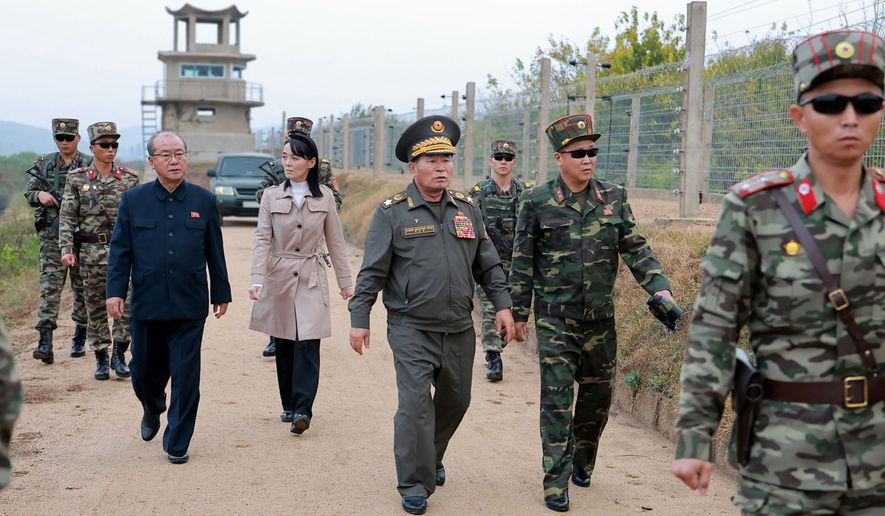

SEOUL, South Korea — The powerful sister of North Korean leader Kim Jong-un said Wednesday that Pyongyang will resume propaganda broadcasts across the Demilitarized Zone, blunting Seoul’s attempts to defuse recent tensions and initiate talks.
“Within October, the loudspeakers for psychological warfare against [South Korea] will be in operation along the whole border,” Kim Yo-jong said Wednesday.
The reactivation of broadcasts would restart a cross-border propaganda campaign that had ended in 2025. That would deal a blow to the pro-engagement Lee Jae-myung administration in Seoul, which has been rebuffed in multiple outreaches to the North, with the exception of a halt to propaganda operations.
People were interested in these podcasts
Ms. Kim’s announcement comes exactly one month after a bloody mine blast in the Demilitarized Zone. She also referenced warning shots that South Korean troops have fired in recent days inside the DMZ.
“If the enemy’s warning shot provocation results in doing actual harm to our territorial security and our service persons’ safety, going beyond the level of warning, our border guards will show no mercy for the armed gangsters,” she warned.
Ms. Kim made the statement during an unusual Wednesday visit inside the DMZ, according to Pyongyang state media monitored by Seoul media.
Unlike her elder brother, who is an alumnus of the elite Kim Il-sung Military Academy, Ms. Kim is not known to have a military background. She directs the Politburo’s shadowy General Affairs Department, which handles information flow to Supreme Leader Kim, and writes frequent articles — usually strident — in state media.
Photographs show that Ms. Kim was accompanied inside the DMZ by armed close-protection troops in camouflage and dark glasses, as well as top brass.
DMZ tensions exploded Sept. 21, when three South Korean troops were injured by a landmine — two seriously — at a site just south of the Military Demarcation Line, according to Seoul’s military.
The demarcation line is the actual border that runs through the middle of the 2.5-mile-wide DMZ, which itself cuts across the waist of the Korean Peninsula.
The DMZ was established after the 1953 Korean War armistice. Troops pulled back from front-line positions, north and south, enabling a buffer zone between the two states.
Problematically for the small infantry patrols on each side of the DMZ, the demarcation line is almost entirely unmarked today. Moreover, it is heavily overgrown in many areas with eight decades of foliage, making navigation dicey.
After an investigation, South Korea’s Joint Chiefs said the mines’ blast pattern, placement and recovered components proved the weapons were North Korean.
The Joint Chiefs accused Northern troops of crossing the demarcation line — albeit only by a few yards — and planting the weapons on a South Korean patrol route.
The North angrily denied the accusations, shouted down demands for an apology and complained that South Korean troops have fired warning shots inside the DMZ.
A day earlier, North Korean adviser to the Ministry of National Defense Pak Jong-chon accused Seoul of “deliberate, premeditated and absurd” claims, according to state media.
“Our army knows where our borderline is better than any others, and we are doing what we should do in our territory,” Mr. Pak said.
The wider background to DMZ tensions is a fortification program underway inside the buffer zone since North Korea, in 2024, ditched decades of reunification policy and dubbed South Korea a hostile, foreign state.
In some parts of the supposedly demilitarized strip, North Korea is installing minefields, barbed wire, military roads and a concrete wall fronted by a ditch and designed to foil armored vehicles.
“The border has been clearly blocked and turned into a fortress more thoroughly,” Ms. Kim said Wednesday.
Seoul has repeatedly expressed discomfort over these actions, to no avail.
Ms. Kim’s statements are just the latest blow to the progressive Lee administration.
Since taking power after the ouster of the prior conservative administration in June 2024, Mr. Lee and Unification Minister Chung Dong-young have bent over backward to restore trust with North Korea and restart inter-Korean communications.
The Lee administration jailed former President Yoon Suk Yeol, key advisers and senior officers, accusing them of launching a November 2024 black operation — a drone incursion over Pyongyang — to generate tensions with the North.
Those tensions, investigators alleged, would have underwritten a declaration of martial law by Mr. Yoon, thereby expanding his powers over the opposition-led National Assembly.
However, the December 2024 martial law decree was botched. It was withdrawn in the face of furious public and political opposition within hours, setting up Yoon’s impeachment and imprisonment.
The Lee administration has made multiple offers to North Korea: a peace treaty to replace the 1953 armistice, an easing of sanctions and an abandonment of long-held Seoul hopes of absorbing its smaller and poorer neighbor.
None has piqued the North’s interest.
An offer by Mr. Chung — of joint talks to address security issues within the DMZ in the wake of the mine incident — has also gone nowhere.
The administration’s only positive inter-Korean win was the North’s reciprocation of Seoul’s nixing of broadcast propaganda operations — high-volume K-pop, news and political commentaries — blasted from military speakers over the DMZ in 2025.
Previously, the North had returned fire with white noise and ghostly wailing and moaning sounds over the DMZ — sounds that many South Koreans living close to the border found disturbing.
Ms. Kim’s statements suggest this aural war will soon resume.
Still, it is not just South Korean outreach that North Korea is ignoring: President Trump is getting a similarly cold shoulder.
Mr. Trump, who held two unprecedented summits with Mr. Kim in 2018 and 2019 that eventually led nowhere, publicly stated his hopes of restarting dialog in August.
Some have suggested an appropriate location: The Nov. 18-19 Asia Pacific Economic Cooperation Leaders Summit in Shenzhen, China.
However, Mr. Trump told reporters on Monday that he did not know whether any such meeting would happen.
Contact the author

Please read our comment policy before commenting.