



A version of this story appeared in the daily Threat Status newsletter from The Washington Times. Click here to receive Threat Status delivered directly to your inbox each weekday.
The Energy Department is urgently working to strengthen U.S. nuclear weapons capabilities as dual threats from China and Russia mount, according to the administrator of the National Nuclear Security Administration.
Brandon Williams, a former nuclear missile submariner and current NNSA administrator, also said in public remarks that he favors his agency’s efforts to build low-yield nuclear warheads and is ready to resume underground nuclear tests if President Trump orders the blasts.
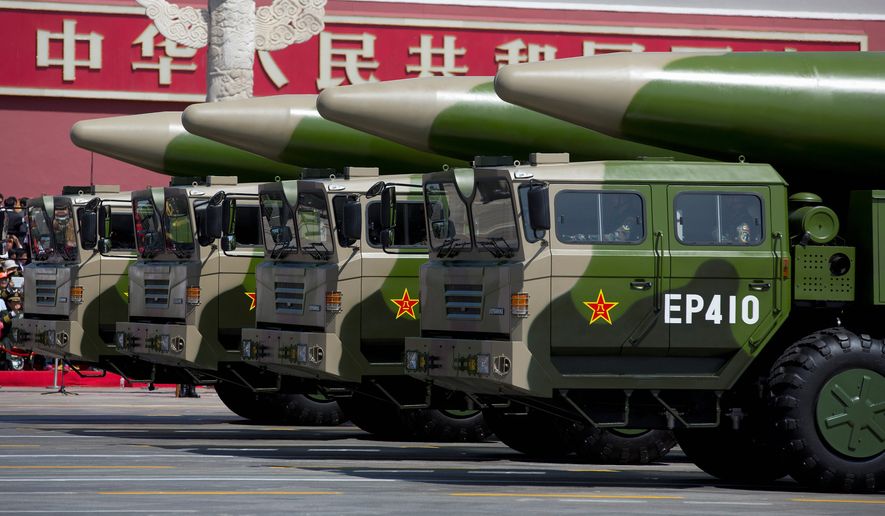
On China, Mr. Williams told a recent conference at the Hudson Institute that the Chinese military is moving rapidly to build up both nuclear weapons and missile delivery systems.
People were interested in these podcasts
“China is urgently producing weapons and rapidly expanding its nuclear weapons enterprise,” he said in little-noticed but significant comments on June 18. “There is only one intent to do that.”
The expansion includes hundreds of silos for new land-based intercontinental ballistic missiles in the western Chinese desert, and testing and deploying new submarine-launched ballistic missiles, he said.
“They are rapidly expanding all of that capability,” Mr. Williams said. “And guess what the Chinese do well? Manufacturing. And guess what they are manufacturing? They are manufacturing nuclear weapons at an extraordinary pace.”
China’s warhead stockpile grew from around 250 warheads several years ago to more than 600 warheads today and is projected to increase to around 1,500 warheads in the coming years, with no plans by Beijing to join arms reduction talks or to disclose when the expansion will end.
Mr. Williams warned that the ability of the U.S. to deter a nuclear conflict is being strained by the rapid expansion of strategic forces by both China and Russia.
The problem is similar to the physics idea called the “three-body problem,” he said, where three bodies of relatively equal mass in a gravitational orbit produce chaos.
Past strategic deterrence was more stable based on the principle of mutually assured nuclear destruction between the United States and the Soviet Union and later Russia.
The addition of significant Chinese nuclear threats requires more weapons and added targeting by U.S. forces to deter an attack.
“I don’t think it has to be that way, but that is why we have so much urgency today,” Mr. Williams said.
American nuclear forces are undergoing a multibillion-dollar modernization to replace obsolete systems with new land-based missiles, new missile submarines and new strategic bombers.
The new Sentinel ICBM to replace aging Minuteman III missiles and the Columbia-class nuclear missile submarine programs are behind schedule and over budget. The B-21 strategic bomber is largely on schedule and within budget with the first bomber set for delivery next year.
Mr. Williams, who traveled to Beijing’s Tiananmen Square in 1989, a month before Chinese military forces massacred hundreds and perhaps thousands of unarmed pro-democracy protesters, warned against underestimating the country’s communist rulers.
“I have no illusions about the Chinese Communist Party and you shouldn’t either,” he said, noting that after the experience, he studied nuclear deterrence at Harvard and later joined the Navy’s nuclear program. He eventually served on six strategic submarine patrols aboard an Ohio-class ballistic missile submarine armed with Trident nuclear missiles.
The Russian nuclear threat is also growing and includes recent threats by Moscow to use nuclear weapons against Ukraine.
Moscow is also developing novel strategic weapons, such as a megaton-class nuclear-tipped underwater drone called Poseidon and a nuclear-powered, nuclear-tipped cruise missile called Skyfall, he said.
Iran also was covertly seeking to become a nuclear weapons power before U.S. and Israel military action, Mr. Williams said.
Tehran, until recently, was engaged in a large-scale program similar to the U.S. World War II-era Manhattan Project to build a nuclear weapon.
The Iranian project included thousands of technicians and large-scale uranium enrichment, he said.
North Korea is also expanding uranium enrichment in a bid to expand its nuclear weapons program, Mr. Williams said.
The new U.S. nuclear deterrent strategy is distinct from the Cold War-era mutual destruction plan. Instead, nuclear arms are being used to dissuade adversaries from any actions that could escalate into a nuclear conflict and to prevent the first use of a nuclear weapon during a war or crisis, Mr. Williams said.
Statements and behavior by China and Russia suggest both militaries believe they could use a small handful of theater or tactical nuclear weapons to try and intimidate the United States.
That threat is “hugely destabilizing,” and therefore U.S. forces should be equipped with smaller, low-yield nuclear weapons to “meet them in an equal way.”
Current congressional authorization legislation will provide funding to support a low-yield sea-launched nuclear cruise missile.
The NNSA administrator outlined two possible small-scale nuclear attacks by Russia and China. Moscow could conduct a theater nuclear strike on Ukrainian troops that occupied Russia’s Kursk region, and a Chinese tactical nuclear strike could be carried out against Japan, Mr. Williams said.
“Maybe they would target a Japanese frigate out in the sea. No TV cameras. No burning building. No moms holding babies like you’ve seen with the Hiroshima footage,” he said.
“And yet they’ve made a declaration that they’re willing to use and cross the nuclear threshold,” he said of the Chinese.
“Would we evacuate Guam? Would we abandon the first island chain. Would we walk away from any perceived commitments we have to Taiwan? What would we do if they crossed that threshold? That, to me, is the greatest danger,” Mr. Williams said.
Contact the author
Please read our comment policy before commenting.