



OPINION:
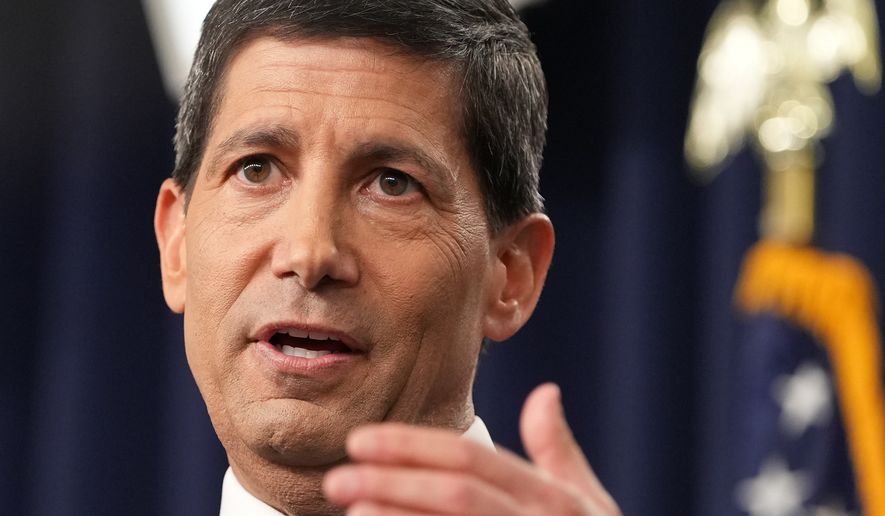
Federal Reserve Chairman Kevin Warsh has stated emphatically that curbing inflation is job one and he has curbed forward guidance.
But it’s high time the Fed started talking about how federal and state policies constrain its ability to deliver price stability and solid growth.
Russia’s invasion of Ukraine and Western sanctions, COVID-19 lockdowns, climate change policy reversals, immigration restrictions, tariffs and the war with Iran have disrupted supply chains and contributed to five years of inflation above the Fed’s 2% target.
People were interested in these podcasts
The federal deficit swelling to nearly 6% of GDP and the burst of investment from the artificial intelligence data center boom are boosting the job market overall but adding to inflation.
During the Biden years, illegal immigration created an anarchy of homelessness in major cities, exacerbated housing shortages and strained social service budgets and schools.
However, deportations do little to boost domestic employment without a sound program to boost legal immigration because immigrant labor is a complement to, not a substitute for, native-born worker employment.
If a builder can’t find enough qualified immigrant carpenters, then licensed American electricians may face unemployment.
Shortages are so acute in some occupations that Meta, like other businesses, is establishing training programs that guarantee jobs to build its data centers.
With immigrants filling one-fifth of STEM positions and over two-fifths of doctoral level science and engineering roles and with indigenous population growth slowing, the country needs better schools to more adequately equip our young people. We also need more immigrant workers with the skills and inclinations to fill jobs Americans can’t or won’t do.
AI has the potential to hyperscale productivity, but the disruptions to labor markets must be managed.
A New York Federal Reserve study found that nearly 90% of the tariffs are passed along to consumers through higher prices and have not been effective in creating additional manufacturing jobs.
The Biden administration going all in on climate change and then President Trump curbing many of those initiatives resulted in much wasted capital and forever-lost opportunities for productivity growth.
Even if ultimately accomplished, reopening the Strait of Hormuz won’t return energy markets to the status quo ante.
None of that is the handiwork of the Federal Reserve.
Mr. Warsh has established task forces to examine five areas central to the conduct of monetary policy: Fed communications, balance sheet policy, use and reliance on existing data sources, productivity and jobs in an era of transformation, and the Fed’s inflation frameworks.
The roles that immigration has and could play in boosting the productivity of the indigenous population would be a suitable area of inquiry.
The Fed is well positioned to articulate the potential positive impacts of AI on productivity and the negative consequences of inadequate training opportunities for displaced workers, the deteriorating performance of public education and tariffs.
Mr. Warsh challenges Keynesian frameworks like the Phillips Curve, which posits a basic dilemma for monetary policy and is a tradeoff between inflation and unemployment.
That’s not heresy.
A brief period of high interest rates to break an inflation crisis as Paul Volcker executed from 1979 and to 1982 can instigate prolonged decelerating inflation.
But persistently tight money, which might now appear appropriate with large federal deficits boosting aggregate demand, wouldn’t curb federal spending and its inflationary impulse. It would add to borrowing costs and increase liquidity by adding to Treasury securities in circulation.
Higher interest rates limit home construction and if adopted as a quasi-permanent policy, create more inflation in the future by worsening the trajectory of the housing shortage.
Similarly, were it possible to curb the data center boom with tight money, it might slow inflation a bit in the present. But it would limit AI’s productivity dividend, restraining consequences for future inflation.
The same can be said about local governments’ efforts to curb data centers and overregulate AI.
These are subjects the task forces should address.
Mr. Warsh rightly questions the timeliness and accuracy of official inflation data. But even measured against those, the Fed, like other advanced-economy central banks, generally has been slow to react to inflation, no matter how measured.
The Fed is unique among major central banks with a mandate to achieve both full employment and price stability. Congress and President Trump interpret the former as license to meddle in its work.
It’s only reasonable, then, that the Fed should explore and explain how Congress and the president’s actions and those of the states impair appropriately calibrated immigration, restrict housing supplies, hamper student learning, exacerbate the consequences of wars and handicap the progress of technology. And in turn, push up inflation and tax growth.
Mr. Warsh does well to tamp down forward guidance. But the Fed should use the space in its policy statements vacated by those soliloquies to challenge other actors in Washington to do their jobs better.
• Peter Morici is an economist and emeritus business professor at the University of Maryland, and a national columnist.
Follow the author

Please read our comment policy before commenting.