



OPINION:
We’re living in an era of terrorism — where a trip to your local mall, attending your workplace Christmas party, going to a nightclub, running a marathon, or simply walking the streets of a major city, can be dangerous.
Democrats argue these attacks are rare — that you or I have a better chance of getting into a car crash than being killed or injured by a radicalized jihadist on U.S. soil — but does this line of thinking make anyone feel safer? To me, it just invites complacency.
FBI Director James B. Comey has said trying to identify and spot homegrown terrorists is like looking for “needles in a nationwide haystack.” I get it. But that doesn’t mean there aren’t some simple, common-sense solutions that can be deployed to make law-enforcement’s job a little easier.
People were interested in these podcasts
Increased screening on immigrants coming into the United States from countries with terror connections — like Afghanistan, Iraq, Syria and Somalia — should be one of them.
And there’s a lot of work to be done in this regard.
Just on Monday, an internal audit was released by the Department of Homeland Security that found 858 people were mistakenly granted U.S. citizenship even though they had deportation orders against them. Apparently DHS and the FBI failed to digitize all their fingerprint files, which allowed people to apply for citizenship using fake identities.
If that audit’s not proof enough the government has some major housecleaning to do in the vetting and granting citizenship of immigrants, nothing will be.
For Syrian refugees, the U.S. vetting process is rigorous; however, it’s the exception to the rule — and even some Democrats questioned whether the U.S. should halt its Syrian refugee program after the Paris terror attacks last November. Potential U.S. Syrian refugees are vetted in person in the region they are fleeing, not on U.S. soil, and they are subjected to biometric and other background checks against security databases, the Wall Street Journal reported.
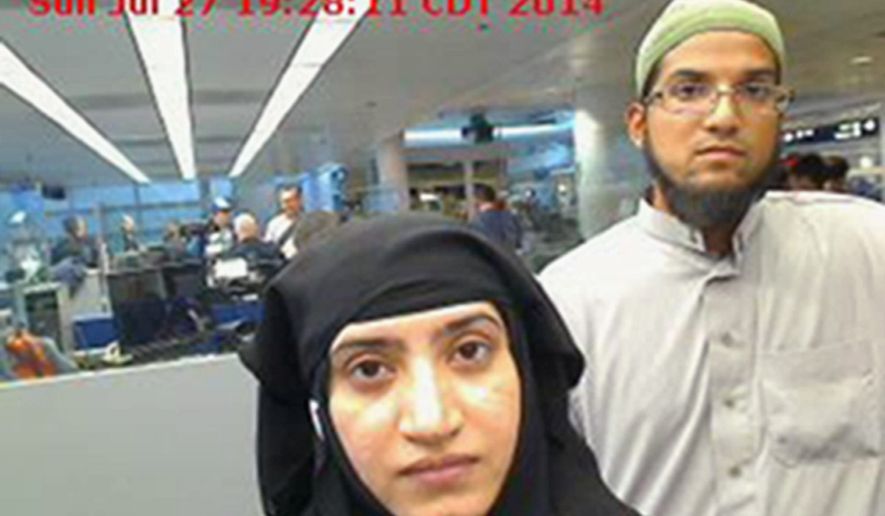
But that doesn’t mean that our Visa program couldn’t use some improvement, as was demonstrated by the San Bernardino terrorist Sayed Rezwan Farook obtaining a visa for his radicalized wife, Tashfeen Malik.
As Jessica Vaughn, the director of policy studies at the Center for Immigration Studies, wrote in the National Review, the U.S. Citizenship and Immigration Services (USCIS) first had the opportunity to screen the couple, but USCIS protocols don’t call for a full vetting of the person sponsoring the alien — Malik’s husband.
Farook had come to the attention of U.S. counterterrorism officers according to various reports as a result of contacts he had with others who were of interest to authorities — so a red-flag in his fiance’s visa process may have been drawn had this loop been closed, Ms. Vaughn wrote.
Throughout his wife’s visa process, many things reporters’ were easily able to find that would raise suspicions were overlooked by U.S. bureaucrats, including that her family had ties to extremists, the school she had been attending was reportedly a radical madrassa, and that she had given a fake address on her visa application.
“For years, the GAO and others have raised serious questions about the effectiveness of the visa-security units, and Congress has poured millions of dollars into improving them. Will the president knock some heads together now to make this a real priority?” Ms. Vaughn questioned.
After the shooting rampage in San Bernardino, even California Democratic Sen. Dianne Feinstein supported a bill to restrict people entering through a special visa waiver program if they had visited Iraq or Syria in the previous five years.
Yet, somehow when Republican presidential nominee Donald Trump brings up the issue, it’s racist.
Additionally, the U.S. needs to be more vigilant about tracking down and identifying those who overstay their visa’s.
Immigration agents catch an abysmally small percentage of the illegal immigrants who arrived on visas but overstayed their welcome, authorities admitted to Congress in June, describing a loophole that those around the globe are increasingly using to gain a foothold in the U.S.
At least 480,000 people overstayed their visas last year, adding to a backlog that’s reached some 5 million total, members of Congress said. But immigration agents launched investigations into just 10,000 of them, or about 0.2 percent, and arrested fewer than 2,000, less than 0.04 percent, saying the others don’t rise to the level of being priority targets.
That’s a stunning statistic. We, as a nation under attack, can clearly do better.
Follow the author

Please read our comment policy before commenting.