



ANALYSIS/OPINION:
I still appreciate when a movie can broadside me with its greatness. Providentially, on the same day that I saw the worst movie so far this year (“The Neon Demon,” about which I can come up with almost nothing positive to say other than it was “competently” directed), I then was treated to the amazing sights and beauty of the singularly amazing film “The Innocents” from France, directed by Anne Fontaine (“Coco Before Chanel”) — far and away the best film of 2016 so far.
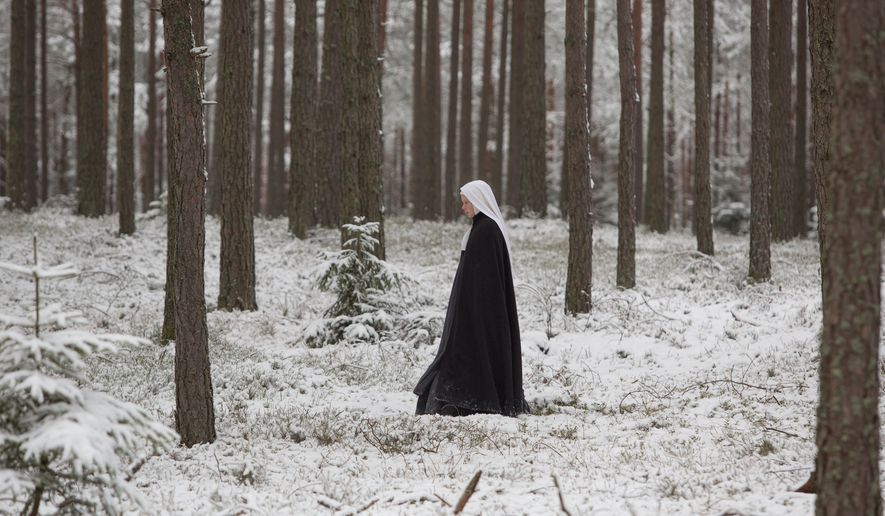
Based loosely on real events, “The Innocents” tells a tale of haunting moral choices and the calculus of attempting to understand “God’s plan” even in the face of unimaginably horrid events. Opening in 1945, the film takes place at a Polish convent which, much like the rest of Poland — if not the world — is struggling to pick up the pieces after World War II has at last ended. Into this cloistered world comes Mathilde (Lou de Laage) a French health worker for the Red Cross, who discovers that one of the nuns is in fact with child. So secret, so shameful is this, that the information is kept from the stentorian mother superior (an icy Agata Kulesza), and so entrenched into this secluded religious culture are these women that its practitioners are forbidden from even touching their reproductive areas, let alone having someone else — man or woman — assist with such medical needs.
People were interested in these podcasts
More pregnancies among the sisters are discovered, and the reason for such an unusual pattern of inseminations among the celibate becomes tragically clear: First the retreating Germans, and then the “liberating” Soviets, have engaged in a systematic campaign of unimpeded rape at the nunnery.
Throw in that Mathilde is a Jew, “one of the few still left in Europe,” she and her boss and lover Samuel (Vincent Macaigne) drearily relate in tragic understatement. And she is French, and must have her medical instructions translated by the bilingual Maria (Agata Buzek), a nun whose faith will be tested in more ways than one throughout the story.
Ergo, Mathilde is triply an outsider: a Jew, a foreigner and someone whose professional training as a midwife cannot seemingly be rectified to treat women whose bodies are entirely covered, even in private. (That she is not trusted by the mother superior, and that some of her subordinates must go behind her back, goes without saying.)
Catholic theology and its stentorian pre-Vatican II strictures are as much in the fore as is the messy postwar situation in which Eastern Europe would find itself for decades after the Nazis retreated. It is starkly beautiful how the sisters awake at dawn to chant the ancient Latin prayers, and do so several more times per day, even while experiencing labor pains.
And how can their souls, married to God and not to man, rectify that their bodies contain gestating humans formed there against their will? It is a no-win scenario, one nun observes, that God’s plan would foist this upon her, that her vows would be broken through no conscious action of her own. Rape leaves behind shame enough, but its resulting in pregnancy for the victim (yes, victim, which is the only, only word that can reasonably apply in any such situation) doubles the humiliation, particularly in a culture where sex and procreation is administratively absent.
The word “shame” continues to come up throughout the film, as the mother superior seems far more worried about “the word” getting out about pregnant nuns under her than that they were so grossly violated — it is victim-blaming long before such a term ever came into being.
And yet Mathilde, even with her desire to help at great personal and professional risk, walks the line of keeping the secrets while carrying out her Hippocratic oath. In fact, it is only when she threatens to inform her superiors that the convent overseers allow her to proceed.
While ostensibly a story of the ongoing tragedies that befell 20th century Europe — even at the end of a war to supposedly erase tyranny — “The Innocents” is pertinent now given that there continue to exist world cultures that demand “honor killings” of rape victims to somehow “restore” the family’s honor — as if murder has anything to do with honor. One need only parse the headlines to realize that even still, in our supposed enlightened age, the meaning of consent and sexual assault remain too blurred for too many, as the righteous uproar over the Stanford swimmer getting but six months in jail for sexually assaulting an unconscious woman demonstrates (his father infamously called it a harsh punishment for “20 minutes of action,” leaving little doubt as to his attitudes having fallen very far from the tree).
“The Innocents” deals in impossible choices faced by those who have vowed to uphold certain codes and dictums. Indeed, the mother superior makes a decision late in the film that will strike viewers as both unendurably tragic and yet, simultaneously, as perfectly, horrifyingly logical given the mandates of her vocational dictums. That Miss Kulesza is able to express both devotion to her “code” and the damnation that she has rightfully earned (while believing she is somehow saving others) in a single scene is a testament both to her acting and to Ms. Fontaine’s assured direction, which never panders to her audience or her characters, even when they do things we abhor.
Films like “The Innocents,” which is so rich in substance, moral complexities and clashes of faiths and rectitude, are a rarity, and should be rightly celebrated. That it also features first-rate performances and direction only adds to its value as the best film of 2016.
“The Innocents” opens Friday at the Landmark Bethesda Row Cinema.
Please read our comment policy before commenting.