



Everyone remembers the tour she gave the American public of the White House for television. The bright smile. The way she carried herself in public.
And the wardrobe, the most infamous piece of which was the pink dress forever soiled with her husband’s blood.
Jacqueline Kennedy, though she lived for another three decades after her husband’s murder in 1963, never shook the scars of that fateful day in Dallas.
People were interested in these podcasts
“One of the nice things about this period in history is that there is no shortage of scholarship about it,” said Noah Oppenheim, screenwriter of the new film “Jackie,” opening Thursday, which dramatizes the unspeakably difficult period for the first lady that followed President Kennedy’s assassination.
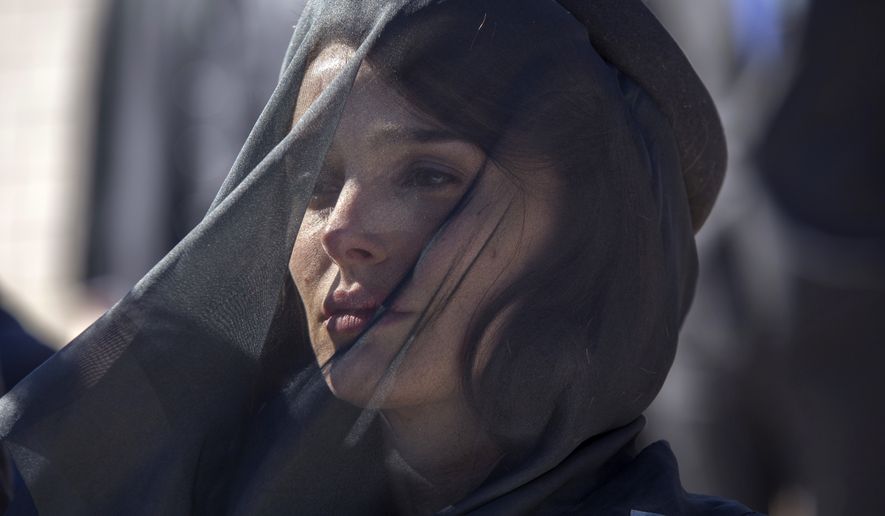
Oscar-winner Natalie Portman — a veritable shoe-in for another nod for “Jackie” — stars as the haunted widow, trying under terrible duress to be strong for the couple’s children and to reassure a broken nation that the business of government would continue even under the most testing of circumstances. Billy Crudup co-stars as a fictional journalist who travels to the Kennedy compound in Hyannis Port, Massachusetts, to interview the former first lady.
Mr. Oppenheim says he waded through an “ocean of material” before starting his script. One of the most surprising findings concerned one of the most famous aspect of the Kennedy mythos.
“I had for a long time assumed that the Kennedy administration had been referred to as ’Camelot’ since its beginning. I was pretty shocked to find out that Jackie Kennedy was the person who coined the phrase,” Mr. Oppenheim, a lifelong historian of the Kennedys, said of his research, adding that the term was applied by Jackie Kennedy just after the president’s murder.
“That was one of the big foundational pieces of the screenplay,” he said. “That even in the immediate [aftermath of] her husband’s murder, she had the presence of mind to realize that this was her last chance to define his legacy, and also to come up with this cultural reference that would stick in the public’s mind so powerfully.”
As portrayed by Miss Portman, Jackie, though never far from tears, demonstrates a practiced, throughly self-controlled equipoise in her scenes with the journalist. She chain-smokes throughout the interview, then calmly tells her interviewer, “I don’t smoke,” once more fashioning the mythology.
“There’s a line in the film where Jackie says, ’The characters we read about on the page are often more real than the men who stand beside us.’ I think that’s even more true for the characters we see portrayed on the screen,” Mr. Oppenheim said. “When you’re writing about history, I personally feel a sense of obligation to adhere as closely as possible to fact.”
In a crucial scene, Jackie makes the difficult decision to walk with her husband’s body through the streets of the District, a move advised against by officials of the nascent Johnson administration, fearful assassins might be able to target either her or President Johnson out in the open.
“As we revised [the screenplay], our goal was to dig deeper into the emotional experience that she was having, explore her humanity as much as possible,” Mr. Oppenheim said. “And layer in as many aspects of her character as we could in trying to build this collage-like portrait of who she was.”
Flashback scenes show the Kennedy White House in happier times, with the star couple entertaining guests. Hundreds of artists recreated the Executive Mansion of the early 1960s on a soundstage in Paris — filmed close to where Miss Portman was living at the time. (While interiors were accomplished in France, exterior shots of the District were taken for key scenes of “Jackie.”)
“The lengths to which these craftsmen went to replicate every last detail is pretty extraordinary,” Mr. Oppenheim said of the simulation. “Because we were shooting a recreation of the White House tour as part of the film, that made it all the more imperative that the sets exactly matched” how the chief executive’s mansion looked at the time — a sheer feat of artistry in the service of both history and entertainment.
Based on his resume, “Jackie” might seem on the surface a departure for Mr. Oppenheim from his for-hire work as screenwriter of “The Maze Runner” and “Allegiant,” but he says that sci-fi and historical biopics bear more in common than at first glance.
“No matter what your subject matter, you’re always trying to tell a compelling story about rich characters,” he said. “I think a lot of Americans understand their history through television and films. For me, it was important that [’Jackie’] be true to what really happened as much as possible.”
“Jackie” opens a month after Donald Trump was elected the nation’s 45th president. When asked what he sees as the major difference between the days of the Kennedys and the era of Mr. Trump and his tweets, Mr. Oppenheim allows that the greater transparency of the 21st century can be a blessing for the public but perhaps a hindrance to the elected.
“John F. Kennedy and Jackie Kennedy led private lives that were completely off-limits to the press and to the American public in a way that would be incomprehensible right now,” Mr. Oppenheim said. “We just had an election in which access to every single email of one of the candidates wrote was an issue.
“In the Kennedy era, the idea that the public would have first-hand knowledge of every conversation taking place in the halls of government would have seemed preposterous.”
Mr. Oppenheim heaps praise on Miss Portman and the able direction exhibited by Chilean filmmaker Pablo Larrain behind the camera.
“It’s a really harrowing experience to go through this period from Jackie’s perspective,” he said. “And I think that people who are more intimately familiar with the history find different pieces of it that are surprising, that are fresh.”
Mr. Oppenheim, who says he would like to write more screenplays about historic figures, advises up-and-coming screenwriters to find their innermost passions in their work.
“But I also think you should strike a balance by writing about things that have larger relevance to the outside world,” he said. “Try to say something about the world through art.”
Please read our comment policy before commenting.