



ANALYSIS/OPINION
The aphorism goes that the sins of the father shall be visited upon the son, but what of the sin of willful ignorance even in the face of overwhelming evidence? This is the question posed by “What Our Fathers Did: A Nazi Legacy,” a documentary of sorts opening Friday at the District’s Bethesda Row Cinema.
Directed by David Evans, the film follows Jewish-English human rights attorney Philippe Sands confronting the sons of two high-ranking Nazi architects of Hitler’s Final Solution with the transgressions against humanity committed by their fathers against Mr. Sands’ Ukrainian ancestors, nearly all of whom perished in the Holocaust.
People were interested in these podcasts
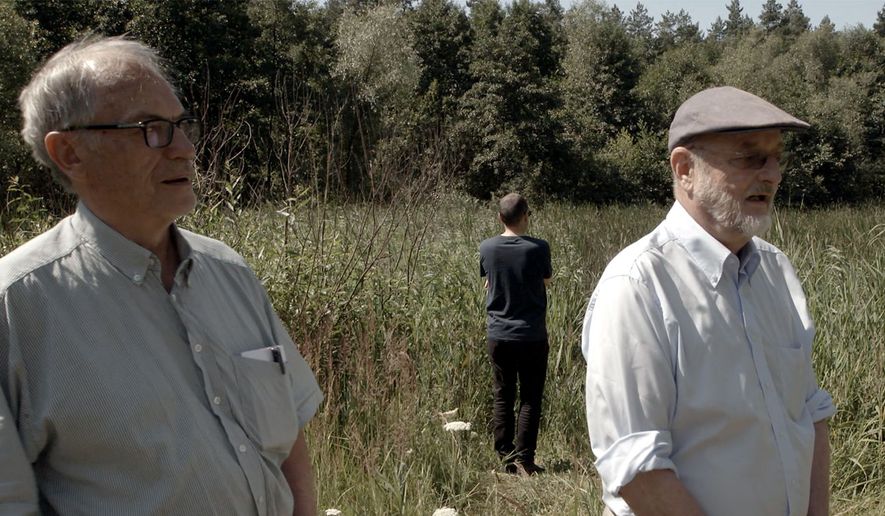
If Mr. Sands is the hero of the piece, then he is given for companions two complicated, if not villains, perhaps antiheroes. One is Niklas Frank, whose father Hans was governor-general of Nazi-occupied Poland. Mr. Frank bears no illusions as to his father’s despicable actions and part in Hitler’s evil machinations for a Jew-free Europe, and in his words and facial expressions is a man who has spent a lifetime trying unsuccessfully to disentangle his DNA from a war criminal.
The other more fascinating character is Horst von Wachter, whose Austrian father Otto was Hitler’s governor of Krakow, Poland, and Galicia, Ukraine, site of some of the most notorious exterminations of Jews during the Second World War. Despite Mr. Sands presenting him with more and more incontrovertible evidence of his father’s collusion in the Holocaust, Mr. Von Wachter stonewalls, excuses and continually disbelieves, to the utter frustration of both Mr. Sands and Mr. Frank.
Mr. Sands’ flustering at Mr. Von Wachter’s apologism is understandable, but it one of the profound, humane highlights of the work that Mr. Frank is so adamant against his fellow horror architect’s son: Our fathers did this, he says, and we owe the dead and the living such an acknowledgment.
One is tempted to believe this is the stuff of history, but the film’s most soul-chilling sequence shows Mr. Sands bringing both of his subjects along to a neo-Nazi rally in Ukraine, where the acolytes, upon learning of Mr. Von Wachter’s pedigree, hurry to shake his hand for the “great work” of Otto. That such a scene took place in 2014-15 is a sobering reminder that the business of hate is alive and well, and that economic woes and European xenophobia continue to be its progenitors.
The film labors at times to overstate its case, but no more fascinating three subjects could be found for this story. Both Mr. Van Wachter and Mr. Frank respond in inflected English to Mr. Sands’ queries, and are shown only in passing using the language of their homelands. But no matter what language he uses, Mr. Von Wacter’s denials and obfuscations, delivered without apology, will leave the viewer haunted. As Mr. Sands fights, pleads, begs with him to recognize what his father and so many others did in their destruction of Europe, the shrugging of the shoulders, the “we must move on” of Mr. Van Wachter is a stinging reminder precisely why we must not forget.
Rated NR: Contains a few bad words and vintage photos of concentration camp victims.
Please read our comment policy before commenting.