



OPINION:
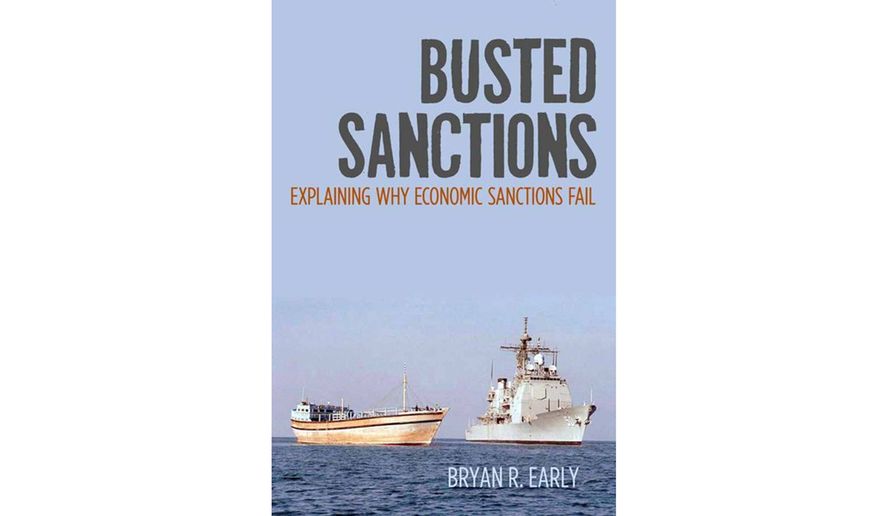
BUSTED SANCTIONS: EXPLAINING WHY ECONOMIC SANCTIONS FAIL
Stanford University Press, $29.99, 275 pages
At a time when once again, for the umpteenth time in postwar America, the imposition of economic sanctions and just how they should be applied is a hot-button topic in Washington’s corridors of power, here comes this provocative book which seems to be telling us that using them is at best almost useless and at worst actually counterproductive. Certainly, its subtitle is about as bald an evaluation of their lack of efficacy as you could wish for, and Bryan Early, a professor at the University of Albany, SUNY, is equally direct throughout much of his book about “the fatal attraction” he sees as having existed between U.S. foreign policy and economic sanctions for the past six decades.
He points out that “the United States has employed economic sanctions more than any country in the world — and by a large margin” and goes on to write, “Not only does the U.S. government frequently employ economic sanctions when they have little chance of succeeding, but U.S. policy makers also remain committed to failed sanctioning efforts for far too long. When the United States has imposed economic sanctions to achieve a political objective, they have failed to achieve their objectives almost 66 percent of the time.”
But it would be a grave mistake to take this thoughtful, penetrating and supple book just as an argument against using sanctions as an instrument of foreign policy. It is in fact a primer filled with hard facts and harder lessons from past efforts — and mistakes — designed to show how this process can actually become more effective and productive of the intended result.
Mr. Early points out that although sanctions are often adopted as a cheaper alternative to military action, their costs have been consistently underestimated. Not only can they produce blowback as damaging in its way as that from bombing or other forms of warfare, but they can result in other countries taking over the profitable trade we forego in the name of our high-minded goals. Much of this book, as its title indicates, deals with the so-called sanctions busters, who are not only those friends of our enemies who help them evade the effects of our sanctions, but also countries nominally — and sometimes even actually — allied with us who have no compunction at scooping up the commerce we are so nobly rejecting.
People mostly think of sanctions busters as those countries — often neighbors or otherwise strategically placed — who vitiate the chilling effects by making the targeted nation “porous,” allowing forbidden goods in or out. In the case of Iran, very much on our minds these days, which has had sanctions against it not only by the United States but also the European Union, Mr. Early points to the United Arab Emirates (“a close military ally of the United States”) and Turkey “a NATO ally of the United States and most of the EU’s members” as prime examples of the Islamic republic’s enablers.
When Britain was trying to impose sanctions against its rebellious colony of Rhodesia in the 1960s, Portugal — Britain’s oldest ally — and South Africa — one of its largest trading partners — combined to make them ineffective and made the term “sanctions busting” familiar to Britons back then. When it came to sanctions against South Africa two decades later, they had little chance of any success when Margaret Thatcher’s United Kingdom refused to adopt them, despite enormous pressure by the Commonwealth, almost all of whose other members were passionately in favor of them. As was so often the case, her close ally Ronald Reagan shared her view that their joint policy of “constructive engagement” with the apartheid regime was more likely to produce results. Both administrations and their ambassadors in Pretoria were convinced that this policy of coaxing successive reluctant South African leaders, rather than sanctions, was the determining factor in the release of Nelson Mandela and the transition to multiracial democracy.
Of course, unlike Thatcher, Reagan had to deal with a government with other branches equal to his executive one, and the Congress overrode his veto of their sanctions bill. None but the most diehard fans of sanctions would argue that this had much impact in any case since the State Department continued its parallel policy of engaging with the South Africans. But it is salutary to remember this act by the Congress now that the shoe is on the other foot and the parties find themselves in the opposite position to the late 1980s. Democrats who protest that congressional desire for tougher sanctions against Iran is unwarranted interference in what should be executive branch-driven foreign policy should remember that they had a very different attitude back then. Amid all the facts and figures and charts and tables in this excellent book, there is one thing you need to remember. Sometimes imposing sanctions is necessary, not just because, correctly done, they can be effective, as Mr. Early details, but because it is quite simply the right thing to do.
• Martin Rubin is a writer and critic in Pasadena, Calif.
Please read our comment policy before commenting.