


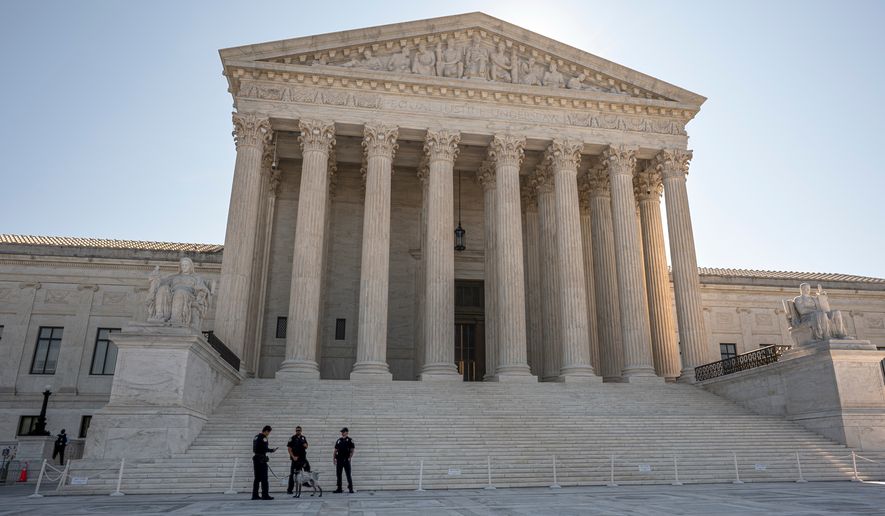

Democrats eyeing majorities in the House and Senate are plotting how they would police Supreme Court justices they say are influenced by right-wing, dark-money groups.
Sen. Sheldon Whitehouse of Rhode Island, the top Democrat on the Senate Judiciary subcommittee on federal courts, told attendees at the Polk County Steak Fry in Des Moines, Iowa, that he was preparing aggressive investigations and a stack of subpoenas alongside Rep. Jamie Raskin of Maryland, the House Judiciary Committee’s top Democrat.
“He and I are already working together. We are already meeting monthly to plan,” Mr. Whitehouse said.
People were interested in these podcasts
Mr. Whitehouse and Mr. Raskin headlined the Steak Fry, an annual Iowa tradition that features state and national Democratic candidates.
Mr. Whitehouse told the crowd that if he secures the Senate Judiciary Committee gavel and Mr. Raskin becomes chairman of the House Judiciary Committee — an outcome expected if Democrats win control of Congress — the justices would be their first target.
“If we’re working together, we can do twice the work, and we’re going to put a lot of attention right away into the Supreme Court,” Mr. Whitehouse said.
Democrats have railed against Supreme Court decisions such as overturning Roe v. Wade and nullifying portions of the Voting Rights Act.
Many Democrats and Democratic candidates are calling on Congress to expand the Supreme Court.
Mr. Raskin has authored a package of legislation that would require justices to explain emergency rulings from the so-called shadow docket and would establish a rotating panel of federal appeals court justices to select cases for the Supreme Court.
Rep. Jim Clyburn, former House majority whip and informal senior adviser to House Democratic leaders, recently told NBC’s “Meet the Press” that Democrats would add justices if they take control of Congress.
“I think that we are in a position now that calls for some significant actions taken by the Congress, and we ought to expand. And 13 is a pretty good number,” Mr. Clyburn said.
Democrats also plan to scrutinize Supreme Court justices.
Mr. Whitehouse said the House and Senate “need to do a lot of investigating” of the high court because “not enough people know the story about how the court got captured by a bunch of creepy right-wing billionaires.”
Mr. Whitehouse and Mr. Raskin said they plan to issue subpoenas, which can be blocked by a filibuster in the Senate but not in the House.
“They cannot block a Jamie Raskin House subpoena,” Mr. Whitehouse told the Steak Fry crowd.
He did not specify who would be targeted with subpoenas, but noted that many questions remain regarding the court’s conservative justices. In particular, he pointed to Justice Clarence Thomas, who bought a $267,230 luxury motor coach using a loan from a wealthy healthcare executive that Senate investigators say was forgiven without repayment.
“There are a lot of simple questions like, did Clarence Thomas ever pay his taxes on the quarter-million-dollar loan forgiveness for his motor coach?” Mr. Whitehouse said.
Mr. Whitehouse authored legislation that would impose 18-year active-docket terms on Supreme Court justices, after which they would rotate to senior status. He introduced the legislation in July, citing low public approval ratings for the high court and the “disastrous” 2010 campaign finance ruling in Citizens United v. Federal Election Commission that “supercharged an organized, dark-money-funded scheme by right-wing special interests to capture and control the Court.”
Senate Democrats who co-sponsored Mr. Whitehouse’s bill said the court has become politicized and faces a “legitimacy crisis” that requires it to be “more representative of America.”
The Washington Times sought comment from Mr. Raskin and Mr. Whitehouse on whether they plan to subpoena Justice Thomas or other justices. They did not respond.
The Congressional Research Service wrote in 2023 that “there appear to be few clear answers to the legal questions that would arise from a congressional subpoena to a sitting Supreme Court justice,” and that if challenged in court, “a congressional subpoena to a sitting Justice would likely be subject to heightened judicial scrutiny with its final validity possibly determined by the Supreme Court itself.”
Contact the author

Please read our comment policy before commenting.