



OPINION:
With the midterm elections rapidly approaching, the Cook Political Report predicted last week that Republicans are on track to lose their House majority, as 15 race ratings have shifted toward Democrats.
In the Senate, the Democratic Party needs to flip four seats to win control, and Alaska, Iowa, Maine, Ohio and Texas — all currently in Republican hands — have been declared “toss-up” races.
More disturbingly, it has been 94 years since Kansas elected a Democrat to the U.S. Senate. This cycle, Republican incumbent Roger Marshall’s reelection race against Democratic challenger Adam Hamilton, a United Methodist megachurch pastor from the Kansas City area, has surprisingly tightened into a competitive statistical dead heat.
People were interested in these podcasts
As the Iran war drags on — President Trump predicts it will conclude “immediately after” the November U.S. midterm elections — Americans feel worse about the economy than they have at almost any other point in modern history.
Diesel prices averaged $6.50 a gallon on Friday, just below their record high of $6.53 on Sept. 22 and up $3.69 from a year ago, according to AAA.
Gas prices have risen to nearly $4.50 a gallon nationally, and interest rates on 30-year mortgages have surged above 7%.
According to a Wall Street Journal poll released last week, 60% of voters think Mr. Trump’s economic policies have made the economy worse, with 65% giving the economy a negative rating and 61% giving Mr. Trump a negative job rating.
The White House should be laser-focused on touting the passage of its One Big Beautiful Bill Act with middle-class tax cuts, no tax on tips and no taxes on overtime. It should concentrate on all the bureaucratic red tape it has cut for small businesses.
It should highlight the lower prescription drug costs achieved under Mr. Trump’s most-favored-nation drug pricing policy.
It should be promoting its Trump Accounts, in which children younger than 18 can invest tax-deferred, with those born between 2025 and 2028 receiving a one-time $1,000 seed contribution from the U.S. Treasury.
It is doing none of those things.
Last week, the images coming out of the White House were of the administration’s glitzy state dinner with Chinese President Xi Jinping and tech industry titans. Dan Scavino, the White House deputy chief of staff, posted an artificial-intelligence-generated image on X of himself, his wife and Eric and Lara Trump — all in black-tie attire — popping Champagne while wheeling around on a bellhop cart.
Other than two pandas arriving at Zoo Atlanta, it is unclear what deliverables the Chinese state visit produced for the American people.
The White House celebrated the establishment of an AI hotline between the two countries, but when COVID-19 emerged from a Chinese lab, Chinese officials could not muster a call to warn the U.S., so Beijing is unlikely to ring the line if one of the country’s AIs goes rogue.
Over the weekend, the White House released some new political ads — or, as it describes them, “public service announcements” — which feature the president exclusively. The latest shows Mr. Trump walking down a hallway as he asks people to join him to “expel the warmongers from our government” as the war in Iran continues.
Another has him urging Americans to “defeat communism” while a choir in the background sings, “Love me.”
All were paid for with taxpayer dollars, igniting an unwelcome and unhelpful political firestorm from the mainstream media, which questioned the ads’ legality.
Other distractions include the president’s legal fight to have his name included on the John F. Kennedy Center for the Performing Arts and the construction of his ballroom and Triumphal Arch. Banning news organizations from the White House grounds may have had merit, but it led to a critical news cycle in which the administration ultimately caved.
The perception that the only people benefiting from Mr. Trump’s second term are his family and friends has been perpetuated by recent headlines that Donald Trump Jr.’s lavish wedding in the Bahamas was partially funded by a Russian oligarch.
Then there is The Wall Street Journal’s report of U.S. Ambassador to Greece Kimberly Guilfoyle (former fiancee of Donald Trump Jr.) using her job to push deals for Greek construction firm Aktor Group, with its chief lobbyist accompanying her on her travels.
What about the “booming market” for Trump Organization branding deals internationally, with developers from Georgia, Abu Dhabi, Vietnam and the Maldives all lining up “to adorn their hotel and golf course projects with the Trump name,” as The Journal reported this month?
The president has retained ownership in the organization he built but has given up operational control while serving in the White House.
Forbes estimates that Mr. Trump is now $2.7 billion richer than when he won the 2024 election, “having cashed in on crypto ventures and overseas deals.”
Americans have proved — by reelecting the president — that they are willing to overlook these potential conflicts of interest if he delivers and fights for them. Improving the economy and closing the border were the two top reasons he won the White House.
However, of late, it seems that the president has forgotten the promises he made on the campaign trail. Instead of being laser-focused on winning the midterm elections and promoting an affordability message, his administration has become distracted by vanity projects.
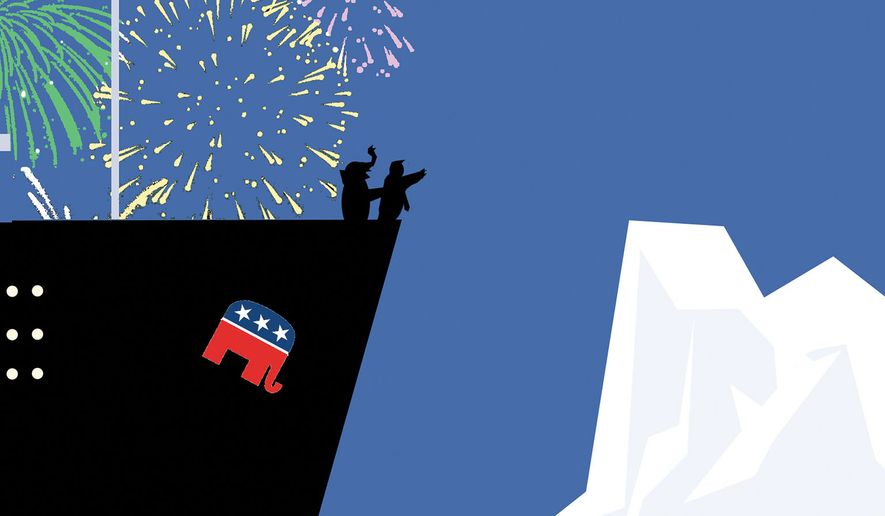
As a result, Republicans are sailing into the midterms on the Titanic, panicking and desperately trying to save their lives. The White House is aboard, seemingly content and sipping Champagne.
• Kelly Sadler is the commentary editor at The Washington Times.
Follow the author
Please read our comment policy before commenting.