



OPINION:
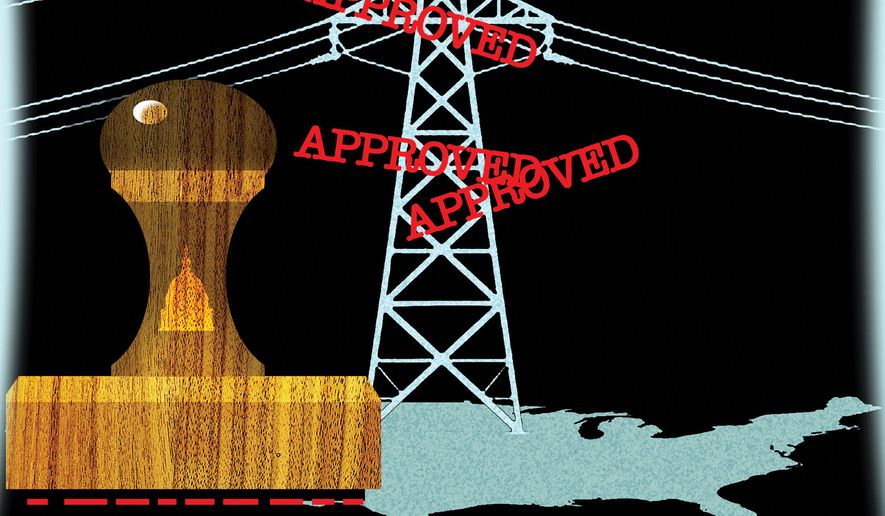
A handful of members of Congress for the past six months have been trying to negotiate, mostly without the benefit of outside help, reforms to the process by which the federal government permits infrastructure such as power plants, natural gas pipelines and transmission lines.
To date, they have failed.
In a well-functioning legislative body — as Congress used to be — a bill addressing the issues at hand would be drafted and then shared with a handful of members. If they concluded that the draft legislation had merit, it would proceed to a subcommittee for amendment and, hopefully, improvement.
People were interested in these podcasts
Then, a full committee — or committees, depending on the complexity and jurisdictional scope of the legislation — would examine, amend and vote to move the legislation to the House or Senate floor.
The process would be repeated in the other chamber and, if successful, the House and Senate would eventually reconcile their differences, vote on a final version, and present the legislation to the president for his signature.
This process, typically referred to as regular order, involved everyone with a stake in the issue at hand and, for the most part, guaranteed a solid product informed by diverse perspectives.
Unfortunately, this process has mostly been supplanted by the idiosyncratic, ad hoc effort chosen by the permitting reform crew. In this approach, a handful of members spend months, sometimes years, trying to see whether the four, six or eight of them can muster the expertise and emotional maturity to write legislation acceptable to the House and Senate.
It almost always leads to legislative text, typically riven with errors, that appears and must be voted on within hours — well before anyone has a chance even to read, let alone understand, its provisions.
Did the regular order take some time? Yep. Did it mean that not everyone got everything they wanted? Yes. Was the product demonstrably better than it is nowadays? Absolutely.
In the instance of permitting reform — which is complicated and implicates dozens of federal laws, hundreds of rules and thousands of federal personnel — reliance on something other than regular order is guaranteed to lead to disaster. No small clutch of lawmakers has the expertise necessary to improve permitting, assuming that is the motivation that they share.
It is no coincidence that this effort has gone on for some time and has yet to yield fruit. More ominously, as best we can tell from descriptions of the text, the legislation probably would make the permitting process worse, not better.
It seems to be built around the idea that involving more lawyers and bureaucrats will magically simplify and speed the process. As anyone who has ever dealt with bureaucracies, lawyers or both will tell you, they never simplify or accelerate anything.
It is no surprise that the Democrats have inserted language into the proposed legislation that would compel the administration to act on wind projects, expand the scope of federal authority, require costs of energy projects to be imposed on those who receive no benefit, encourage more litigation, and lead to the infringement of private property rights and on and on.
At the same time, the legislation fails to address the core problems that affect permitting. It does not repeal the National Environmental Policy Act. It does not address the disastrous effects of Title I of the Clean Air Act on local and regional development. It does little to solve the problem of states impeding linear projects, such as pipelines or transmission lines, that must cross water bodies.
I could go on, but you get the idea.
Finally, no one involved seems to have asked the simple, essential question: Do we really need permitting reform? The reality is that few energy projects in red states are unduly delayed. The legislation being drafted in secret may very well wind up impairing red states rather than helping blue states improve their processes.
It should not make anyone feel better that the senior Democrat in this process is Sen. Sheldon Whitehouse of Rhode Island, who currently anchors the left flank on environmental and energy issues in the Senate.
We should all be skeptical of legislation that cannot stand public scrutiny. This is especially true for complicated legislation that affects our energy supply and, at the moment, looks very much like a solution in search of a problem.
• Michael McKenna is a contributing editor at The Washington Times.
Follow the author

Please read our comment policy before commenting.