


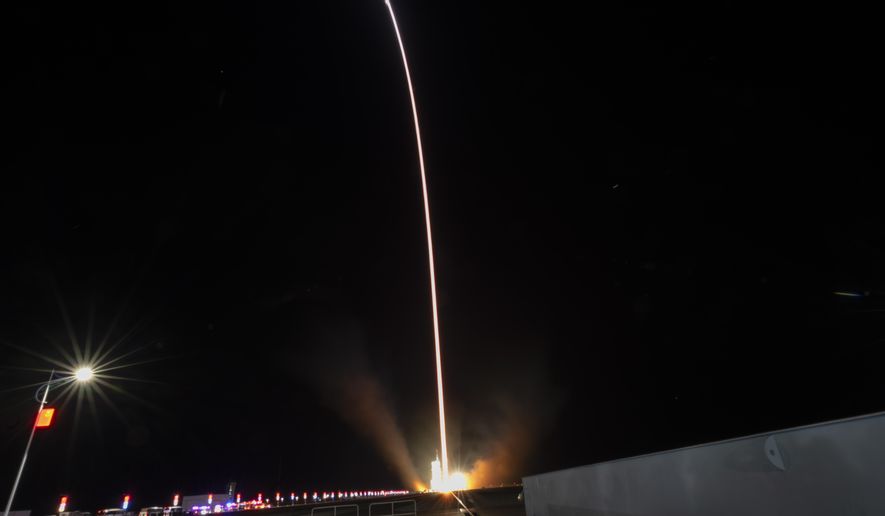

China’s military is set to launch a rocket or missile that could land close to the coast of the Philippines, a U.S. ally that in recent months has been engaged in a tense military standoff with Beijing.
The Philippines government issued a notice Jan. 24 warning air traffic that China is expected to fire a “missile, gun or rocket” on Feb. 11, one that could produce unburned debris in three areas, including one zone in the Sulu Sea close to southern Philippines. The notice posted on the website of the International Civil Aviation Organization stated that debris from the launch could land as close as 70 miles west of Zamboanga airport.
The Philippines Office of Civil Defense announced two days later that the scheduled flight of a new Chinese space launch had been postponed until February. It identified the rocket as the Long March 8A. The office warned Filipinos not to touch any debris they encountered from the test as potentially toxic.
The notice posted on the website of the International Civil Aviation Organization stated that debris from the launch may land about 70 miles west of Zamboanga airport.
China’s People’s Liberation Army is in charge of all Chinese space and missile launches and thus its rocket firings are closely watched by U.S. intelligence agencies. A Pentagon surveillance aircraft crashed not far from the air closure test location on Thursday, killing a U.S. Marine and three defense contractors, the Indo-Pacific Command announced.
Geographical coordinates contained in the notice to airmen showed three potential landing locations.
The launch warning was first reported by Duan Dang, a Vietnamese blogger who monitors China’s South China Sea activities.
“The NOTAM issued by the Philippines raises doubts about the true nature of the launch, particularly regarding its designated impact zone in the Sulu Sea,” he stated on X.
Richard Fisher, a China military affairs expert, confirmed that the initial launch of the Long March 8A had been set for late January, but was rescheduled for Feb. 11.
The payload for the launch has not been identified by the Chinese government. However, an earlier variant of the launcher was used to orbit groups of satellites for surveillance and communications.
The three splashdown locations contained in the notice to airmen straddle the Philippines island province of Palawan, with a possible third stage impacting in the Sulu Sea, a Philippines waterway, at a time of heightened Chinese coercion against the Philippines, Mr. Fisher said.
“China regularly uses space launch vehicle stage splash-downs near Taiwan to accentuate its military coercive campaign against the island democracy,” he said.“In a similar vein, this latest Long March-8A mission represents an escalation in Chinese threats against Manila.”
Pressure campaign
Beijing’s aggressiveness against the Philippines throughout last year included hundreds of Chinese coast guard and navy ship patrols against multiple disputed islands and shoals in the South China Sea.
The Philippines government also arrested a group of Chinese spies suspected of gathering intelligence on Palawan. The five suspected Chinese agents were charged last month with spying on Philippine navy and coast guard facilities, ports and ships on Palawan near the South China Sea.
Mr. Fisher said the activities included monitoring Ulugan Bay, an area he said is a likely location for any future Chinese amphibious invasion.
“A Chinese threat to Palawan is real, as the People’s Liberation Army requires control of Palawan in order to secure control over the South China Sea or West Philippine Sea, which China seeks in order to secure its nuclear missile submarine and strategic lunar and deep space launching bases on Hainan Island,” he said.
U.S. and Philippine Marines hold regular military exercises to practice defending Palawan, and Manila recently increased U.S. access to bases in the province.
“The planned Feb. 11 Long March-8A launch is a reminder that other PLA missiles can directly target U.S.-Philippine forces on Palawan,” Mr. Fisher said.
The stepped-up military coercion against Manila appears to reflect Beijing’s anger over the grounded Philippine navy ship Sierra Madre, which is being used as the basis for Filipino sovereignty claims on the Second Thomas Shoal. China has been harassing resupply vessels en route to the Sierra Madre and wants the grounded ship removed.
China also is angered by the Philippines’ decision to host U.S. Typhon medium-range missiles in the northern Philippines. The Philippines government announced in January that the missiles that were initially deployed temporarily will remain in the country.
The Typhon can fire long-range Tomahawk land attack cruise missiles that can hit targets throughout southern China. The system also can fire SM-6 anti-aircraft and anti-ship missiles with ranges of up to 165 miles.
“For over 15 years U.S. military treaty ally the Philippines has been subject to blatant campaign of Chinese military coercion, and like the Chinese coercive campaign against Taiwan, coercion could escalate to military strikes at any time as the PLA now has commanding military superiority,” said Mr. Fisher, an analyst with the International Assessment and Strategy Center.
To deter any Chinese attack on the Philippines, he said, the Trump administration should immediately transfer F-16 jet fighters and precision-guided Army Tactical Missile System, known as ATACMS, to the country.
The Long March 8A “is specifically developed to meet the launch requirements of large-scale constellation networks in medium-Earth and low-Earth orbits (LEO), according to chief designer Song Zhengyu,” NASASpaceFlight.com reported, noting that it was developed by China Academy of Launch Vehicle Technology, a company identified by the Pentagon as a Chinese military company.
CALT is said to be developing China’s fractional orbital bombardment system, a unique, Earth-orbiting nuclear missile first tested in 2021.
Contact the author

Please read our comment policy before commenting.