



OPINION:
Lots of people in and around our federal government are convinced that the process by which we permit power plants, pipelines and transmission lines is hopelessly broken and needs to be reformed as soon as possible.
Like many others who have worked for years in the permitting business, I am susceptible to the argument that the permitting process is broken and must be urgently reformed.
Unfortunately, the simple reality is that most energy projects (with the current exception of wind projects) move through the permitting process without too much delay or difficulty. Apart from the well-publicized and well-worn examples — such as Keystone XL — most energy projects with paying customers wind up being built.
Even if there were widespread problems, the offered solutions would not be particularly appetizing. For instance, Section 401 of the Clean Water Act requires states to certify that permit applicants’ proposed activities will not prevent the state from achieving its clean water goals.
To remedy that and change Section 401, Congress would need to vitiate states’ authority over their waterways. That seems contrary to the Republican Party’s well-established preference for the preeminence of states and localities wherever possible.
Or consider long transmission lines capable of carrying wind and solar power from where it is generated to the population centers. In many instances, such lines would cross privately held property. Also, in many cases, the owners of the affected property are unlikely to derive much benefit from the transmission lines they would unwillingly host.
That resistance from owners sometimes places the lines squarely at odds with the somewhat old-fashioned notion that private property is more or less sacrosanct.
Instead of spending a lot of time trying to negotiate away first principles, let me propose a more straightforward approach that would shrink government a bit, respect private property, allow state authority to remain unimpaired and minimize the role of lawyers in the process.
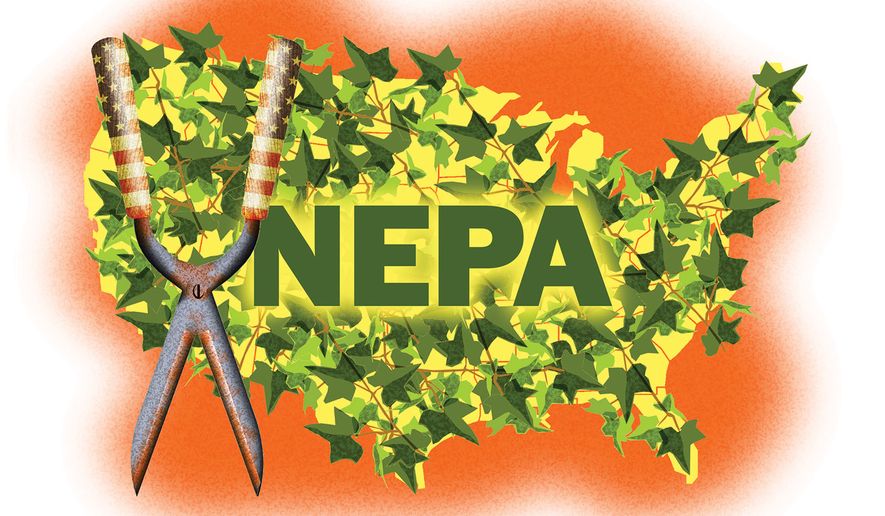
We should consider repealing the National Environmental Policy Act of 1969.
When originally passed, NEPA was designed as a catchall for federal permitting, but in the intervening 56 years, the Clean Water Act, Clean Air Act, Endangered Species Act and a host of other federal laws have been put into place. These laws now govern the entire range of environmental protections contemplated when NEPA was created and implemented.
Despite the propaganda about NEPA being the “bedrock” of environmental law, NEPA does not regulate emissions, protect wildlife or set any environmental standards. Other environmental statutes do that. Repealing NEPA would not eliminate a single environmental protection.
NEPA adds only one thing to the federal permitting process: paperwork. It requires applicants to write environmental assessments and environmental impact statements — typically consisting of thousands of pages of analysis, alternatives and cumulative impact projections — before taking almost any action.
This paperwork does nothing to protect the environment, but it does introduce delays (sometimes as long as 10 years) into the process.
NEPA turns every project into an invitation for lawsuits. Any group opposed to a project — activists, competitors, sometimes even unions — can litigate on procedural grounds. The law’s emphasis on paperwork is a feature, not a bug.
The statute is designed to toss applicants into a spiral of progressively less valuable and less probative paperwork.
Who pays for all this? The same people who pay for everything: consumers. The costs of delays are embedded in higher energy prices paid by households and businesses. These higher costs are regressive. They hurt the poor, the elderly, those on fixed incomes, and local institutions on budgets, such as hospitals and schools. NEPA is a stealthy, pervasive tax on Americans.
The time has come not to “streamline” or “modernize” NEPA, but to repeal it.
Permitting reform that leaves NEPA in place is of limited value. Congress should repeal NEPA entirely and rely on the organic statutes to address potential air and water pollution, effects on endangered species and, where appropriate, concerns about historic preservation.
If the United States wants to lower energy prices, restore the manufacturing base and win the artificial intelligence race, we must start by clearing the regulatory path. That starts with repealing NEPA.
• Michael McKenna is a contributing editor at The Washington Times.
Follow the author

Please read our comment policy before commenting.