


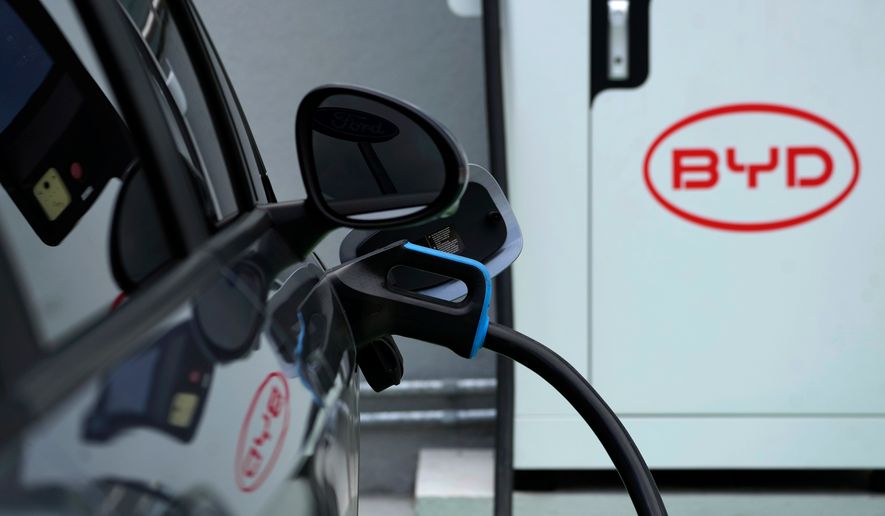

SEOUL, South Korea — The U.S. military, citing unspecified “risks to our personnel,” on Monday banned electric vehicles manufactured by Chinese automaker BYD from Kadena, a key U.S. air base on Okinawa.
“These vehicles present an unacceptable and unmitigable risk to our personnel and our mission,” spokesperson Lieutenant Colonel Alli Stormer said, per Reuters.
She did not say what specific concern had prompted the move against vehicles produced by BYD, the largest global supplier of EVs, but the firm had, in June, been put on a Pentagon black list of 188 Chinese companies.
People were interested in these podcasts
Japanese media speculated that the presence of Typhoon missile systems at the base — a weapon that is capable of hitting Chinese ports, and which has irked Beijing — may be one reason for the ban.
Current-generation civilian vehicles — “smartphones on wheels,” with inbuilt navigation sensors, dashboard cameras and other systems that record and store location, image and audio datasets — are emerging as new security risks.
Those risks came into stark view in an exercise conducted earlier this month by Norway’s Home Guard.
According to Scandinavian media, Volvo rental cars used by the reservists recorded and stored the cars’ locations, took photos of the soldiers who entered and exited the vehicles and captured security pad codes during the drills.
One of the Norwegian officers reportedly discovered the extent of the data storage by accident.
Volvo is owned by China-based multinational Zhejiang Geely Holding Company. After the reports appeared, Volvo stated that, by law, none of the cars’ data could be transferred to China.
Also this month, the Dutch Intelligence Service, in a report made public, pointed out the rising perils represented by smart cars’ in-built systems.
“These systems collect a great deal of data about occupants, the vehicle itself, and about objects and people in the vicinity,” the document, which was widely reported, stated. “Various parties, including state actors, can gain access to this data.”
Last year, British defense companies warned staff not to connect their personal devices to Chinese-made cars for fear of data extraction.
China, wielding economies of scale, a high-tech industrial base and aggressive pricing initiatives, is leading the charge in global smart car sales.
According to specialist website Automotive Manufacturing Solutions, China overtook Japan as the world’s leading vehicle exporter as far back as 2019.
Chinese manufacturers, led by BYD and Chery, are also the world’s leading suppliers in the EV sector, AMS found.
It is not just carmakers that are making Western counterintelligence officials nervous.
In June, the Pentagon named 188 companies, including automakers BYD and NIO, e-commerce firm Alibaba, and internet firm BYD, as enterprises supporting China’s military, Reuters reported.
Contact the author

Please read our comment policy before commenting.