



OPINION:
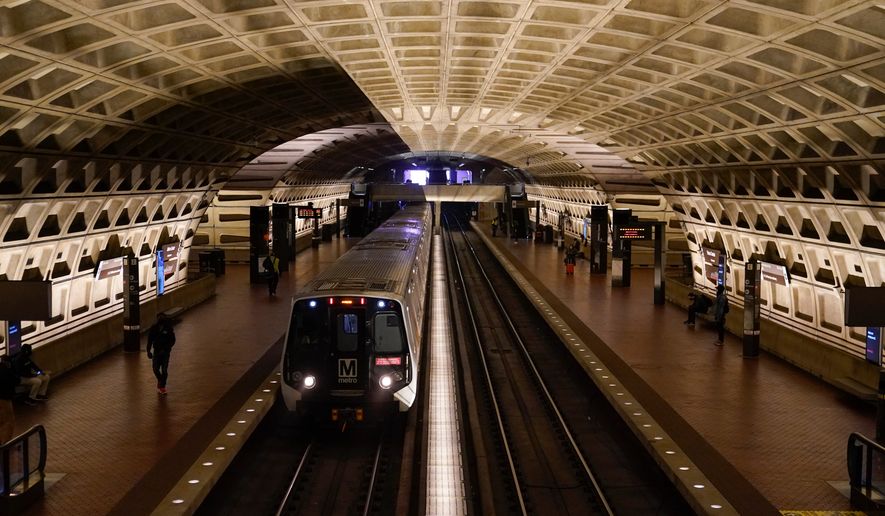
In May, the Washington Metropolitan Area Transit Authority started an advertising campaign designed to encourage Metro riders to … pay for their bus and train rides.
The campaign, called Fares Pay for Service, is, as one might expect, spiffy and gauzy and features pictures of mostly diverse young folks. The ad text commends them for paying what they owe to ride the Metro because customer fares pay for buses, trains, maintenance, better service and long-term investments.
That all sounds great, but one thing the campaign fails to mention is that evading fares is illegal. This is not a small or shrinking problem on the system.
People were interested in these podcasts
In 2020, Metro Transit Police recorded only about 1,600 fare evasion enforcement events. This year, enforcement actions have topped 18,500. As one who rides the system numerous times each week, I can tell you that those numbers reflect only a portion of the illegality, since most fare evasion goes not just unreported but also ignored by Metro employees and commuters.
The problem with the Fares Pay for Service campaign is that it presents paying your way and obeying the law as optional rather than something enforced by the apparatus of the state in the event that you are not prepared to be civic-minded. I am not sure that is a message we should be sending to the populace.
Tolerance of habitual transgressions, irrespective of magnitude, leads any social system to eventual failure.
In the case of fare evasion, those of us who pay full freight sometimes understandably feel like suckers as we watch others ride for free without consequence.
I was thinking about these Metro ads and the nature of incentive structures while watching chunks of the once-great French nation burn to the ground. No doubt the rioters originated in the no-go neighborhoods of Paris, Marseille, Toulouse and Lyon.
These neighborhoods and their residents have been abandoned by the police for the better part of a generation. They routinely endure riots and random criminality. It is small wonder that the residents of such places have little attachment to law and order and the French state more generally.
In short, these neighborhoods are anarchies stitched into the fabric of French life.
No doubt the first step down that terrible road occurred when someone in authority concluded that perhaps it would be best if the police looked the other way when people committed what might be considered minor crimes. No doubt it became progressively easier to ignore most or all crime.
Once you head down that road, however, whatever civilization you might be trying to build or maintain crumbles under the weight of those who have neither fear nor respect for the law.
That brings us back to the Metro. Encouraging good behavior is commendable, but sometimes it is more important to alert certain people that crimes of any kind will be punished.
It is not fair to the psychological adolescents who make up much of the criminal class to send the message that some laws are enforced and some are not — and for authorities to hope they can figure out which is which. Is fare evasion a crime? Yep. Should it be prosecuted? Every time.
Lack of clarity regarding society’s commitment to faithfully following the law, wherever it might lead, is ultimately not good for anyone.
Ask the French.
• Michael McKenna is a contributing editor at The Washington Times.
Follow the author

Please read our comment policy before commenting.