


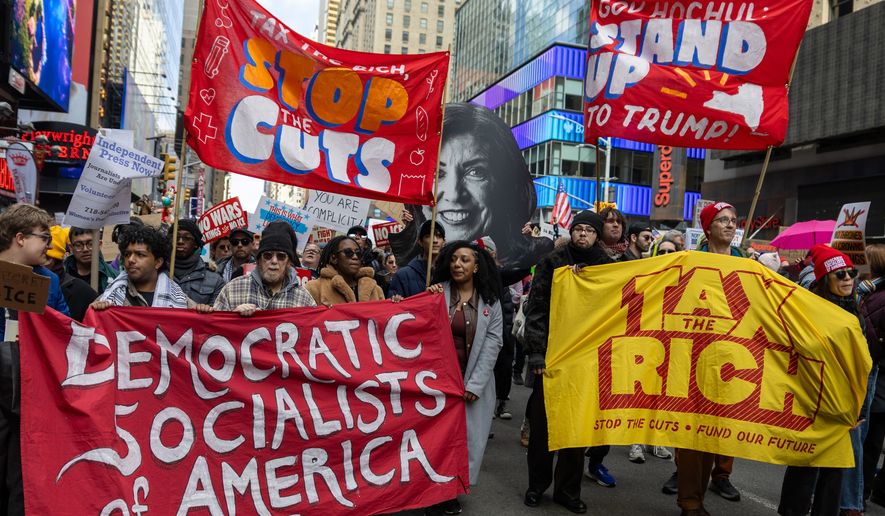


The Texas Public Policy Foundation warned President Trump against a hasty response if the Democratic Socialist of America sparks a street protest crisis.
The DSA strategy aims to corner the president into invoking the Insurrection Act or look weak when confronted by widespread, violent street clashes from leftist factions before the 2028 presidential election.
People were interested in these podcasts
The conservative think tank’s Chuck DeVore references a recent data dump and analysis by former Department of Government Efficiency staffer Jennica Pounds, best known on X as DataRepublican. The data included documents and recordings from DSA and allied networks on a post-midterm election strategy for the 2028 election cycle.
“The reported DSA-linked planning treats the Insurrection Act as a trap that works only if Trump walks into it on their timetable and terms. Refusing the invitation does not require ignoring anarchy,” Mr. DeVore said.
“Accepting it does not guarantee a clean narrative win. Protecting federal interests while the consequences of progressive local governance stay localized is one coherent approach. Direct intervention to restore order, even against the wishes of the elected officials of the affected jurisdictions, is another. Both carry political, economic, and human costs.”
The Advocates reached out to the DSA for comment.
Mr. DeVore warned that the Left’s apparent goal is to compel the decision, then push back on whichever option is chosen.
“How much disorder materializes, how local authorities respond or decline to respond, and how voters process the resulting images will shape the outcome. The planning is the warning,” he said.
In one scenario, Mr. Trump would invoke the law.
“Invoking the Insurrection Act and placing federalized National Guard or active-duty forces in law-enforcement roles inside Democratic cities would supply the ‘fascism’ narrative,” Mr. DeVore said.
In another scenario, if Mr. Trump resisted invoking the Insurrection Act and still is blamed for the chaos.
“Progressive media and political groups would work to reframe the disorder as the product of federal non-intervention or systemic factors rather than local choices,” Mr. DeVore said. “The plan assumes Trump will choose immediate order over patience, and hand his opponents the optics they have prepared. Whether that assumption holds depends on the costs of each path.”
Libertarians want to rein in president’s Antiquities Act power
It is time to roll back the 120-year-old law that lets presidents declare national monuments on federal lands and is now being used to lock up entire ecosystems, said the Competitive Enterprise Institute.
To fix it, the libertarian think tank is pushing a bill spearheaded by GOP Rep. Paul Gosar of Arizona to rein in that presidential power.
Former presidents Bill Clinton, Barack Obama and Joseph R. Biden largely abused the 1906 Antiquities Act over the last 30 years, said CEI analyst Jacob Thomas.
“There’s a pretty strong case to be made that up until around the Clinton era, it wasn’t really abused. There were monuments designated before the 1990s, but for the most part, they were pretty tame,” Mr. Thomas told The Advocates.
When Mr. Clinton set aside 1.7 million acres as Utah’s Grand Staircase-Escalante National Monument, he used the 1906 law written to protect specific historic and natural sites.
“That designation [of the Grand Staircase] sort of set a precedent, in a way, for Obama and then Biden to designate places just as large or larger,” Mr. Thomas said.
Mr. Gosar’s bill, the Legislative Approval for National Designations Act or the LANDs Act, would require congressional approval for federal land withdrawals exceeding 5,000 acres.
It would cap new presidential monument designations at 640 acres without congressional consent, require private property owner consent, prohibit the reservation of water rights through designations and limit future monument designations.
Utah’s Bears Ears National Monument, a designation by Mr. Obama, was about the same size as Grand Staircase.
During his first term, Mr. Trump shrank the monument designation size of both Grand Staircase and Bears Ears, from close to two million acres down to 100,000 acres, making him the first president to shrink monuments.
Trump urged to make Jones Act waiver ‘even stronger’
Eighteen free market organizations called on President Trump to issue a new waiver of a near-century-old law that requires commercial sea traffic between U.S. ports to be on American-built, -owned, -flagged and -crewed ships.
In an Oct. 22 letter to Mr. Trump, the organizations urged him to make his next waiver “even stronger,” saying that the most recent extension added a new regulation requiring shippers to receive prior approval for shipments.
“This requirement is significantly weakening your efforts to bolster domestic shipping. Just 19 voyages have been authorized under this stricter waiver,” the letter said.
Mr. Trump waived the Jones Act through Nov. 15, allowing foreign-flagged vessels to transport commodities covered by the law.
Named for Sen. Wesley Jones of Washington state, who sponsored the legislation that made its way into Section 27 of the Merchant Marine Act of 1920, the ship must be owned by at least 75% U.S. ownership and crewed with U.S. citizens making up the officers and most of the crew.
The law’s supporters say it maintains American ship manufacturing and the maritime workforce that the military can depend on in an emergency while protecting U.S. jobs from cheap foreign labor.
Critics of the law say it raises shipping costs, especially for Puerto Rico, Hawaii and Alaska.
The free market groups include the National Taxpayers Union; Americans for Prosperity; American Energy Alliance; Americans for Tax Reform; American Commitment and the Cato Institute.
• The Advocates column is a weekly look at the political action players who drive the debate and shape policy outcomes in Washington. Send tips to theadvocates@washingtontimes.com. Click here to receive The Advocates in your inbox each week.
Contact the author

Please read our comment policy before commenting.