



OPINION:
Ukraine is so short on men to serve in its army that Andrii Stebivka, a 38-year-old Greek Catholic priest, was forcibly detained at a checkpoint earlier this month by Ukrainian military recruitment officers and sent to a military training camp.
Mr. Stebivka is facing potential deployment to the front lines of combat, as recruitment officers rejected the proof of his priesthood and active ministry that he presented.
Jonathan Karlinsky, an Israeli Ukrainian Breslov Hasid, was arrested while crossing the Ukraine-Romania border after Rosh Hashana and drafted into the Ukrainian army. He is awaiting transfer to a military base near Odesa, where he is expected to serve as an army doctor.
People were interested in these podcasts
“We tried to secure his release, but it wasn’t feasible,” his family told The Jerusalem Post. “His medical expertise, combined with the Ukrainian army’s growing shortage of medical personnel, meant the army needed him immediately and could not let him go.”
Ukraine is providing no exemptions to any potential soldiers as its war with Russia grinds into its fifth year.
Ukrainian military estimates place the daily death toll for Ukrainian service members at roughly 100 men per day, though it is likely much higher. More than 2 million soldiers on both sides have been killed or wounded since Russia’s February 2022 invasion. CIA Director John Ratcliffe said that Russian recruits arriving on the front lines in Ukraine survive an estimated 20 to 30 minutes before being killed or wounded.
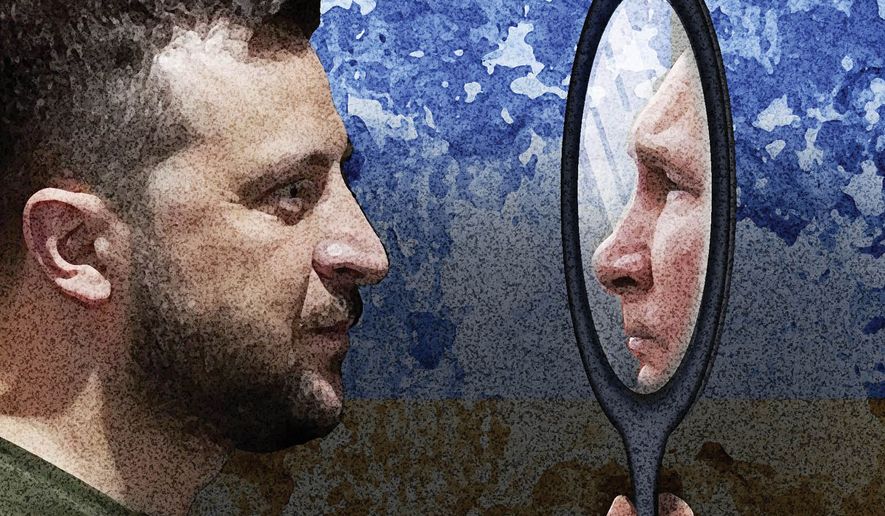
Still, Russia has a population almost four times larger than Ukraine’s and Russian President Vladimir Putin is notoriously unsympathetic to his country’s loss of life. Ukrainian President Volodymyr Zelenskyy seems to be unsympathetic to his country’s loss of life as well.
Oleksiy Goncharenko, a Ukrainian member of parliament, last week confirmed a leaked 2023 peace plan reported by the Financial Times. At the time, Mr. Putin reportedly was prepared to consider it, but Mr. Zelenskyy and the Biden administration rejected it.
In the proposed plan, Ukraine would have to recognize Russian control over Crimea and part of the Donbas region, which Russia controlled before the invasion. Ukraine would also have to grant Russia an unobstructed land corridor — to be built at Russia’s expense — to Crimea. The ceasefire would be monitored and enforced by NATO countries, including the U.S.
Mr. Zelenskyy had the opportunity to walk away from the conflict with what was roughly the status quo before Russia’s invasion, but he wanted more. Three years later, his country has received less. Tens of thousands of children have lost their fathers, young men have lost their lives, innocent civilians have been killed, and homes and businesses have been destroyed.
Many within foreign policy circles like to view the war through the lens of good (Ukraine) versus evil (Russia). Yet as with most things in life, it is more complex. Mr. Zelenskyy seems to enjoy traveling around the world, being celebrated by elites as a hero of democracy, while his ongoing wartime stance is impoverishing and killing his people.
The number of Ukrainians living in poverty has grown by 1.8 million since 2020, bringing the total to about 9 million, or 29% of the population living in Kyiv-controlled territory, according to the World Bank. The increase in poverty was driven by the loss of jobs, with more than one-fifth of adults who were employed before the war losing their employment.
“Perhaps the biggest gap is the one between different experiences of war,” Tymofiy Brik, a sociologist and rector of the Kyiv School of Economics, told RFE/RL. “Some [Ukrainians] are hunting for a place in a kindergarten in Berlin, while others need a pickup truck for their military unit.”
The class divide in Ukraine is growing. The wealthy oligarchic layer is no doubt profiting from the billions of dollars in foreign aid being funneled into the country. Ukraine’s small middle class was able to flee to Europe. The largest segment of Ukraine’s population — the working class — is now experiencing subjective or objective poverty, living within a wartime economy.
Mr. Zelenskyy’s trust and approval ratings in Ukraine have declined from wartime highs of more than 80% in 2022 to 2023. On Oct. 20, the Kyiv International Institute of Sociology officially published the results of an Oct. 8-16 poll, which found that 54% of Ukrainians trusted Mr. Zelenskyy, while 41% distrusted him.
It should be noted that, while under martial law, Mr. Zelenskyy remains president unopposed. His poll numbers tick up when he picks a fight with Washington.
So perhaps that is why we have seen him mouthing off against Elon Musk, whose technology is powering Mr. Zelenskyy’s wartime effort, and the U.S. Yet as Secretary of State Marco Rubio so aptly put it while speaking with reporters during a visit to India on Oct. 21, if it were not for our assistance, “there would be no Ukraine right now.”
With Mr. Putin agreeing to trilateral negotiations with Ukraine and the U.S. next month, Mr. Zelenskyy should show deference to his people and make a deal. If he does not, it could be argued that Mr. Zelenskyy is becoming exactly what he has been fighting against: an authoritarian dictator profiting from the riches of war.
• Kelly Sadler is the commentary editor at The Washington Times.
Follow the author
Please read our comment policy before commenting.