



NEWS AND ANALYSIS:
The arrest of a suspected Chinese agent in southern California highlights how China’s Ministry of State Security conducts covert surveillance of political opponents, according to a former counterintelligence official.
Nick Eftimiades, a former CIA, Defense Intelligence Agency and State Department specialist on Chinese intelligence, said the operation by alleged Chinese agent Zhang Wanying and a second agent at the home of the son of Taiwan’s president in Washington state showed key elements of MSS spy tradecraft.
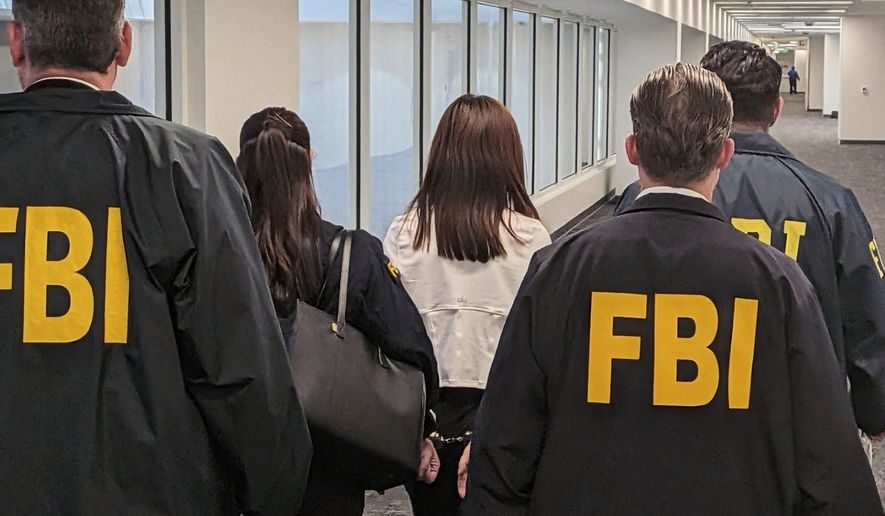
Ms. Zhang, also known as Heather, was arrested by FBI agents Oct. 4 as she was preparing to board a flight to Shanghai. She was charged with acting as an unregistered agent for China and is now in jail pending a trial.
People were interested in these podcasts
“This arrest of Heather Zhang shows a consistent pattern of aggressive espionage operations by China’s Ministry of State Security,” Mr. Eftimiades told Inside the Ring. “China continues to exploit its diaspora worldwide in its ’whole of society’ approach to espionage.”

A detailed FBI complaint in the case disclosed how Ms. Zhang, a real estate agent, and a second suspect, identified in press reports as Miao Fatai, traveled to Seattle in September 2025 and spied on Lai Ting-yu, son of Taiwan President Lai Ting-chi.
The FBI said a court filing Tuesday that Mr. Miao is in China and that he had a romantic relationship with Ms. Zhang, who is married with two daughters.
FBI counterspy Kevin Holt stated in a court filing arguing against releasing Ms. Zhang on bail that a review of her text messages revealed she has more than $190,000 in Chinese bank accounts and has engaged in “the unlicensed transfer of money from the People’s Republic of China to the United States.”
China prohibits citizens from transferring more than $50,000 a year out of the country and Chinese Communist Party elites have used real estate transactions to circumvent the limit, according to the Treasury Department.
Ms. Zhang also is an investor in a Shanghai nightclub, he said.
Ms. Zhang was linked to Chinese intelligence in court papers through her ties to the University of International Relations, a school institutionally linked to the MSS and where she graduated first in her class.
Mr. Eftimiades, now president of the private counterintelligence training firm Shinobi Enterprises, said a review of the case shows key MSS operational security features.
They included intelligence tasking by MSS officers in China, compartmentation of roles by the two agents, a short duration car rental, an indirect travel route to Washington, secure voice communications and attempts to send operational imagery through Apple AirDrop instead of less-secure text messaging.
Outside the target resident, Ms. Zhang hid in a reclined seat in the rental car while Mr. Miao gathered photographs, video and vehicle-license-plate information that Ms. Zhang then transmitted to a Chinese intelligence official, he stated.
Two Chinese officials are each identified in court papers as “PRC Official.” Mr. Eftimiades said one is an “academic spotter” or recruiter and the second is an active case officer who provide direction for the operation, Mr. Eftimiades said.
Significant operational flaws in the Seattle spy operation included Mr. Miao transmitting surveillance material over the Chinese messaging app WeChat despite being instructed to use only AirDrop, Mr. Eftimiades said, noting the change from WeChat to AirDrop may reflect a new agent communication method.
“The objective was to acquire information that could provide the [People’s Republic of China] with potential coercive leverage against Taiwanese political figures and their families,” he said.
Potential objectives include physical intimidation; transnational repression; future human-intelligence targeting; and “contingency planning during periods of cross-[Taiwan] Strait political or military tension,” he said.
China for more than a decade has been engaged in what the Justice Department calls aggressive “transnational repression” targeting perceived enemies, mainly dissidents.
The Zhang case is the first time the FBI publicly uncovered a Chinese effort to target the family of a senior Taiwanese official.
Court papers in an earlier Chinese spy case in California revealed that China operates clandestine assassination and kidnapping teams, including one based in Hong Kong, that are dispatched globally to conduct targeted killings or coerced repatriations.
Beginning in 2014, Chinese intelligence launched a program called Fox Hunt to capture fugitives and dissidents and that program later led to numerous U.S. cases of Beijing coercion against overseas Chinese.
A federal indictment of seven Chinese nationals in 2022 revealed how China engages in Beijing-sanctioned surveillance, harassment, intimidation and coerced repatriation.
A U.S. intelligence official said Fox Hunt morphed from targeting criminals into control of former Chinese citizens abroad, and likely will escalate further into trying to dictate what natural-born Americans can say and print in the U.S. about China.
“The CCP never lets go. It’s like the world’s largest mafia, except with sovereignty, nukes and a [United Nations Security Council] seat,” the official said.
British counterspy agency warns against helping China spy unit
The British domestic intelligence service MI5 recently issued a warning identifying a Chinese institute that is engaged in spying technology development.
The China General Technology Research Institute (CGTRI) is an academic unit with the main purpose of developing Ministry of State Security technical capabilities for espionage, the spy agency stated in a security service espionage alert made public Sept. 30.
MI5 Director Ken McCallum said in a speech Tuesday that China poses a major state security threat to Britain, along with Russia and Iran.
While Moscow is “aggressor No. 1,” China is conducting espionage, coercion and interference in the democratic system, he said.
Mr. McCallum said the espionage alert to the academic community revealed that Chinese intelligence has been funding projects in Britain aimed at improving Beijing’s formidable spy apparatus.
The Chinese institute is also translated as the China Academy of General Technology (CAGT) has very strong ties to the Ministry of State Security, the main civilian spying and counterintelligence service.
“MI5 has identified that more than 100 UK-linked academics have contributed to projects funded by MSS via CGTRI,” the report said. In some cases, academics may not be aware that CGTRI is funding the Chinese research project they are contributing to.”
British academics have supplied the institute with information on artificial intelligence, cybersecurity, covert communications systems and steganography — the use of online images to transmit clandestine messages.
The activity is supporting Chinese spying and threatens British national security, the report said.
Many of the British academics that helped the institute did so in good faith based on CGTRI’s ability to hide its relationship with the Chinese spy service.
The report urged all academic institutions to immediately review any ongoing collaboration with the unit to prevent additional spy benefits to Beijing, which is engaged in large-scale intelligence gathering on an array of targets globally.
Chinese intelligence is seeking both traditional government secrets and advanced technology and engages in both human spying operations and technical intelligence collection, mainly through cyberespionage.
One motivation for the British cooperation has been funding from China and MI5 urged all universities and research institutes to check on funding sources before engaging in support.
The report did not elaborate on the institute’s very strong links to the MSS. However, MI5 warned the academics that assisting a foreign intelligence service is illegal under a 2023 National Security Act.
Former German spy chief linked to China
The former director of Germany’s BND foreign intelligence service who has been charged with espionage, had close ties to a former high ranking Chinese general, according to Spiegel magazine.
August Henning, BND director from 1998 to 2005, was arrested Oct. 6 and charged with “treasonous espionage” for an unidentified foreign spy service in one of the most stunning spy cases since the Cold War.
As head of the Federal Intelligence Service, the English name for BND, Mr. Henning would have had access to extremely valuable secrets, including those shared among NATO allies, meaning the case could prove to be a potentially grave compromise of Western security.
Mr. Henning traveled several times to China, where he knew a former official who had served in China’s embassy in formerly Communist East Germany.
The case involves some 2,000 internal documents provided by his former chief of staff, Manfred Dankesreiter, 64, from 2010 to 2012.
Some of the documents were used to produce an analysis for a foreign intelligence officer, reportedly from Azerbaijan.
Additional charges from the German public prosecutor’s office said Mr. Henning also had “close contact” with someone working for another foreign intelligence service who was provided confidential political information based on BND files for several years.
Spiegel identified the former People’s Liberation Army general as Gen. Wang Jianzheng, an expert in German affairs who had translated a number of books from German to Chinese.
Gen. Wang is now with the state-run China Institute for International Strategic Studies, a PLA think tank and told the magazine he had not seen Mr. Henning in a long time and decline further comment.
Mr. Hanning has stated he is being “wrongfully persecuted.” His lawyer told Der Spiegel he possessed confidential BND files but denied passing to the detriment of Germany or for money.
New ICBM warhead carrier tested
The Air Force Nuclear Weapons Center recently carried out a test launch of a new warhead carrier for the forthcoming Sentinel intercontinental ballistic missile from Vandenberg Space Force Base, California, the service said in a statement.
The unarmed warhead known as the MK21A reentry vehicle was launched Oct. 9 atop a Minotaur I test rocket, the statement said.
Reentry vehicles, or RVs, are cone-shapes, high-technology missile stages used to target nuclear warheads from space. They range from single to multiple warhead configurations and the Mk21A is the next-generation weapon.
“The Mk21A is crucial to modernizing our ICBMs in response to the rapidly changing global threat picture posed by our adversaries,” said Maj. Gen. William Rogers, Air Force acquisition executive for ICBMs at the Nuclear Weapons Center. “The reentry vehicle’s development will ensure a safe, secure and effective deterrent for generations to come.”
The RV is being developed by Lockheed Martin and will carry the W87-1 nuclear warhead, a new thermonuclear weapon developed by the Lawrence Livermore National Laboratory as a higher-yield replacement for the aging W78 warhead now on Minuteman III missiles.
• Contact Bill Gertz on X @BillGertz.
Contact the author

Please read our comment policy before commenting.