



OPINION:
“It is forbidden to kill; therefore, all murderers are punished unless they kill in large numbers and to the sound of trumpets.” — Voltaire (1694-1778)
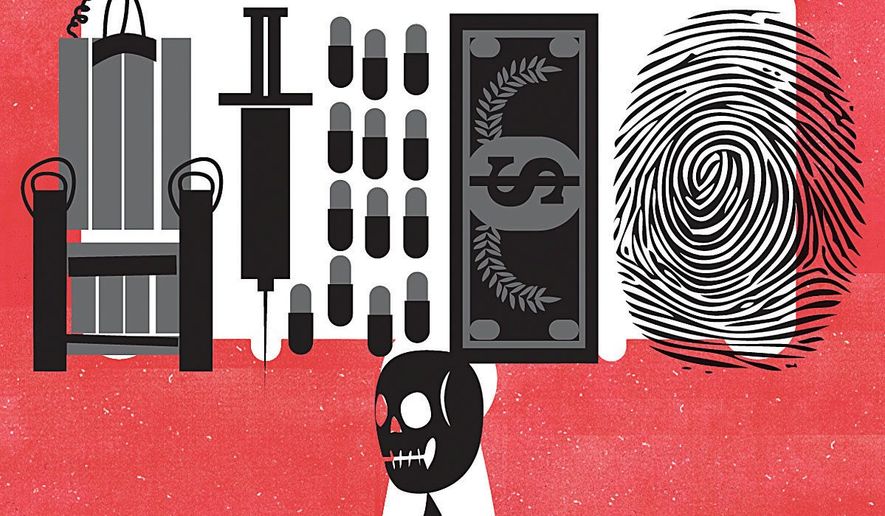
A government that claims the authority to kill persons after they have been subdued, disarmed, tried, convicted and confined in prison has made a startling claim about the nature of political power. It claims not merely the authority to protect the innocent from violence, but also the authority to inflict violence when no immediate threat exists.
It claims that the taking of human life, which it rightly condemns when committed by private individuals, somehow becomes morally permissible when committed by government agents. This is the fundamental contradiction of the death penalty: that the government killing the helpless somehow protects the living.
People were interested in these podcasts
The Declaration of Independence offers a radically different understanding of government. All human beings possess natural rights, and governments are instituted to protect those rights. The government’s just powers derive solely from the consent of the governed.
Government is not the owner of our lives. It is our creature, established to protect rights that precede its existence. Its authority is limited, and it cannot legitimately claim powers that the people whom it governs do not themselves possess.
Individuals possess a natural right to defend themselves against an unlawful attack. They may use necessary and proportionate force to repel an aggressor. Because the people possess that right, they can delegate it to the government, including to the military, for defensive purposes.
The government’s legitimate authority to wage defensive war is a moral and legal derivation of the people’s preexisting right of self-preservation.
Yet what right does an individual possess to kill a defeated enemy who has surrendered, is disarmed and locked in a prison cell? What right does a private person possess to execute a prisoner who no longer presents an immediate threat? None. The right of self-defense does not include the right to kill a helpless captive as retribution for a past offense.
If the people do not possess that right, how can they delegate it to the government? The principle is straightforward: Government cannot legitimately acquire, through the consent of the governed, a power that the governed themselves do not possess.
Confinement protects society. Execution reveals the state’s claim to omnipotence.
Defense Secretary Pete Hegseth’s plans to have a convicted defendant executed publicly and livestream the killing represent a particularly repulsive vision of state power. If implemented, such a spectacle would not demonstrate the strength of American civilization. It would advertise its moral depravity. It would turn the deliberate destruction of a human being into political entertainment, with the machinery of government serving as producer and promoter.
There is something profoundly disturbing about officials who would turn a human death into a public performance. What lesson would such a livestream teach? That the state is entitled to kill, that its violence deserves an audience and that adults and children should watch with approval as the life of a powerless, wheelchair-bound prisoner is extinguished by military sharpshooters? Is the proper response to wrongdoing not the restraint of power, but the celebration of its most lethal expression?
This is a cruel and unusual descent into barbarism, a glorification of government killing and an invitation to cultivate a culture of fear and death. Civilization advances when it restrains violence, even in response to terrible crimes. Barbarism advances when violence becomes an instrument of public spectacle and collective gratification.
The military’s involvement makes the proposal still more grotesque. The Department of Defense exists to defend the country against external threats, not to transform the execution of prisoners into a propaganda production. The armed forces should not be reduced to stagehands for a political morality play in which the government celebrates its power over a captive’s life.
A free society should be especially suspicious when government seeks to dramatize its capacity to kill. The framers understood that all government power must be confined and limited, not worshipped. Publicly celebrated executions would encourage the opposite attitude: reverence for the state’s ability to destroy rather than respect for its obligation to protect.
A government that wishes to demonstrate moral seriousness should protect the innocent, prosecute crime fairly, provide due process and confine dangerous offenders securely. Life imprisonment incapacitates a murderer without requiring society to pretend that killing is an act of healing. It also leaves open the possibility of correcting a wrongful conviction.
None of this diminishes the suffering of murder victims or their families. Their losses are profound, and their endless grief deserves compassion rather than political exploitation. Still, the state does not honor victims by imitating the violence that destroyed them. It honors them by establishing a system of justice that refuses to confuse vengeance with virtue.
The values underlying both the Declaration of Independence and the Constitution reject unlimited state government authority. The framers established a limited government whose legitimacy depends on the actual consent of the governed.
Consent is not a blank check, and a democratic majority cannot make every exercise of government power morally legitimate simply by funding it.
The death penalty transforms the government from the protector of life into its deliberate destroyer, then asks the public to call the destruction justice. A publicly streamed execution would take that contradiction to its obscene extreme, turning death into spectacle and state violence into pornographic entertainment.
A free people should reject this culture of death.
The measure of a civilized government is not how efficiently it kills a helpless prisoner, or how many spectators it can gather to watch. It is how faithfully it restrains its own power, even when anger, fear and the demand for vengeance make restraint politically inconvenient.
Government exists to protect our natural rights, not to become the final and unquestionable arbiter of who deserves to live. When the state claims that its right to kill is inherent and righteous, it demands a submission that no free people should grant.
• To learn more about Judge Andrew Napolitano, visit https://JudgeNap.com.
Follow the author
Please read our comment policy before commenting.