Ben Wolfgang is a national security correspondent at The Washington Times, a senior member of its Threat Status team, and the host and producer of the award-winning Threat Status Podcast. Ben covers national security, foreign policy, military affairs, the defense industry and the rapidly evolving landscape of military technology. A Pennsylvania native, he joined The Washington Times in 2011 after serving as a political reporter at The Republican-Herald in Pottsville, Pa. Over the course of his career, Ben has covered the White House, Congress, and four presidential campaigns. His reporting has earned recognition from some of journalism's most respected organizations, including the Virginia Press Association and the Society of Professional Journalists' Washington, D.C. Chapter, among other honors. Ben has interviewed heads of state, chairmen of the Joint Chiefs of Staff, senior military commanders, cabinet secretaries, senior government officials, and the CEOs of many of the nation's largest and most influential defense companies. Ben is a frequent guest on broadcast media, with appearances on C-SPAN, the Sirius XM POTUS channel, and other outlets. He can be reached at bwolfgang@washingtontimes.com.
Nearly a year after the U.S. began bombing Islamic State fighters in Iraq, President Obama said Monday his administration and its international partners still don't have a "complete strategy" for combating the terrorist group.
President Obama and other G-7 leaders on Monday committed to ambitious climate-change goals, including "decarbonisation of the global economy" during this century.
Fracking does not pose a direct threat to drinking water supplies, the Obama administration said Thursday in a major study that represents a serious blow to environmentalists and other vocal opponents of U.S. oil and gas production.
The Obama administration's move last week to increase the amount of ethanol and other renewable fuels that must be blended into gasoline supplies left virtually everyone unhappy, casting new doubt on the future of the government's long, contentious Renewable Fuel Standard.
President Obama and the government's chief intelligence official made a plea Friday for Senate Republican leaders to relent in their fight to preserve the NSA's phone-snooping program, saying that unless a deal is reached by Sunday, investigators will no longer be able to apply for new roving wiretaps come Monday.
The White House said Friday that the ongoing "feud" between Senate Majority Leader Mitch McConnell and Sen. Rand Paul is just the latest in a long line of Kentucky conflicts, dating back to the famous Hatfield-McCoy battles of the late 1800s.
The U.S. energy boom and low gas prices have wreaked havoc with the federal government's mandate to blend more ethanol and other biofuels into fuel supplies, leaving the Obama administration under fire and struggling to meet the mandates set by Congress nearly a decade ago.
The Obama administration on Friday officially removed Cuba from the list of state sponsors of terrorism, removing a key barrier toward full normal diplomatic relations between the U.S. and the communist island.
President Obama on Thursday linked hurricanes and other extreme weather events to climate change -- the latest move by this White House to keep the issue at the forefront of domestic politics while also pursuing a landmark international agreement to save the planet.
In a key test of how much the federal government can regulate electricity markets, the Supreme Court this fall will hear arguments on whether the Obama administration overstepped its bounds in requiring power companies to pay customers who use less energy during peak demand hours.
Saying that children "instinctively" understand the importance of the environment, President Obama said Thursday that climate change should be taught in schools and "weaved" into science and social studies classes.
While raising hundreds of thousands of dollars for the Democratic party, President Obama on Wednesday night blasted Congress for failing to act on everything from immigration reform to education.
Joseph R. Biden said Wednesday that ending the Russia-Ukraine conflict is a key test of U.S. and European leadership for this generation — but specialists say the vice president laid out no new American strategy for countering Russian aggression, and the Obama administration seems content on staying the course with economic sanctions and continued diplomatic outreach to Moscow.
President Obama is missing a key opportunity to grow the U.S. economy and aid key European allies by failing to lift a 40-year-old ban on crude oil exports, former Defense Secretary William Cohen said Wednesday.
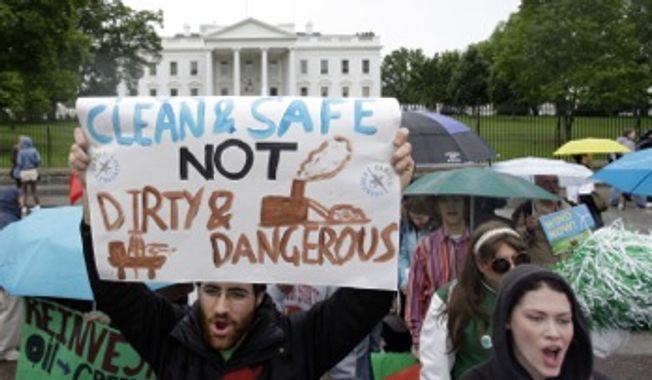
The administration announced rules Wednesday to grant federal agencies sweeping environmental oversight over wetlands, ponds and even some ditches in a move supporters said will clean up dirty waters but which critics said was a capstone power grab for a lame-duck president.
President Obama on Tuesday didn't distance himself from Defense Secretary Ashton Carter's claim that Iraqi forces showed "no will to fight" last week when Islamic State terrorist fighters captured the town of Ramadi -- but the White House also wouldn't explicitly endorse the Pentagon chief's comments.