


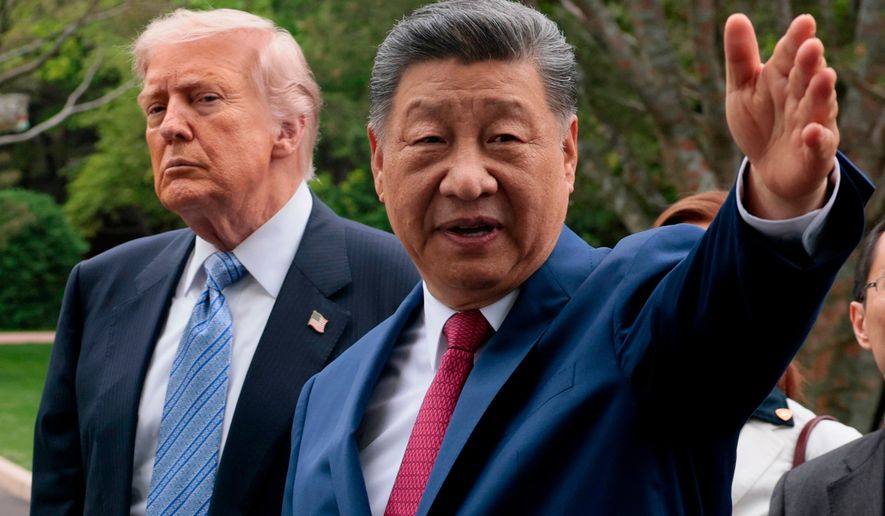

President Trump will host Chinese President Xi Jinping for a lavish state visit to Washington this week, but behind the pageantry, the two leaders will face off across a negotiating table crowded with disputes.
The agenda for their sit-down Thursday at the White House is packed with contentious issues, including tariffs, rare earth minerals, Taiwan, artificial intelligence and a growing military rivalry between the world’s two most powerful nations.
The state visit is also taking place at a politically fraught moment for Mr. Trump, who is seeking economic victories ahead of November’s midterm elections. As his trade war with Canada ramps up, the president wants to keep his fragile trade truce with Beijing from collapsing.
People were interested in these podcasts
Mr. Xi, meanwhile, arrives in Washington with some leverage: his country’s dominance of the rare earths market, which is vital to U.S. manufacturers and the Pentagon. He is not looking for anything tangible but rather how to keep the uneasy relationship with the U.S. functional, buy time and see whether the American political landscape shifts in November.
That puts both presidents in a position where they have reasons to make a deal but must be careful not to give away too much. They could be satisfied walking away with an agreement to maintain the status quo.
“It’s a summit about managing a stalemate, not resolving it,” said Craig Singleton, director and senior fellow of the China Program at the Foundation for Defense of Democracies.
SEE ALSO: Air Force shuts down think tank on China’s military
Mr. Trump wants China to guarantee access to critical minerals, buy more American agricultural products and make further progress in reducing the flow of chemicals into the U.S.
Beijing wants relief from U.S. tariffs and technology restrictions and assurances that Washington will not escalate the trade war once the summit is over.
Taiwan security
Hovering over all that is Taiwan, the self-governing island that is armed by the U.S. but claimed by China as its territory.
U.S. allies in Asia are closely watching for any signal that Mr. Trump could alter Washington’s stance on Taiwan, which is also a major financial hub and the world’s top maker of advanced semiconductor chips.
A top priority for Mr. Xi is persuading his U.S. counterpart to keep delaying $14 billion in proposed arms sales to Taiwan. Mr. Trump has delayed the package since Congress approved it in January 2025.
SEE ALSO: Republican Rep. Chris Smith urges Trump to confront Xi about Americans jailed in China
Mr. Xi could press for concessions on Taiwan in exchange for handing Mr. Trump a win on trade or other economic issues.
“Whether Trump makes concessions on Taiwan depends on what Xi offers in exchange,” said Jim Lewis, senior vice president and technology policy expert at the Center for Strategic and International Studies. “It’s hard to see what he could offer that would be both credible and sufficient to justify concessions by the U.S. So I think this is managing a course that we know is pretty well plotted out.”
Trade, tariffs and rare earths
A tariff truce reached between Washington and Beijing expires Nov. 10, according to official timelines established by the U.S. Treasury Department and China’s Ministry of Commerce. Officials from both countries spent the days before Mr. Xi’s visit negotiating to keep the economic relationship from sliding back toward confrontation.
Treasury Secretary Scott Bessent and Chinese Vice Premier He Lifeng held preparatory talks in New York on Sunday to lay the groundwork for potential agreements on nonsensitive trade topics.
Rare earths could emerge as the clearest test of which leader has the stronger bargaining hand.
China dominates the rare earth supply chain at every stage, controlling roughly 90% of global refined market output, according to data from the U.S. Geological Survey and the International Energy Agency.
China has repeatedly used its dominance over rare earths as leverage, including placing export restrictions on U.S. companies it says have ties to the military. It then ramped up those restrictions by limiting any product with a trace of Chinese rare earth content, a move aimed at bolstering its leverage.
Rare earth shipments from China hit a post-pandemic low in May 2025, with recent customs data showing exports to the U.S. contracting at their fastest rate since the COVID-19 outbreak.
China also restricted its rare earth exports to Japan to deter Tokyo’s support for Taiwan in the event of a potential military conflict, according to trade security analyses by the Center for Strategic and International Studies.
“The real test [of the summit] is going to be after Xi leaves. Do rare earth shipments improve? Do the economic commitments actually get implemented?” Mr. Singleton said.
Mr. Trump could emerge from the summit with a targeted agreement that carries political value at home, such as additional agricultural purchases from China. Beijing bought roughly 1 million tons of American soybeans earlier this year, according to export trade data from the U.S. Department of Agriculture. Any additional commitment to purchase U.S. farm products would give Mr. Trump an economic win for farmers and rural voters. It also could help soothe a traditionally reliable Republican demographic angry over Mr. Trump’s tariffs.
“In agriculture and in trade, the president and the White House will probably be thinking about what are the implications for the midterms, so a nice commitment on the soybean or further commitment [would help],” said Mr. Lewis, the policy analyst. “The midterms are a focus whether we like it or not.”
Artificial intelligence race
AI adds another layer of tension to the Trump-Xi meeting as both nations compete for technological supremacy and seek safeguards to prevent rapidly advancing learning machines from going rogue and triggering a global crisis.
When Mr. Bessent and Mr. He met Sunday, they discussed creating a mechanism for the two countries to notify each other about major AI incidents. That proposal could be part of a broader U.S.-China dialogue on AI safety Thursday.
Plans for cooperation, however, come amid an intensifying race for AI leadership.
American officials have generally maintained that U.S. systems remain ahead, but Chinese developers have rapidly narrowed the gap and become particularly competitive in open-weight AI models.
The two governments have sharply different takes on the threat of AI. In the U.S., the chief fear is AI killing off the human race. In China, the chief fear is that AI will kill off the Chinese Communist Party.
Mr. Trump has resisted calls for tough federal regulations, arguing that it would cede power to China. Beijing, meanwhile, has imposed rules governing algorithms, training data and AI-generated content.
The White House guest list for the state dinner Thursday night includes tech heavyweights such as OpenAI’s Sam Altman, Apple’s Tim Cook, Nvidia’s Jensen Huang and SpaceX’s Elon Musk.
Aalok Mehta, director of the Wadhwani AI Center at the Center for Strategic and International Studies, said China and the U.S. have many incentives to engage in substantive discussions on AI policy.
“There will be some discussion about both technical and governance tools that could allow information to be shared without necessarily relying just on sort of verbal statements from officials,” he said.
Allegations of China stealing U.S. technology have long been a flash point. In August, the Justice Department accused six Chinese companies of copying American AI technology.
The U.S. is considering restricting Beijing’s ability to remotely access data centers in other countries to block them from stealing Nvidia’s advanced chips, according to officials familiar with Commerce Department regulatory proposals. Mr. Trump has largely supported Nvidia’s sale of computer chips to China and other nations, relaxing restrictions imposed by the Biden administration.
Please read our comment policy before commenting.