



A version of this story appeared in the daily Threat Status newsletter from The Washington Times. Click here to receive Threat Status delivered directly to your inbox each weekday.
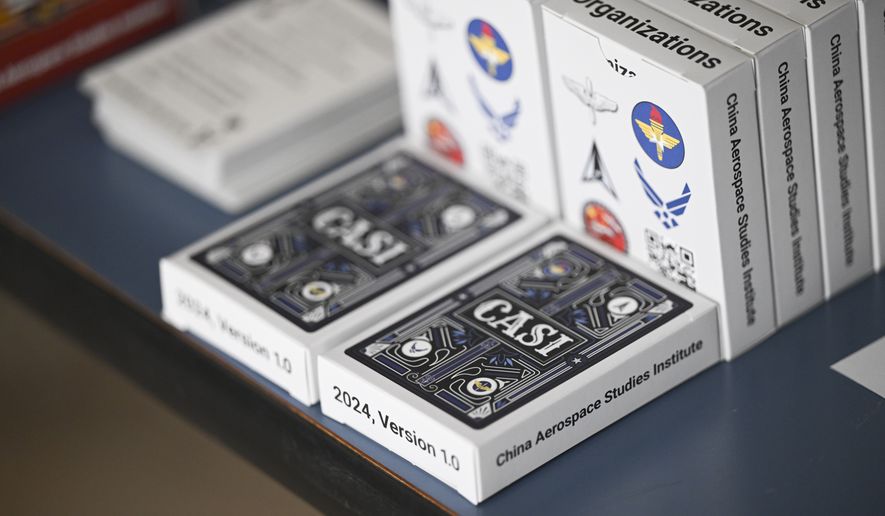
The Air Force is closing down a strategic think tank that produces detailed, open-source reports on Chinese military air, space and cyber warfare capabilities, according to the service branch.
The China Aerospace Studies Institute (CASI), located at the Air University in Maxwell Air Force Base, Alabama, will lose funding for its civilian workforce, Air Force spokeswoman Ann Stefanek said.
The action is part of an “ongoing civilian restructure within Air Education and Training Command,” she said in an email.
People were interested in these podcasts
Employees of the institute were notified Friday that all civilian positions are being defunded, eventually shutting down its operations.
The action comes days before Chinese President Xi Jinping arrives in Washington for a summit with President Trump, and appears to be the latest step in the Pentagon’s efforts to soften its public posture toward the Chinese military and Chinese Communist Party under a new detente policy with Beijing.
The Trump administration is holding up a $14 billion arms package to Taiwan as part of that policy, which has also included increased U.S. military engagement with China’s People’s Liberation Army.
China and the United States are expected to announce greater efforts to build closer military-to-military relations at the summit, such as increased crisis communications, according to published reports.
Ms. Stefanek said the “CASI mission continues, with the organization leveraging assigned military service members to accomplish its objectives.”
Civilian employees will continue in current posts until further notice and will be evaluated for reassignment, she said.
The institute said in a statement it is disappointed by the closing but will continue operating for a time.
“We will continue to publish articles and reports; we have plenty in the queue,” the statement said, noting its researchers will seek work elsewhere. “Unfortunately, it does mean that we will have to cancel the plans for the 10th anniversary CASI event that was scheduled for next February.”
But Brendan S. Mulvaney, the CASI director, said the action effectively guts the institute since only two master sergeants and a vacant lieutenant colonel position will remain authorized.
“So technically CASI will still exist, just without the researchers or the director,” he said.
Under federal rules, civilians at the institute will be designated “surplus” employees with pay and will still be coming to work, Mr. Mulvaney said, a status that can last for weeks, months or years.
“However, the Air Force is now actively going to try to move people to other billets, eventually may RIF us,” Mr. Mulvaney said using the acronym for “reduction in force.”
“So we aren’t just ceasing all operations on October 1, we will continue” at least through March, he said.
Two similar military think tanks will continue operating, the Navy’s China Maritime Studies Institute and the Army’s China Landpower Studies Center.
Since 2017, CASI has produced a range of reports on topics that include China’s nuclear command and control, hypersonic missiles, drone weapons, space warfare plans, and the U.S.-China battle over military use of artificial intelligence.
In August, the institute reported that hundreds of U.S. and allied companies and universities collaborated with Chinese defense institutes that are developing advanced military capabilities for Beijing’s armed forces.
A March report by CASI revealed publicly for the first time that China’s Rocket Force stores and maintains a rapidly expanding arsenal of nuclear warheads for missiles at mountain facilities in China that are vulnerable to strikes or disruption by the U.S. military.
That report, based on public information on one of China’s most important strategic secrets, revealed new details on how the PLA stores, tests, guards and transports strategic and tactical warheads from a central facility located in the Qinling Mountains, 1,200 miles southwest of Beijing.
Steve Smith, CASI director of warfighter engagement, said in a social media post that the institute is “a national security gem.”
“Our superb researchers help enhance DoD-wide awareness of PRC, PLA and PRC aerospace issues in a manner consistent with our core mission directive of ’raising the China IQ’ of the Department of the Air Force,” Mr. Smith said.
“I can tell you that the department-wide demand signal for CASI support is stronger than ever and growing further with each new engagement.”
Mr. Smith said employees received no information on why the institute was defunded. He noted “with some irony” that the defunding occurs Oct. 1 — the anniversary of the founding of communist China.
A Pentagon spokeswoman declined to comment on the think tank closure.
Will Yale, a Navy officer, first disclosed the closure on X stating, “It is extremely unfortunate and regrettable that the Department of the Air Force has decided to shutter the China Aerospace Studies Institute (CASI).”
“CASI, along with its sister institutions the China Maritime Studies Institute (CMSI), China Landpower Studies Center (CLSC)… and China Warfighting Initiative, are the most prolific producers of publicly accessible open source research about the PLA in the United States,” he said.
In addition to its civilians, one of the institute’s key contractors, BlueBath Labs, also will be impacted.
The institute was chartered in June 2021 as “a key enabler” of improving the Air Force’s ability to successfully compete with China.
“CASI serves as the Department of Air Force’s premier center for the study of China and its aerospace capabilities,” the charter states.
The institute conducts translations of Chinese military air, space, cyber and missile writings and analyzes key developments.
Critics said the closing of CASI will sharply curtail public information on China’s growing aerospace military power.
Retired Navy Capt. Jim Fanell, a former Pacific Fleet intelligence chief, said defunding the institute is a grave error and strongly urged the Pentagon to reverse the decision and restore funding.
“CASI established its bona fides from its inception in 2017 and has for the past nine years provided invaluable and unique analysis of Chinese open-source literature regarding the PLA air and space forces doctrine, tactics, techniques, and procedures,” he said.
Military employees that remain at the institute will need civilian researchers who can read and understand PLA writings, he said.
“For CASI, this means that the USAF and the nation will lose a very valuable resource for understanding [the Chinese air force],” he said.
Capt. Fanell said he finds it hard to believe that funding the few billets at CASI could not have been achieved by cutting diversity, equity and inclusion programs in the military.
CASI positions “punch way above their weight and are a great return on investment, if looked at from purely an economic lens,” he said.
Contact the author

Please read our comment policy before commenting.