


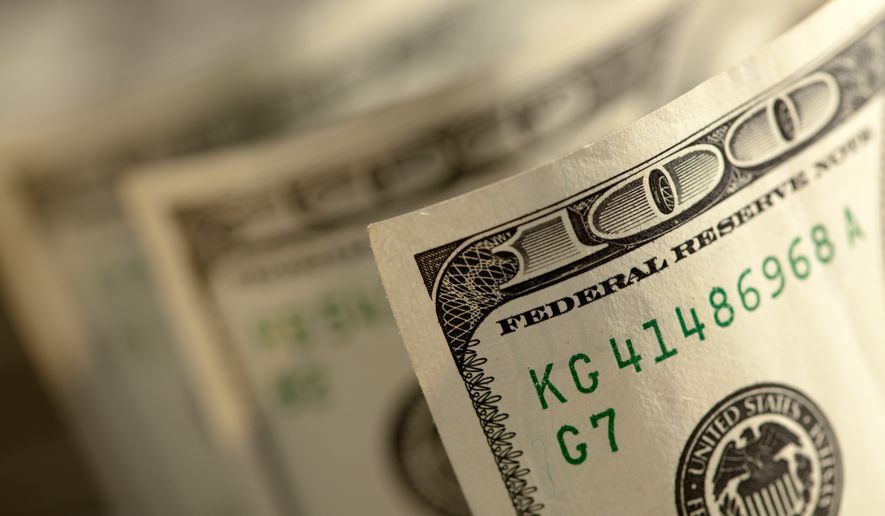

The dollar is winning, despite its detractors.
The international push for an alternative to the dollar as the global reserve currency — led by U.S. adversaries chafing under Washington sanctions and backed by emerging economic rivals worried about American debt — has stalled after a series of recent setbacks, including Sunday’s presidential vote in Brazil.
Brazilian President Luiz Inacio Lula, whose leftist government backs the de-dollarization movement as a member of the BRICS coalition — an acronym for founding members Brazil, Russia, India, China and South Africa — advanced to an Oct. 25 runoff, but he faces an uphill battle against challenger Flavio Bolsonaro, a conservative, pro-America candidate who counts U.S. President Trump among his supporters.
People were interested in these podcasts
The Brazilian election comes just weeks after September’s BRICS summit in New Delhi, where loosening the dollar’s grip on the world’s financial system was a top agenda item. But the loosely connected coalition, bound by little more than a shared frustration with Washington, produced only rhetoric.
The latest developments have unfolded against the backdrop of eight months of a costly, destabilizing Middle East conflict that some analysts predicted would accelerate the BRICS-led move away from the dollar. Instead, the U.S. war with Iran has fueled a geopolitical flight of international capital to safe havens. And despite all the carping and complaining, there is nothing that offers the safety, transparency and liquidity of the dollar.
“Washington has won the dollar fight” for now, said Amara Konneh, a senator in the African nation of Liberia and a former finance minister who spoke to The Washington Times about the dollar’s international standing.
“The first day I sit in the president’s chair, I will reassess whether Brazil should stay in a bloc that is very ideological, used to provoke the United States,” Mr. Bolsonaro said on a podcast in June. He has also opposed efforts to reduce Brazil’s dependence on the dollar. Brazil’s currency jumped more than 4% against the dollar Monday as investors bet on a Bolsonaro win.
BRICS’s developing economies have talked for years about replacing the dollar, at least in trading among themselves, with the currencies of the various members, but the Sept. 12-13 summit in New Delhi produced no common currency, no joint payment system and no timetable. President Trump has threatened tariffs of up to 100% on members that back a rival currency.
The stakes reach American borrowers. Worldwide demand for dollars helps hold down U.S. interest rates, which feed into mortgage and car-loan costs, and lets Washington cut off foreign banks that deal with Iran or Russia.
That leverage exists because the dollar remains deeply entrenched as the foundation of global finance, accounting for roughly 88% of all foreign exchange transactions and 57% of global reserves.
Attempts by BRICS to establish an alternative global currency are severely hindered by internal divisions and economic imbalances. Member states such as India explicitly state they have no policy to replace the dollar, while China refuses to open its capital flows or abandon strict currency controls. Without deep, liquid financial markets, the rule of law, and mutual trust among BRICS nations, a viable competitor remains a distant prospect.
But not every global financial guru thinks the dollar fight is over. Brahma Chellaney, a professor at the Centre for Policy Research in New Delhi, said deals in local currencies and new payment systems “could accelerate the erosion of the dollar’s domination.”
America’s own Warren Buffett warned in 2025 that betting on a U.S. dollar dragged down by unsustainable government borrowing was a risky proposition for investors. “We wouldn’t want to be owning anything that we thought was in a currency that was really going to hell,” he told a meeting of Berkshire Hathaway shareholders.
Pacinte Abdel-Fattah, who heads economics at the Al Habtoor Research Center in Dubai, told The Times she sees a more gradual shift, “from dollar dependence toward dollar optionality.”
But whether the movement is stalled — or just slowed — the next few months are critical for the U.S. dollar.
Finance ministers and central bankers meet in Bangkok next week for the annual meetings of the International Monetary Fund and World Bank.
Then, in January, China — the only BRICS member with the economic weight to build a viable dollar alternative — takes over the bloc’s chairmanship.
“For Beijing, greater monetary and payments autonomy is structural,” said Assaf Orion, who directs the Israel-China Policy Center in Tel Aviv.
Egypt, the most populous Arab country, still needs dollars. President Abdel Fattah el-Sisi has urged members to settle trade in their own currencies, and Cairo expanded a currency swap with China to about $4.4 billion in June.
But Egypt bought $30.1 billion from BRICS members in the first half of the year and sold them $6.6 billion, according to the official statistics agency. China alone sold Egypt $10.4 billion in goods. Most of the gap is paid in dollars.
Egypt controls the Suez Canal and receives $1.3 billion a year in U.S. military aid. Secretary of State Marco Rubio asked Congress on Friday to release about $320 million of that aid, withheld over human rights. Egypt’s food, fuel and debt are paid largely in dollars, through American banks.
The central bank reported record reserves of $57.2 billion at the end of August, but nearly all the gain came from gold. Its foreign-currency holdings fell by about $1.2 billion. The pound has slid past 51 to the dollar.
Egypt is the world’s largest wheat importer, and its rising purchases of U.S. corn are priced, financed and settled in dollars.
“Grain imports still clear in dollars because global benchmarks, liquidity and hedging instruments remain dollar-based,” Mohamed Abdelaziem Elchime, a professor of political science and international relations in Cairo, told The Times.
Nigeria, Africa’s most populous country, is hedging. It took a lesser “partner” status in BRICS in January 2025 and has stayed there. Foreign Minister Yusuf Tuggar says Nigeria will consider joining fully “at the right time.”
Mr. Konneh, who ran Liberia’s finances from 2012 to 2016, said central banks across Africa will stay with the dollar “not out of ideology, but out of pragmatism.”
Liberia, founded in the 1820s as a settlement for free and formerly enslaved Black Americans, keeps both U.S. and Liberian dollars as legal tender.
“Our largest imports, rice, fuel, medicines, are all priced in U.S. dollars and our citizens save in U.S. dollars,” he said. “When we borrow, we borrow in U.S. dollars.”
Central banks worldwide held 56.7% of their reserves in dollars at the end of June, against 2.1% in China’s yuan, according to IMF figures released last week.
Liberia, which is not a BRICS member, was among the African countries that regained duty-free access to the U.S. market in July, a step Mr. Konneh called important “for jobs and for our efforts to move up the value chain.”
“Businesses and families need a currency that keeps its value from morning to evening,” he said.
Please read our comment policy before commenting.