



OPINION:
Addressing Congress nine days after Sept. 11, 2001, President George W. Bush declared: “Our war on terror begins with al Qaeda, but it does not end there.” He added, “It will not end until every terrorist group of global reach has been found, stopped and defeated.”
A dozen years later, President Obama announced that what had become known as the global war on terror, “like all wars, must end. That’s what history advises.”
History does not actually advise, though it can reveal patterns — and Mr. Obama drew the wrong one. Wars against an enemy driven by an ideology of conquest rarely end until that enemy is decisively defeated or abandons its demands.
People were interested in these podcasts
Since 2001, some Islamist terrorist organizations have been diminished by the U.S. and its partners, but not one has surrendered. Nor has any forsworn what its adherents call the jihad — the holy war that began in the seventh century and for more than a millennium drove the expansion of vast empires.
As for Iran — long described by the State Department as the world’s leading state sponsor of terrorism — it too is committed to jihad. Only three years ago, Ayatollah Ali Khamenei said plainly that “Death to America!” should be understood as “not just a slogan — it is a policy.”
Khamenei’s challenge was to develop the capabilities necessary to implement that policy. If you understand that, you grasp why President Trump, unlike his predecessors, took concrete steps to end Tehran’s nuclear weapons development.
The U.S. military and Treasury Department have been depriving Iran’s rulers of the oil revenue they need to rebuild a missile arsenal that would shield their nuclear weapons program, support their foreign terrorist proxies and use the Strait of Hormuz to hold the global economy hostage.
Meanwhile, more good news: Within a few days of one another, three attempted terrorist attacks — one in the Middle East, one in Europe and one in America — were foiled.
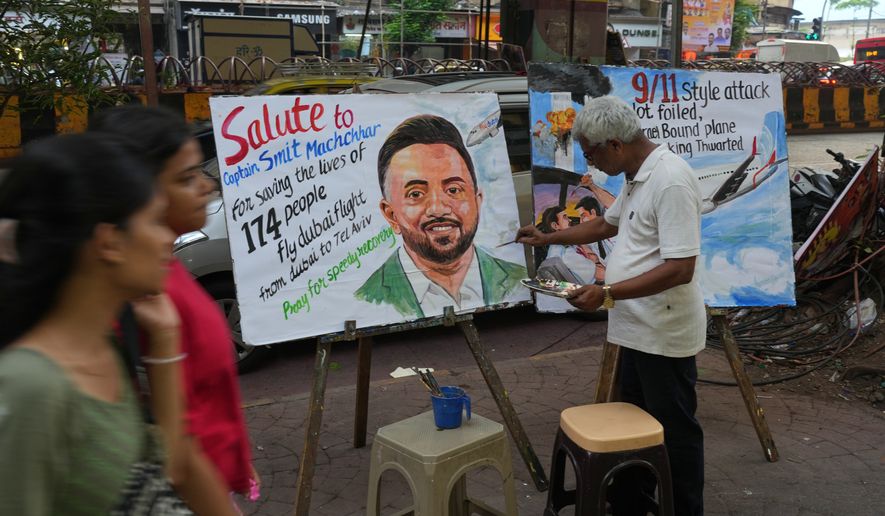
The most dramatic was Sept. 30 — perhaps not just coincidentally between the 25th anniversary of Sept. 11 and the third anniversary of Oct. 7 — when FlyDubai Flight 1073, en route to Tel Aviv from Dubai with 174 passengers, approximately 166 of them Israelis, became the scene of an attempted hijacking.
The Omani co-pilot, identified as Hamam al-Hammami, attacked and severely wounded the Indian captain, Smit Machchhar, with the aircraft’s crash ax and tried to crash the plane.
The Boeing 737 plunged some 17,000 feet in less than a minute. Mr. Machchhar later told Indian Prime Minister Narendra Modi: “When I was lying on the floor, I could feel that the aircraft was plunging, and I said to myself, while I was getting beaten, ’This is the last push, Smit, do it, the door is right there.’”
Yaniv Hayun, an Israeli plumber, put the co-pilot in a chokehold and pulled him away from the flight controls. Mr. Hayun then pulled back on the yoke to level the aircraft — a maneuver he credited to watching the documentary series “Air Crash Investigation.”
An Israeli dentist, Shota Musayev, tended to the captain’s injuries while two off-duty FlyDubai pilots traveling as passengers took the controls and landed safely at Tabuk in northwestern Saudi Arabia.
According to Israeli reports, the co-pilot told interrogators that he intended to fly a normal approach to Ben Gurion Airport and then, too late for interception, crash into the airport, killing everyone aboard and untold numbers on the ground.
On Saturday, the United Arab Emirates’ attorney general said the co-pilot “attempted to carry out a terrorist act.” Israeli Prime Minister Benjamin Netanyahu said Mr. Machchhar “managed to prevent a 9/11 disaster.”
A second apparent terrorist attack was thwarted early on Sept. 27. A farmer near Royal Air Force Fairford, the British base in Gloucestershire used by American bombers in the war against Tehran, had the wits to call police after spotting three vans and masked men nearby.
Police arrested five men in their 20s on suspicion of terrorist crimes. British Prime Minister Andy Burnham cited “strong indications” of Iranian involvement.
On Thursday, counterterrorism police arrested a British-Iranian dual national in Westminster on suspicion of preparing terrorist acts. All six are now out on bail. On Tuesday, police arrested a seventh suspect.
On Sunday, the U.S. withdrew its B-1 bombers from the base. According to U.S. and British officials, Iran’s Islamic Revolutionary Guard Corps had ordered a potential drone attack aimed at destroying aircraft and killing American personnel.
Nearly 5,000 miles away on Sept. 30, Texas Department of Public Safety agents arrested 40-year-old Benny Caldera Jr. at his home near San Antonio. Court documents reveal that he told a friend he was going to the Texas State Capitol in Austin, “and I am going to shoot it up.”
Mr. Caldera reportedly said he was angry at the American Israel Public Affairs Committee, which describes its mission as strengthening the U.S.-Israel relationship. He added, “These people have to be exterminated.”
His friend alerted authorities. Mr. Caldera now faces state and federal charges.
Note that the bulk of the credit for foiling these three attacks goes not to politicians, law enforcement officers or intelligence analysts, but to ordinary citizens — among them a plumber, a dentist, a farmer, a friend who refused to look away and, of course, a bleeding pilot who heroically found the strength his passengers needed.
Mr. Obama, wars do not end because we want them to or because someone in the White House issues a declaration based on anthropomorphizing history.
Wars end only if free people have the courage and will to stand up to their enemies and do what is necessary, for as long as it takes, to decisively defeat them.
• Clifford D. May is founder and president of the Foundation for Defense of Democracies, a columnist for The Washington Times and host of the “Foreign Podicy” podcast.
Follow the author
Please read our comment policy before commenting.