


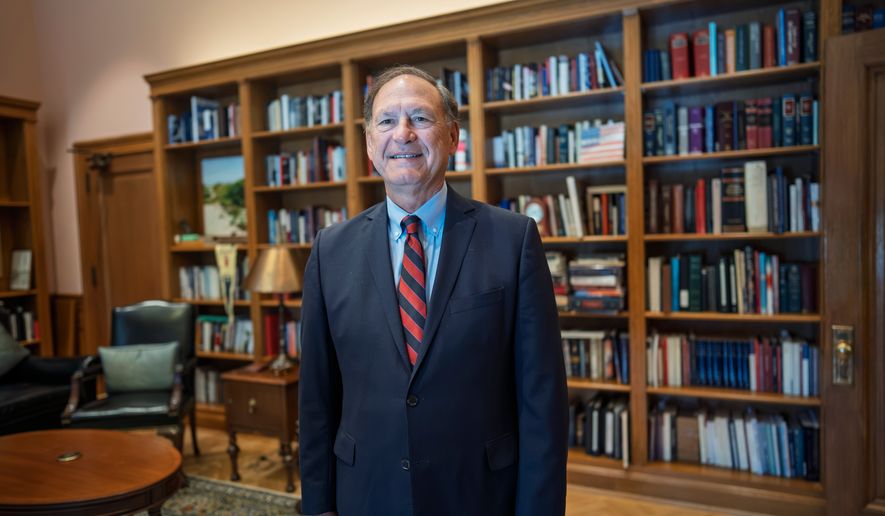

Justice Samuel A. Alito Jr. said lower courts “haven’t gotten the message” about the Supreme Court’s rulings on affirmative action and, to some extent, guns.
In a wide-ranging interview with The Washington Times this week, he also said the Obergefell decision, which established a national constitutional right to same-sex marriage, was among the “toughest” precedents set during his two-decade tenure. He added, however, that he did not want to hint that it should be overruled. He made the comments ahead of Tuesday’s release of his book, “So Ordered: An Originalist’s View of the Constitution, the Court and Our Country,” published by Basic Books.
The volume, which collects and refashions speeches he has given over the years, tracks the emergence of originalist judicial philosophy and defends it against other approaches to judging.
People were interested in these podcasts
Justice Alito was forthcoming in his answers to questions.
Asked which Supreme Court rulings are meeting resistance from the lower courts, he named a pair of 2023 cases that struck down affirmative action and race-based preferences in schools.
“I don’t think they’ve gotten the message on Students for Fair Admissions,” he said, referring to the Supreme Court’s ruling in favor of plaintiffs who challenged race-based policies at Harvard University and the University of North Carolina as elevating Black and Hispanic applicants over Asian American applicants.
SEE ALSO: Justice Alito: Supreme Court isn’t using AI
The justices, in a 6-3 ruling, struck down race-based policies.
Justice Alito pointed to follow-up cases in which residents challenged policies at Thomas Jefferson High School for Science and Technology in Northern Virginia and at a set of selective high schools in Boston.
“In both the Thomas Jefferson case, the TJ case, and the Boston case, the rules were changed, and it was incredibly obvious, absolutely plain, well, there was very strong evidence this was done to bring down the percentage of Asian American students at that school,” Justice Alito said.
In Boston, the head of the school committee resigned after being caught on a hot mic mocking Asian American residents’ names as they queued up to testify on the admissions policy.
Justice Alito said the cases showed signs of “discriminatory animus” toward Asian Americans, but lower courts upheld the policies.
In 2024, the Supreme Court declined to hear both cases, which he characterized as a missed opportunity.
Justice Alito criticized the “tendency to divide us up into tribes, races [and] ethnicities.”
He said it “would be quite destructive in a society that is as diverse as we are.”
“They’ll all elbow each other trying to get ahead,” he said, though he sounded an optimistic note, saying the number of people listing multiple races and ethnicities could solve the matter.
“I think demographics would eventually dissolve it,” he said.
Justice Alito said guns are another area where lower-court judges, “to a degree,” have not understood the high court’s direction, though he acknowledged some legitimately thorny issues in Second Amendment law.
“There’s some hard questions,” he said.
Same-sex marriage and abortion
Justice Alito said the 2015 decision, in which the high court established a national right to same-sex marriage, would be “a good candidate for the toughest” precedent issued during his 20 years on the high court.
“No one in 1868 thought that the interest that is protected by the 14th Amendment included the liberty to marry a person of the same sex. It was absolutely unheard of,” he said.
He also made clear that he is not necessarily agitating for it to be overturned.
“I don’t want to even hint that it should be overruled since a lot has happened since we adopted it,” he said.
That is also true for other thorny legal issues, which have had follow-up cases over time.
Justice Alito called two earlier affirmative action rulings, where the court upheld race-based policies in 2013 and 2016, “big disappointments,” but he said those were corrected when “we did the right thing in Students for Fair Admissions.”
Justice Alito wrote the majority opinion in the Dobbs case, the ruling overturning Roe, the 1973 decision that had established a national right to abortion, mostly unfettered through the first two trimesters.
In Dobbs, the conservative majority on the high court returned the issue of abortion to the states and Congress to be regulated as each saw fit, and since that decision, some states have nearly outlawed the procedure altogether.
Chief Justice John G. Roberts Jr. concurred in the judgment but did not join the majority opinion overturning Roe, saying he would have upheld Mississippi’s law that cut into that two-trimester period without overturning Roe itself.
The chief justice has said he adheres to an approach whereby, unless a judge must confront an issue in a ruling, he should not do so.
Justice Alito said there are times when a narrow ruling is correct, but other times when going broader is the right answer — particularly when the justices believe lower courts will need certainty.
He said the Dobbs case was one of those.
“Had we simply said that the number of weeks that was specified by Mississippi is OK, that would not have settled it — we would have gotten rid of that case, but very predictably you’re going to have a law from another state that’s a week less, a week less, a week less,” he said.
“At some point, unless you’re going to go all the way that we went in Dobbs, at some point you’re going to have to say, ’This is where the line is drawn.’ And then you’re going to have to explain why the line is drawn in that particular place,” Justice Alito said.
“Dobbs itself was hard enough,” he said.
After a draft of his Dobbs opinion leaked and was published by Politico, threats poured in. When asked whether it was difficult to hold the five-justice majority together during that pressure period, Justice Alito answered by pointing to the leaked draft and the final opinion.
“There were very few changes,” he said.
Capital punishment
Justice Alito declined to reveal his thoughts on the botched execution in Tennessee that made national headlines on Sept. 30 and what should happen next with Christa Pike, the woman who survived it.
“I think I should not address it because it’s an issue that could come up,” he said.
The court had been involved in the case on the execution day, lifting a lower court stay and allowing the state to move forward in its attempt to put Pike to death for a 1995 murder.
Pike survived the administration of two doses of pentobarbital but fell unconscious. Days after the attempt, Pike was still unconscious and on a ventilator at a hospital. On Tuesday, she was awake and speaking. Questions about her future abound.
The governor has suspended executions for now, and the state has not said what it would do in Pike’s case.
Justice Alito did say courts have grappled with cases involving the drugs used for executions and upheld those protocols.
In 2008, the court, in a 7-2 decision, upheld the use of a three-drug protocol, rejecting complaints that potential pain from the administration of the drugs violated the Eighth Amendment. In a 2015 case, the court, in a 5-4 ruling, said that states that allow the death penalty must provide a legal method, so challengers to a particular protocol must suggest a viable alternative.
“There have been many executions using the three-drug protocol, and after many of them, we have heard nothing. There has not been media reports, that I am aware of, of anything untoward and unexpected — perhaps a better word — that happened during the execution,” he said.
Contact the author


Please read our comment policy before commenting.