



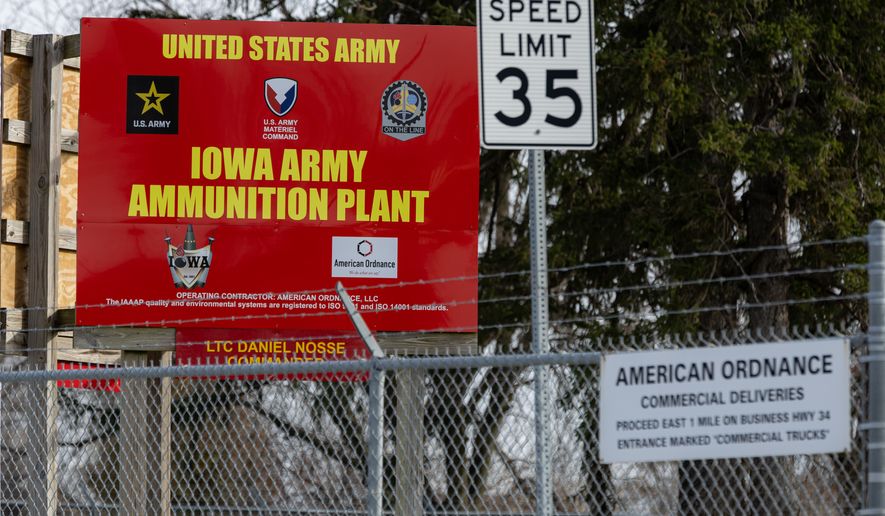
The Army on Wednesday triggered a pair of controlled detonations of degraded lead azide at the Iowa Army Ammunition Plant in Middletown, Iowa.
Officials had said the detonation of about 10,000 pounds of the explosive material, stored in 68 drums in a pair of ammunition bunkers, was expected to produce a dust plume containing lead particles that may travel beyond the Army post and settle on surrounding surfaces.
“The Army’s controlled, mitigated detonation exceeded all expectations and was a huge success. The threat of an uncontrolled spontaneous detonation has been eliminated,” acting Army Secretary Adam Telle said in a statement.
People were interested in these podcasts
The twin blasts sent white and gray smoke rising into the area. Reporters at the scene said the explosions could be heard from miles away. Video showed the plume drifting toward the south before dissipating.
“Early reports from Iowa are that the Army’s mitigation efforts have far exceeded expectations,” President Trump said on social media after the detonation.
Army officials estimated that no more than a quarter of the dangerous material would likely escape their extensive remediation efforts.
The detonation was intended to eliminate the risk of an uncontrolled explosion caused by approaching winter temperatures or attempts to open the containers to chemically neutralize the material.
Lead azide is used primarily as an initiating explosive in detonators to set off less-sensitive main explosives. It is used in small amounts to trigger larger charges because it is highly sensitive to shock, friction, and temperature variables, officials said.
The Environmental Protection Agency on Wednesday said it had already collected more than 1,200 air, land and water samples ahead of the controlled demolition. The agency deployed at least 300 staffers and contractors across the region to conduct post-demolition sampling and remediation.
“Before, during, and after detonation, EPA is fully tackling our sampling and monitoring mission on behalf of all local families and communities,” EPA Administrator Lee Zeldin said in a statement. “To whatever extent necessary, we are just as prepared to jump on any environmental remediation work as well.”
After the twin detonations, Mr. Telle said Army officials were closely monitoring the EPA’s extensive array of sensors in the area to determine if the smoke plume coming from the blast site contained lead azide.
“There are no readings so far above 0.0,” he said.
On Tuesday, the Army said that the 68 barrels stored in the ammunition bunkers in Iowa represented the nation’s entire military stockpile of bulk lead azide. The U.S. consolidated its remaining reserve at the Iowa Army Ammunition Plant in 2009.
• This is a developing story. Check back for updates.
Contact the author

Please read our comment policy before commenting.