



OPINION:
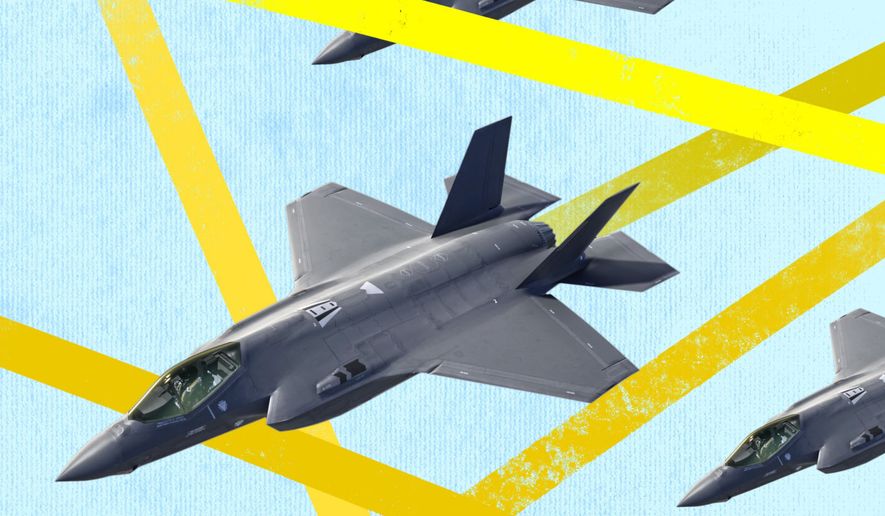
This column has written about the F-35 on several occasions, including on this page on July 9, 2015. None of these discussions has been flattering to the aircraft.
Begun as the “Joint Strike Fighter,” the aircraft evolved into three versions: the A model for the U.S. Air Force, the B model for the Marines and the C model for the U.S. Navy. Each is vastly different from the others and had its own problems in development.
People were interested in these podcasts
The U.S. plans to buy about 1,560 over 10 years. The U.S. has already bought about 700 of them, not including those that we have sold to allies.
It is probably the worst decision that has ever been made on a combat aircraft.
The F-35 is the most expensive defense project ever. The total cost is projected to exceed $536 billion, and the aircraft’s life-cycle cost is about $2 trillion.
The F-35I — the Israeli version — has flown successfully against Iranian air defenses. Its stealth design and radar-absorbing skin are a vast help toward evading radar detection. Still, it can evade radar only at subsonic speeds.
The Defense Department has different categories of problems in its aircraft; the most serious are labeled “Category 1.” Having passed over other “Cat 1” problems, the F-35 now reportedly has another that should take it out of consideration for combat.
The new “Cat 1” problem is that its speed is limited because its skin melts or burns at speeds above Mach 1, the speed of sound.
According to Defense News, the problem is not new: It dates back to 2019. It has not been solved, but the Pentagon considers the issue closed. “To cut down the risk of damage to the jet, the Pentagon imposed time limits on how long F-35B and F-35C pilots can spend at supersonic speeds in full afterburner. An F-35C can only fly at Mach 1.3 in afterburner for 50 cumulative seconds, meaning that a pilot cannot clock 50 seconds at that speed, slow down for a couple seconds and then speed back up. The F-35B can fly for 80 cumulative seconds at Mach 1.2 or for 40 seconds at Mach 1.3 without risking damage.”
Why is it all that important? Because, in combat, pilots will do anything, including violating the speed limits, to get into or out of trouble. It also seems that supersonic intercepts — F-35s flying against other nations’ fighters — are impossible. The F-35 is not, as some have advocated, a solution to all the services’ problems.
The old F-22, of 1980s vintage, is still king of the skies. It is capable of supersonic cruise, meaning it can fly at supersonic speeds without afterburner. Still, much of the F-22’s core architecture is aging. Its onboard computers are old technology, but it is still the only aircraft we have capable of supersonic intercepts. Former Defense Secretary Robert Gates stopped production of the F-22 at fewer than 200 aircraft.
So what do we get for the pricey F-35?
The F-35 costs $92 million to $121 million to build. It costs about $42,000 per hour to fly. The F-22 costs about $42,000 to $57,000 per hour to fly. The F-22’s radar-absorbing skin also suffers from degradation, but not to a degree that limits the aircraft’s functionality.
To sum up the F-35’s problems: It is not capable of supersonic speeds beyond its time limits. Our pilots cannot be saddled with speed limits in defense of Taiwan or in any similar scenario. The F-35 can fly successfully only against Iran or any other nation that has little in the way of defenses.
Congress will be too busy impeaching President Trump and Defense Secretary Pete Hegseth to deal with the F-35. Still, we must stop procuring these aircraft and instead invest in our sixth-generation fighter, the Next Generation Air Dominance aircraft. We need it vastly more than the F-35.
To fly and fight in this century, we need more — and better — aircraft to do the job. The F-35 was intended as a supersonic fighter to fill the gap between the F-22 and the NGAD. It is not capable of doing that. It was intended to be a strike fighter, and in this, it is failing in its purpose.
Speed limits on the F-35 may prove fatal to the pilots who are flying it. Congress must not allow that. The fate of the F-35 will prove which party, if either, is serious about our air capabilities.
• Jed Babbin is a national security and foreign affairs columnist for The Washington Times and a contributing editor for The American Spectator.
Follow the author

Please read our comment policy before commenting.