


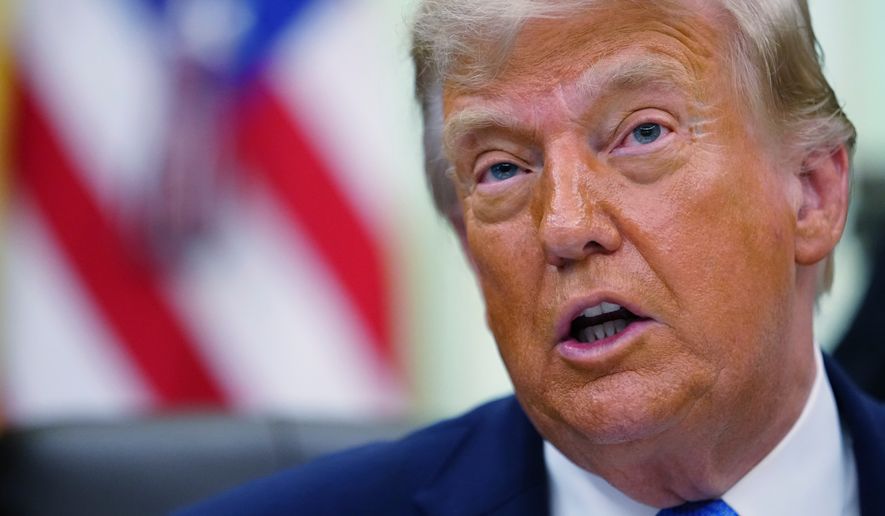

President Trump on Thursday abruptly canceled planned strikes against Iran, citing a breakthrough in peace talks and the planned signing of a deal to wind down hostilities.
The decision was a major reversal from Mr. Trump’s morning vow to pummel Iran and take its oil.
“Based on the fact that discussions with the Islamic Republic of Iran have been brought to the highest level of Iranian leadership and approved, I have, as President of the United States of America, canceled the scheduled strikes and bombings against Iran this evening,” Mr. Trump wrote.
People were interested in these podcasts
He said numerous countries, including the U.S., Israel, Saudi Arabia, the United Arab Emirates, Qatar, Turkey, Pakistan, Bahrain, Kuwait, Jordan and Egypt, reviewed points in the emerging deal.
The Islamic Revolutionary Guard Corps-affiliated Fars News Agency reported that it had not approved any initial memorandum of understanding sent by Washington.
However, Mr. Trump said he believed that Supreme Leader Mojtaba Khamenei had signed off on the pact.
SEE ALSO: The oils of war: Trump plans to seize Iran’s oil — Venezuela-style
Mr. Trump said the reason for Iran’s agreement to a deal was clear: “They’ve taken a pounding.”
“It should get done over the next few days, probably have a signing over in Europe,” Mr. Trump said in the Oval Office.
He said he would not attend, but top lieutenants would be on hand.
He said the Strait of Hormuz would open immediately, bringing down oil prices. Stocks surged on the news of a pending deal.
“When oil comes down, everything else comes down,” the president said. “Most importantly, we have a deal that Iran will never have a nuclear weapon. The documents are [in] pretty final shape, so we’ll see, we’ll see.”
The president said he would maintain a blockade of Iran’s ports until a deal is signed.
The signing of a pact to lift the American blockade and reopen the Strait of Hormuz would be a breakthrough in the 3½-month-old conflict and set the table for thorny talks over stopping Iran’s nuclear program.
Mr. Trump called the draft document a “very strong memorandum of understanding” that is “very detailed” and will prevent Iran from developing a nuclear weapon or buying one. He said a final deal settling all matters with Iran would follow quickly.
The U.S. and Iran have been close to a deal before, only for it to fall apart.
Mr. Trump’s post suggested a higher level of confidence than in previous rounds and followed his threat to ramp up the war if Tehran did not get serious about talks.
Earlier Thursday, Tehran residents fled the city as the last gasp of the April ceasefire seemed to disintegrate and both sides of the conflict braced for a third day of missile fire. Mr. Trump openly debated the merits of his plan to attack the Kharg Island oil depot, which is central to Iran’s economy.
Suddenly, the planned strikes were off, with Mr. Trump hailing progress in talks with senior Iranian leaders.
A delegation from Qatar arrived in Iran on Wednesday to facilitate further peace negotiations with the U.S.
Pakistani and Qatari officials have mediated indirect talks between the U.S. and Iran for weeks, ferrying various proposals for a “memorandum of understanding” that could set the stage for more in-depth conversations about Tehran’s nuclear program.
The president did not offer details of the emerging pact or how it was reached, and the decision will likely be met with skepticism after weeks of close calls.
Social media was abuzz with claims Mr. Trump was seized by “TACO Thursday,” using an acronym for “Trump Always Chickens Out.”
Some Republicans have urged Mr. Trump to finish off the Iranian regime with renewed military action, likening Tehran’s negotiating style to Lucy holding the football for Charlie Brown and pulling it away at the last moment.
Days ago, Mr. Trump said he hoped for a peace deal within days. Instead, the ceasefire all but disintegrated as Iran downed an American Apache helicopter and the U.S. lobbed retaliatory strikes on southern Iran.
Sen. Lindsey Graham, South Carolina Republican and a national security hawk, said he hopes the diplomatic solution meets Mr. Trump’s red lines and improves on President Obama’s nuclear deal.
“As in the past, any agreement reached with Iran related to their nuclear program will be presented to Congress for review and approval,” Mr. Graham said on social media. “I look forward to that process.”
U.S. Central Command launched what it termed “self-defense strikes” just after midnight Wednesday, targeting the cities of Bandar Abbas, Minab and Sirik. Bombing was also reported near Qeshm Island in the Strait of Hormuz.
U.S. strikes reportedly targeted military barracks and a manufacturing complex used by Iran’s Islamic Revolutionary Guard Corps near Tehran. Iranian state media also reported the bombing of an air base in Bandar Abbas and the city of Sirik, which hosts a naval base.
Iran retaliated just hours later, aiming at U.S. military installations in Bahrain and Kuwait. Iran’s Islamic Revolutionary Guard Corps said the strikes targeted Sheikh Isa Air Base in Bahrain and the Ali Al-Salem and Ahmad Al-Jaber air bases in Kuwait.
Mr. Trump said “very hard” airstrikes would continue for a third day, prompting a defiant response from top Iranian officials.
“Wrong strategies and impulsive decisions will reset the entire board for the worse, explode energy infrastructure and markets, and create an endless quagmire that you will be stuck in for years,” Mohammad Bagher Ghalibaf, speaker of Iran’s Islamic Consultative Assembly, said on social media. “You will see a different Iran.”
The president backtracked later in the day, claiming diplomatic progress soon after he outlined a risky plan to seize Iran’s oil and gas industry.
Mr. Trump’s plan would have replicated the playbook he ran in oil-rich Venezuela.
“At some point in the not too distant future, we will be taking Kharg Island, and other oil infrastructure points, and assume total control of their Oil and Gas Markets, much like we have with Venezuela, which is working out brilliantly for both Venezuela and the United States of America,” he said on social media.
Mr. Trump was referring to the U.S. raid that captured Venezuelan strongman Nicolas Maduro to face American drug charges in New York. The U.S. is working with the interim government in Caracas to sell oil that enriches both nations.
However, Mr. Trump’s threat to impose a similar model would face stiff resistance from Iran, a much larger country with a long track record of defiance of the West.
Kharg Island is a vital oil storage depot for Iran in the Persian Gulf. It has a capacity of 30 million barrels of oil.
It is unclear how many barrels are stored on the island, though mid-March estimates put the number at 18 million.
Yet Mr. Trump appeared to debate the Kharg Island maneuver in his comments to Fox News.
“I don’t know that America has the stomach for it,” he said. “I think they’d like to see us come home. But we did it with Venezuela. Venezuela’s worked out great for everybody.”
Mr. Trump also said he could knock out the Iranian regime easily.
“They’re finished,” he said. “I don’t want to have boots on the ground. But if I wanted to, we could [send] a small group of soldiers and take over the whole place.”
Mr. Trump faces pressure to wind down the war before the midterm elections and to ease oil shocks that have driven up U.S. gas prices.
The U.S. average price of a gallon of gas stood at $4.13 on Thursday, down from $4.52 a month ago but up 39% from when the war started, according to AAA.
Democrats said Mr. Trump erred by launching the war on Feb. 28, alongside Israel, because Iran knows it can use the Strait of Hormuz as leverage.
“This war hasn’t strengthened America’s national security; it’s weakened it,” said House Minority Leader Hakeem Jeffries, New York Democrat. “Iran is stronger now, and everyone in the world knows it.”
Contact the author


Please read our comment policy before commenting.