


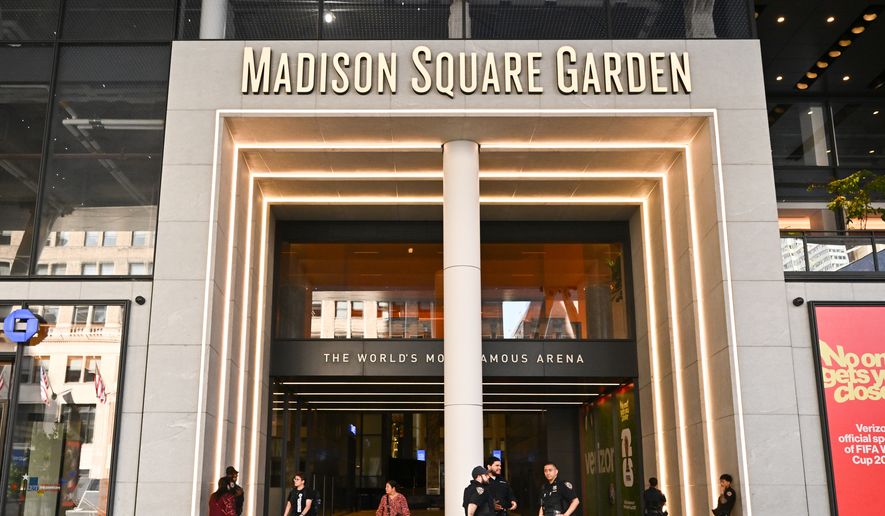

Three Madison Square Garden corporate entities filed a defamation lawsuit Thursday against Wired, its corporate owner Advance Publications and three of the magazine’s journalists, accusing the outlet of twisting hacked customer data into a false narrative that the company tracked and discriminated against LGBTQIA celebrities.
The companies electronically submitted the complaint Thursday in New York Supreme Court in Manhattan. The plaintiffs, Madison Square Garden Entertainment Corp., Madison Square Garden Entertainment Holdings LLC and Madison Square Garden Sports Corp. (the last of which owns the Knicks and Rangers), name Wired publisher Advance Magazine Publishers Inc., Advance Publications Inc., contributing editor Noah Shachtman, reporter Maddy Varner and Global Editorial Director Katie Drummond as defendants. MSG is seeking a jury trial and compensatory, presumed and punitive damages, along with a retraction and correction.
At issue is a July 9 Wired article headlined “Madison Square Garden Kept a List of Gay Celebrities,” which described a talent database of nearly 40,000 records that included risk scores for hundreds of people and sexual-orientation fields for some entries. The story drew on data stolen from MSG’s Salesforce customer relationship platform by ShinyHunters, a hacking group that had attempted to extort the company before publishing the material online after MSG refused to pay.
People were interested in these podcasts
MSG alleges the reporters isolated 93 LGBTQIA-tagged entries, out of roughly 40,000 talent records that also included mundane fields such as dietary restrictions and birthdays, to create the misleading appearance of a discriminatory list. The company contends the orientation field was created in August 2022 for inclusion-oriented purposes, including Pride event invitations and charitable outreach, and that access was tightly restricted to a handful of employees. MSG also points to a statistical gap it says undercuts the story: Only 4% of LGBTQIA-tagged records contained any entry in a separate “Threat Management notes” field, compared with 9% of records tagged “Heterosexual.”
The complaint leans heavily on Mr. Shachtman’s television appearances after publication. According to the document, it was during a July 10 interview on NBC News NOW that he “expressly acknowledged” being told that security risks were kept in a separate database. MSG argues those remarks show Mr. Shachtman understood that security threats were maintained separately but continued to promote what the company considers a misleading connection between the fields. The lawsuit says this was a characterization he repeated that same day on CBS News 24/7 and on WNYC’s “The Brian Lehrer Show,” where he said he was told security threats were kept in “an entirely different database.”
The complaint further alleges Mr. Shachtman used information from a current MSG employee who was bound by confidentiality obligations, forming the basis of a second cause of action for tortious interference alongside the defamation claim.
Wired responded Thursday with a statement defending its reporting and calling the suit “baseless and ridiculous.” The outlet said it stands by the article and looks forward to continuing its coverage of MSG and Executive Chairman James Dolan’s use of technology.
The complaint also cites previous criticism of Mr. Shachtman’s editorial judgment, including accusations that he omitted details, while a Rolling Stone editor, about former ABC producer James Gordon Meek’s connection to a child pornography investigation.
The article prompted quick reaction from public figures, including New York Assemblymember Tony Simone, and was widely amplified on social media, the complaint says. MSG says it intends to seek discovery of Wired’s editorial and source communications, subject to court approval and any privilege claims.
This article was constructed with the assistance of artificial intelligence and published by a member of The Washington Times' AI News Desk team. The contents of this report are based solely on The Washington Times' original reporting, wire services, and/or other sources cited within the report. For more information, please read our AI policy or contact Steve Fink, Director of Artificial Intelligence, at sfink@washingtontimes.com
The Washington Times AI Ethics Newsroom Committee can be reached at aispotlight@washingtontimes.com.
Please read our comment policy before commenting.