



A version of this story appeared in the daily Threat Status newsletter from The Washington Times. Click here to receive Threat Status delivered directly to your inbox each weekday.
Russian President Vladimir Putin agreed Wednesday to restart trilateral negotiations with the U.S. and Ukraine on how to end Moscow’s war with Kyiv.
Yuri Ushakov, foreign policy aide to Mr. Putin, told reporters after a meeting with White House Special Envoy for Peace Missions Steve Witkoff that Mr. Putin had agreed “in principle” to resume talks after Nov. 10.
The talks will center on building a “security system” for Russia and Ukraine after the war concludes.
People were interested in these podcasts
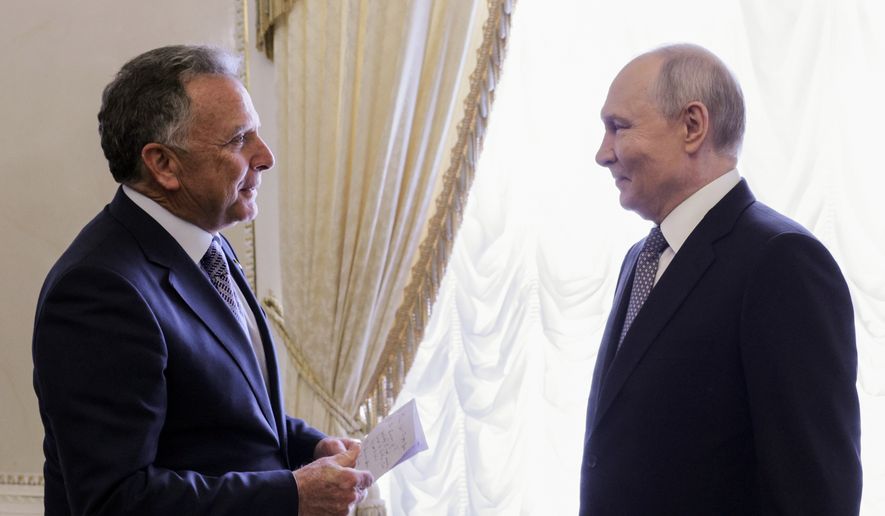
Mr. Witkoff met Wednesday with Mr. Putin, Mr. Ushakov and Russian presidential envoy Kirill Dmitriev for three hours in St. Petersburg to discuss the war and U.S. peace efforts.
Mr. Witkoff said ahead of the meeting that he hoped to press Mr. Putin to consider trilateral peace talks involving the U.S. and Ukraine. He said U.S.-Russian economic cooperation has massive potential after the war concludes.
He thanked Mr. Putin for agreeing to a deal brokered by President Trump to export Russian diesel to the U.S. The agreement has frustrated some U.S. lawmakers and Ukrainian President Volodymyr Zelenskyy, who say it will provide Moscow with billions of dollars to support its war machine.
Immediately after the meeting, Mr. Trump announced that Stephen Hubbard, a retired American teacher detained by Russian forces in eastern Ukraine in April 2022, had been released by Russian authorities.
“The United States, out of respect for President Trump, was not required to give anything in return — an unprecedented situation for Russia,” Mr. Trump said on social media. “There was no ‘swap’ necessary for this release. This major return should have taken place long ago through the Biden Administration, which got nowhere in its negotiations with the Kremlin.”
Without lifting sanctions on Russian fuel, he said, negotiations for Mr. Hubbard’s release would “have come to a complete and total halt.”
Mr. Witkoff praised Mr. Putin as a “humanitarian” after news of Mr. Hubbard’s release, drawing sharp backlash from many pointing to Russia’s human rights record.
Mr. Putin thanked the U.S. ahead of the meeting for its war mediation efforts. He said Russia is prepared to discuss further economic cooperation with the U.S. and assist in mediation efforts with Iran, with which the U.S. has been at war since late February.
Reports suggested that Mr. Putin had floated the idea of trilateral talks, reportedly discussing the idea with Mr. Trump in a phone call this month.
The St. Petersburg meeting is the latest evidence of the Trump administration’s renewed push for a permanent peace agreement between Ukraine and Russia.
Mr. Witkoff met with Mr. Zelenskyy on Tuesday in Oslo, the Norwegian capital, for talks the envoy described as productive. Finnish President Alexander Stubb, who was at the meeting, said the talks made progress toward peace.
Norwegian Prime Minister Jonas Gahr Store said the meeting marked a new phase of diplomacy surrounding the war in Ukraine, adding that the Russians are “also looking for opportunities” for peace. Asked whether Mr. Zelenskyy could accept the existing front line as the new border with Russia, Mr. Store said: “I don’t think Ukraine will ever formally accept it and say that this is the new border. But whether they can live with it is another matter.”
Mr. Zelenskyy said the meeting covered a possible ceasefire agreement with Russia, future security guarantees for Kyiv, postwar reconstruction efforts and occupied territories in the east.
He said he supported Washington’s push to restart talks swiftly.
“The agenda is clear: to end the war, bring peace closer and, as I understand it, prepare everything for a meeting at the leaders’ level,” he said.
In televised remarks, Mr. Putin said he was ready to consider prospects for the restoration of U.S.-Russia economic ties and was prepared to discuss the U.S.-led conflict with Iran and to use his relationship with Tehran to help bring peace.
All those issues have proved near impossible to resolve during the earlier round of negotiations. Ukraine has insisted that it will not abandon any of the eastern provinces occupied by Russia, while Moscow has said it should be allowed to keep them.
Additionally, Russia has resisted a temporary ceasefire agreement that would stop the fighting while negotiations continue, arguing that it would give Ukraine time to resupply.
Tensions between Kyiv and Washington hit new highs this month. Mr. Zelenskyy has been increasingly frustrated by what he sees as concessions by the U.S. to Russia.
Mr. Zelenskyy has specifically called out Mr. Trump’s waiving of sanctions on Russian oil, which he argues will provide an important economic lifeline to Moscow.
The waivers and diesel agreements are part of the Trump administration’s efforts to lower fuel prices for American consumers ahead of the Nov. 3 midterm elections. Gas prices have remained above $4 a gallon for months, mostly because of the Iran war.
Mr. Trump also has blamed higher oil prices on Ukraine’s attacks on Russian oil refineries, which have been a key component of Kyiv’s war effort in recent months.
Adding to the feud are reports that Ukraine did not receive early warnings ahead of two Russian missile strikes this month, fueling speculation that the U.S. stopped sharing intelligence with Kyiv.
Mr. Trump and Secretary of State Marco Rubio have insisted that official policy regarding Ukraine has not changed.
Mr. Zelenskyy has also sounded the alarm over an apparent slowdown in the Ukrainian military’s use of Starshield, the military-grade version of SpaceX’s Starlink satellite internet service.
The Wall Street Journal, citing unidentified U.S. officials and people familiar with the matter, reported Tuesday that SpaceX CEO Elon Musk ordered the slowdown. Reuters separately reported that the call to throttle the service in Ukraine came from the White House.
Contact the author

Please read our comment policy before commenting.