



A version of this story appeared in the daily Threat Status newsletter from The Washington Times. Click here to receive Threat Status delivered directly to your inbox each weekday.
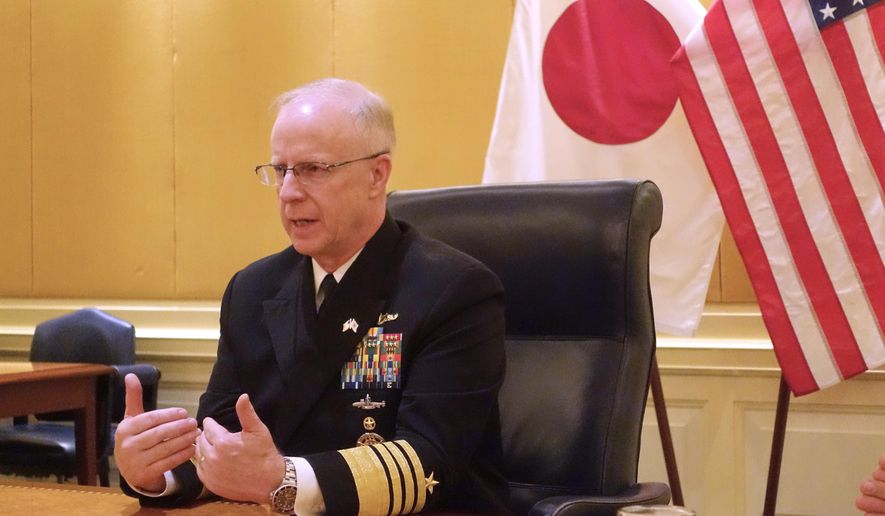
NAVAL STATION NORFOLK, Va. — Adm. Daryl Caudle, chief of naval operations, says the Iran war and other conflicts in the Middle East are presenting challenges to the Navy in keeping China at bay in the Pacific.
Pressure is mounting on the Navy to provide resources to U.S. Central Command for “major combat operations” in the Middle East, Adm. Caudle told reporters Wednesday at an invite-only lunch at Naval Station Norfolk.
“We need conversations between Admiral [Brad] Cooper [commander of U.S. Central Command] and I to make sure that he has everything he needs to confidently be prepared to conduct major combat operations,” Adm. Caudle said.
That includes moving an aircraft carrier strike group out of the Pacific to replace Navy ships that have operated in the Persian Gulf over the past nine months. Adm. Caudle said there is a “whole of government” approach to maintain U.S. interests in the Pacific.
The aircraft carrier USS Abraham Lincoln has been on one of the longest deployments since the end of the Cold War. It’s slated to be replaced by the USS Theodore Roosevelt, which is pulling it out of the Pacific fleet.
Asked if that presents a dilemma for the Navy, Adm. Caudle was direct.
“The fact that we’re short on carriers in [U.S.] Pacific Command, because we keep moving them into Central Command, yeah, of course, it does,” he said.
Adm. Caudle said that while the Navy has shifted its focus to the Pacific for decades, right now its ships have “got to be sourced from somewhere” to support the Iran war. The combat power remaining in the Pacific, roughly 200 ships and 1,500 aircraft, is focused squarely on projecting U.S. influence in the region.
“We know the pacing threat is the PRC,” said Adm. Caudle, using the abbreviation for China’s formal name — the People’s Republic of China. “We want to be postured to actually make sure that we’re prepared for any kind of conflict in the Pacific.”
China has long been a focus of the U.S. military as part of White House National Defense Strategies going back years. Adm. Caudle said that shifting one of the Navy’s few carriers in the Pacific to focus on the Middle East is a risk that the Trump administration has heard and acknowledged as worth the cost.
Adm. Caudle described a “60-40 split” of focus on the Pacific versus other theaters around the world.
Adm. Samuel Paparo, commander of the U.S. Pacific Command, “describes that risk, through his chain, to his chairman and to the Secretary of War,” the naval operations chief said.
But Adm. Caudle, chief of naval operations and a member of the Joint Chiefs of Staff, said those risks are being covered by other means.
“We have to make decisions on our global force management on where that force goes. In the meantime, we have the whole of government, all levers of national power,” he said, describing the other executive departments. “You’ve gotta mitigate when our forces can’t be there to do things across these other levers of power.”
Contact the author

Please read our comment policy before commenting.