


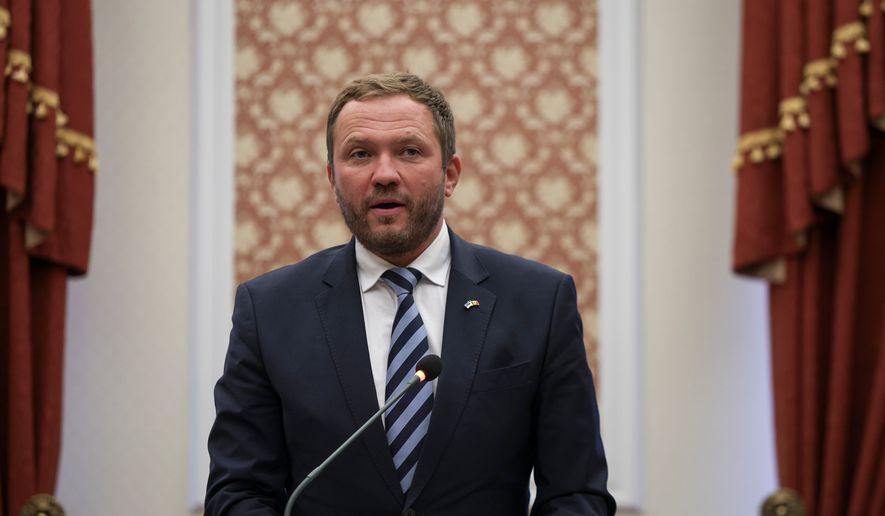

PARIS — Estonia is preparing to close its remaining road crossings with Russia after authorities accused Moscow’s military intelligence agency of ordering an attack on an Estonian drone manufacturer, the latest in a series of suspected Russian sabotage operations against the Baltic NATO member.
Moscow on Monday dismissed the allegation as “baseless.”
The crossings at Narva, Luhamaa and Koidula are expected to be shut to vehicles and pedestrians on Dec. 1.
People were interested in these podcasts
The Estonian government has yet to approve the duration of the closure or any exemptions.
Rail freight through Narva could continue, officials said Monday.
“By closing the border crossings, we are sending a clear message to the Kremlin: Russia’s hostile actions come at a cost,” Estonian Foreign Minister Margus Tsahkna said Sunday.
Estonia summoned Russia’s top diplomat in Tallinn on Monday to protest the attempted attack, which Estonian security officials say was directed by the GRU, Russia’s military intelligence service.
At about 3 a.m. Saturday, suspects tried to break into the premises of Threod Systems in Viimsi, north of Tallinn, break windows and pour flammable liquid inside, according to Estonia’s Internal Security Service (KAPO).
Investigators say the plot was to start a fire and cause an explosion.
A company security guard intervened. No one was injured, and the company’s production was unaffected.
Eight Latvian citizens were detained in Estonia. Prosecutors have sought pretrial detention for five, while investigators continue to establish the suspects’ roles and possible accomplices.
Latvia’s State Security Service said it had provided advance intelligence to its Estonian counterparts. Searches of nine locations in Latvia yielded explosive devices, ammunition, pyrotechnics, phones and electronic storage equipment, the agency said.
KAPO Director General Margo Palloson told Estonian public broadcaster ERR on Monday that Russian intelligence is targeting about 10 Estonian defense companies. He said some recruits for Russian sabotage operations have been paid only a few hundred euros.
The attempted attack followed an August arson at Milrem Robotics in Tallinn, which Estonia formally attributed to Russian intelligence in September.
Milrem manufactures unmanned ground vehicles used by Ukrainian forces. The company said the attack did not disrupt production..
“Russia’s aim is to make us afraid, make us hesitate and weaken our support for Ukraine,” Prime Minister Kristen Michal said Sunday.
The attacks fit a pattern identified before the latest arrests by Marek Kohv, head of security and resilience at the International Centre for Defence and Security, a Tallinn-based think tank.
“Right now, number one priority for Russia is actually Ukraine. What Russia is doing in Europe is connected with that,” Mr. Kohv told The Washington Times in an October interview.
He said Russian operations increasingly target defense companies and transport routes used to supply weapons to Kyiv.
Estonia, a Baltic state of 1.3 million people that shares a 183-mile border with Russia, has faced Kremlin-linked operations beyond its defense industry.
In 2024, its security service detained suspects accused of vandalizing the cars of an interior minister and a journalist, and desecrating war memorials, on the instructions of Russian intelligence.
In May of that year, Russian border guards removed navigation buoys from the Narva River, drawing diplomatic protests from Tallinn. In 2024, Estonia linked cyberattacks on government ministries four years earlier to GRU.Unit 29155, the same unit named in a U.S. Justice Department indictment alleging attacks against NATO countries.
The confrontation intensified in September 2025, when three Russian MiG-31 fighters violated Estonian airspace for more than 10 minutes, according to NATO.
Allied aircraft responded and Estonia requested consultations under Article 4 of NATO’s founding treaty.
The proposed border closure would end direct pedestrian and road travel across a frontier where residents, particularly in the mostly Russian-speaking city of Narva, still have family connections on both sides.
Narva Mayor Jaan Toots has urged the government to consider humanitarian exceptions for residents visiting elderly relatives or attending funerals.
Interior Minister Igor Taro said traffic had already fallen by more than 90% since before Russia’s full-scale invasion of Ukraine.
Mr. Kohv cautioned in October that the movement of operatives across Europe’s largely passport-free Schengen area complicates counterintelligence work.
“All these recruiters can travel inside the Schengen zone quite freely,” he said, pointing to the ease with which suspected Russian operatives can cross internal European borders.
He said Moscow shifted recruitment toward social media after European countries expelled Russian intelligence officers operating under diplomatic cover in 2022.
The Kremlin denied directing the Threod operation. Spokesman Dmitry Peskov on Monday called Estonia’s accusations “entirely baseless” and compared the planned border closure to building a wall.
Estonian officials say closing the crossings will reduce opportunities for Russian intelligence to recruit or pressure travelers. But the latest case has also exposed the limits of that approach:
All of the suspects are Latvian nationals, arrested inside Estonia, rather than Russians stopped at the border.
Please read our comment policy before commenting.