



OPINION:
For decades, Washington underestimated Alaska’s importance to America’s national security and its potential to drive economic growth.
That is changing.
Alaska has always been on the front lines of America’s defense. During World War II and throughout the Cold War, our state served as a strategic gateway to the Arctic and the Indo-Pacific. But after the Cold War, the Pentagon forgot. It closed bases, proposed force reductions and even planned to shrink the Coast Guard’s presence in Alaska.
People were interested in these podcasts
That was a mistake not only for America’s security, but also for Alaska’s economy.
Since I was elected to the Senate, I have worked to reverse that neglect through my seat on the Senate Armed Services Committee and as chairman of the Senate Commerce Subcommittee overseeing the Coast Guard. Working closely with Alaska communities, we have helped restore our state’s central role in America’s Arctic and Indo-Pacific strategy.
The result is one of the largest military buildups in Alaska’s history and a tremendous economic opportunity for Alaska workers and businesses.
This is about more than just a buildup of military forces and equipment. It is about good-paying jobs, billions of dollars in investment and opportunities for Alaska contractors, engineers, manufacturers, suppliers and skilled tradespeople.
The latest example is the full recapitalization of Joint Base Elmendorf-Richardson in Anchorage.
At $7 billion, the Fighter Town Recapitalization Project is likely the largest military construction project in Alaska’s history. Over the next decade, it will create 26 state-of-the-art facilities supporting multiple generations of fighter aircraft and approximately 4,000 private-sector jobs.
That means work for Alaska construction companies. It means contracts for Alaska suppliers. It means opportunities for engineers, electricians, welders, heavy-equipment operators and other skilled workers. And it means billions of dollars flowing through Alaska communities.
The project builds on roughly $400 million we have secured for a new runway at JBER and another $300 million for the Air Force’s new Joint Integrated Test & Training Center.
And JBER is only part of the story.
In 2022, the redesignation of Alaska’s 1st and 4th Infantry Brigade Combat Teams as the historic 11th Airborne Division reaffirmed Alaska’s importance to America’s military. Eielson Air Force Base has since welcomed two squadrons of F-35s, joining the F-22s stationed at JBER to create the world’s largest concentration of fifth-generation fighter aircraft.
Billions of dollars in new missile-defense investments through the “Golden Dome” initiative will further expand Alaska’s military footprint while supporting construction, logistics and other economic activity across the Interior.
These investments demonstrate an important principle: national security investment can also be economic investment.
Nowhere is that more apparent than with the U.S. Coast Guard.
For years, I warned that America was falling dangerously behind in the Arctic. Russia operates more than 50 icebreakers, while China continues expanding its Arctic ambitions. For too long, the United States relied on just two aging heavy icebreakers based in Seattle.
We are finally changing course.
Earlier this year, the Secretary of Homeland Security announced that three additional Coast Guard icebreakers will be homeported in Alaska, joining the Coast Guard Cutter Storis in Juneau.
That decision will strengthen America’s Arctic presence but it will also create a long-term economic benefit for Alaska.
Homeporting major Coast Guard assets means demand for housing, infrastructure, maintenance, logistics, ship repair and other services. It means more Coast Guard personnel and their families living and spending money in Alaska communities.
Communities from Ketchikan and Seward to Kodiak, Juneau, Sitka, Petersburg and Valdez are already seeing the benefits. Alaska shipyards, marine repair facilities, construction companies and small businesses are benefiting from increased demand for vessel maintenance, infrastructure improvements and support services.
The economic impact extends beyond Alaska’s borders, too. Shipbuilding, aviation, construction, logistics and defense manufacturing are national industries. Strengthening Alaska’s military infrastructure strengthens the broader American industrial base and creates opportunities for businesses and workers throughout the country.
Taken together, these military investments represent one of the largest federal economic development opportunities in Alaska’s history. They are creating thousands of high-paying jobs, supporting Alaska contractors and suppliers, strengthening our maritime industry and generating long-term economic activity in communities across our state.
And these investments are helping rebuild America’s ability to defend itself.
The Arctic is becoming more strategically important. The North Pacific is increasingly contested. Russia and China are investing heavily in the region. America needs a strong military presence, resilient infrastructure and a modern Coast Guard capable of operating in some of the world’s most challenging environments.
Alaska provides the geography and the people to make that possible.
The federal government is finally recognizing what Alaskans have always known: Alaska is America’s first line of defense and an increasingly important engine of American economic opportunity.
By restoring Alaska’s role in our national defense, we are creating opportunities for Alaska workers, businesses and families while strengthening the industrial base and security of the entire United States.
That is a win for Alaska.
It is a win for American workers.
And it is a win for America’s security.
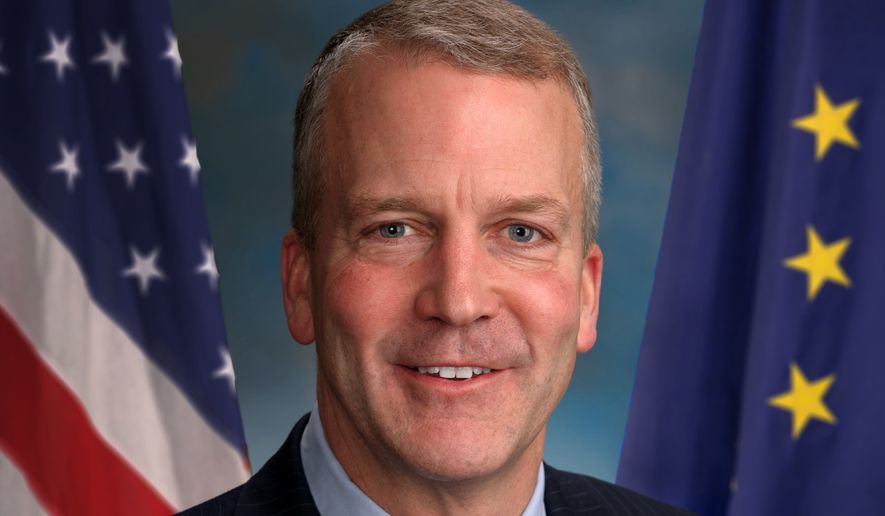
• Sen. Sullivan was sworn in as Alaska’s eighth United States Senator on Jan. 6, 2015. He serves on four Senate committees vital to Alaska: Armed Services, Environment and Public Works, Veterans’ Affairs, and Commerce, Science and Transportation.
Please read our comment policy before commenting.