



A version of this story appeared in the daily Threat Status newsletter from The Washington Times. Click here to receive Threat Status delivered directly to your inbox each weekday.
A Chinese national in Panama is being sought by Beijing as part of the high-stakes geopolitical battle between the United States and China for control of the ports near both entry points to the strategic Panama Canal.
Prominent Chinese businessman Kenneth Liang Zhang is fighting an extradition request from China over allegations that he misappropriated funds from a Chinese Communist Party-linked company that lost out in a canceled bid to build a major port on Margarita Island, near the Atlantic entrance to the canal.
Mr. Zhang’s situation, meanwhile, reads like a lost verse from Warren Zevon’s “Lawyers, Guns and Money,” about a man entangled in Cold War intrigue who gambles in Havana and flees to Honduras.
People were interested in these podcasts
China seeking retaliation
The extradition request is working its way through the Panamanian government’s legal system, and Mr. Zhang has been held in jail since his arrest in July.
“It’s geopolitical retaliation aimed at the United States and the pro-U.S. Panamanian government while pursuing the unlawful and unjust extradition of an individual caught in the middle of China’s effort to reclaim influence and strategic interests it has lost in Panama,” said Mijail Castillo, an attorney for Mr. Zhang in Panama.
A complication involves a lawsuit Mr. Zhang filed against an American energy company. Mr. Zhang’s Sinolam, a Panamanian energy developer, sued Arlington-based utility AES Corp. in January for $4 billion, alleging the company improperly blocked Sinolam from a Panamanian liquefied natural gas project.
Court documents from that case state that Mr. Zhang was abducted and physically threatened, and they accuse several Panamanian presidents and powerful local businessmen of engaging in uncompetitive practices against his company.
Mat Youkee, a Panama-based journalist who has covered Mr. Zhang’s cases, said on his Substack that Mr. Zhang at one point managed the failed roll-on, roll-off port project on Margarita Island, which had raised U.S. security concerns about a potential third Chinese dual-use military-civilian threat near the canal.
After the Margarita deal soured, Mr. Zhang sold the interests to a U.S.-linked company called Notarc against the wishes of a subsidiary of the China-connected Landbridge Group.
“In a few short years, Zhang managed the remarkable feat of simultaneously aggravating the U.S., China and Panama,” Mr. Youkee told The Washington Times. “He was a ’man without a country,’ as one source put it to me, flying between the U.S. and Panama on a St. Lucia passport while his legal case against AES passed through courts in Virginia.”
Mr. Castillo said the AES case had been suspended in federal court, though legal records indicate the $4 billion lawsuit was remanded to the Virginia state court and a parallel arbitration was initiated.
Regarding the extradition, Mr. Castillo told The Times that the effort is not about legitimate law enforcement in China.
Mr. Zhang’s attorneys are seeking to block the extradition by filing a petition with the Inter-American Commission on Human Rights. They have also filed an asylum and refugee protection request with Panama’s refugee office, known as ONPAR.
A former associate of Mr. Zhang told investigators in Panama that she was detained, pressured and tortured into making false accusations against him, which are central to China’s extradition.
China says Mr. Zhang obtained millions of dollars from a Beijing-linked company, Hong Kong Landbridge Port Services Ltd., after the local government canceled the Margarita port for failing to meet its contract obligations.
That company is part of China’s Landbridge Group, owned by Chinese billionaire Ye Cheng, who has ties to the Chinese Communist Party and has been defended by the Chinese government in the past.
Landbridge also owns a port in Darwin, Australia, that Australian authorities are pursuing to cancel on national security grounds, with U.S. pressure also a factor.
Beijing alleged in an Interpol Red Notice arrest request that Mr. Zhang, his company Sinolam and others improperly stripped Landbridge of its 51% interest in the failed Margarita port project by altering documents.
Landbridge won the concession in 2017 and publicly described it as part of China’s Belt and Road global infrastructure initiative.
By 2020, however, delays and unmet promises of Chinese funding led the government to declare the contracts breached, and Mr. Zhang transferred project shares to Sinolam.
A year later, the shares were sold to the U.S.-owned Notarc Management Group, which has agreed to complete and operate the port.
Landbridge then said the agreement transferring shares was forged, asserting the company had not relinquished its 51% stake in the project and wanted back into the deal.
That led to criminal charges against Mr. Zhang in Panama. After a multiyear investigation, the Panama Public Prosecutor concluded on Dec. 30 that the evidence did not show any criminal conduct.
China then worked through Interpol, where it has previously been shown to wield substantial influence, to pursue Mr. Zhang’s arrest and extradition.
The Panamanian government has until early November to rule on the request. Panama and China have no formal extradition treaty, and current law prohibits sending suspects to nations that could impose the death penalty or a life sentence.
Mr. Castillo said China’s extradition request does not include those guarantees.
The case is unfolding amid a major effort by the Trump administration to regain control over the Panama Canal and eliminate Chinese influence.
The United States built the canal from 1904 to 1914 across the narrow Isthmus of Panama. In September 1977, President Carter signed two treaties, ratified by the Senate in 1978, to return control of the canal to Panama.
Panama and the U.S. shared control from 1979 to 1999, with administration by the Panama Canal Commission, a U.S. agency. The Panama Canal Authority assumed full control on Dec. 31, 1999.
President Trump publicly threatened to “take back” the canal in December 2024 over concerns of Chinese influence and canal fees charged to U.S. ships.
In February 2025, Secretary of State Marco Rubio met in Panama with Panamanian President Jose Raul Mulino and told him Mr. Trump had made a preliminary determination that Chinese Communist Party influence over the canal violated the 1977 handover treaty. Mr. Rubio told Mr. Mulino that the U.S. would take action unless changes were made.
At the State Department, a spokesman was asked whether the department was concerned that China’s effort to extradite Mr. Zhang might allow Beijing to gain information useful in its efforts to regain commercial access to ports in Panama. “Panama is a pillar of our maritime trading system, and as such must remain free from any undue external pressure,” the spokesman said. “Any attempts to undermine Panama’s sovereignty are a threat to us all.”
The Pentagon’s National Defense Strategy also warned that access to the canal is in danger.
The document, made public in January, prioritized securing the Panama Canal and warned that, in January 2025, access to the key passageway was “increasingly in doubt.”
The Department of Defense “will therefore provide the president with credible options to guarantee U.S. military and commercial access to key terrain from the Arctic to South America, especially Greenland, the Gulf of America, and the Panama Canal,” the strategy stated.
China loses two canal ports
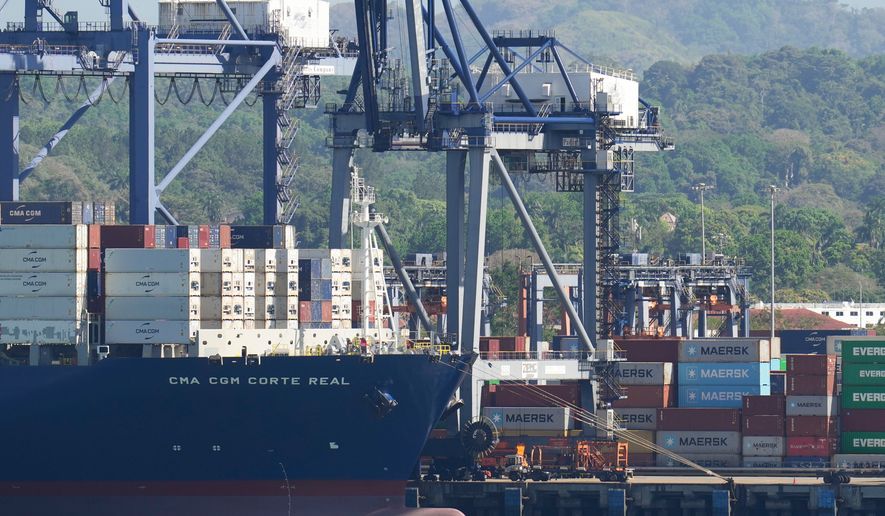
After pressure from the Trump administration, Panama in March 2025 retook control of two ports leased to Panama Ports Co., a subsidiary of Hong Kong’s CK Hutchison Holdings, which also has close ties to the Chinese Communist Party.
Those ports are the Balboa terminal on the Pacific side and the Cristobal terminal on the Atlantic.
CK Hutchison agreed to sell a 90% stake in Panama Ports Co. and an 80% stake in its broader global ports holdings, including the two Panama terminals, to a consortium led by BlackRock and Terminal Investment Ltd. for about $22.8 billion in total enterprise value.
Beijing, however, had an antitrust regulator review the deal and freeze it, calling the sale an inappropriate capitulation to American pressure.
Panama’s government then audited the concession to China on the ports and declared that Panama Ports operated them for two decades under an improper contract and owed back payments.
In January, the Panamanian Supreme Court ruled that Hutchison’s concessions were unconstitutional and void, leading the government to annul the contracts in February. Interim control of the canal ports was given to Maersk and MSC instead of the stalled BlackRock consortium.
China has engaged in economic retaliation by conducting intensive inspections and detaining Panama-flagged ships entering Chinese ports.
Landbridge dispute linked to CCP
Mr. Castillo, the lawyer, said he regards Landbridge’s ties to the Chinese Communist Party as central to the case.
“We believe the objective is to place him under enormous pressure to manufacture a claim that the China-backed Landbridge company — not the U.S.-aligned ownership group — controls this strategically important port project,” he said.
The Panama Canal Authority has plans to expand ports on both sides of the canal. One is set to be built at Corozal on the Pacific side near the canal’s entrance, and a second is planned on the Atlantic side at Port Telfers Island.
Those ports will be part of an $8.5 billion infrastructure development plan through 2035, separate from the Panama government’s revived plan for Margarita Island.
The authority requires that a single company not operate the new terminals to avoid large-scale Chinese influence.
Companies from Europe, the Americas and Asia, including China, are permitted to bid on the new port project, further complicating U.S. efforts to prevent Beijing’s presence near the canal.
A spokeswoman for Landbridge did not respond to a request for comment.
Contact the author
Please read our comment policy before commenting.