


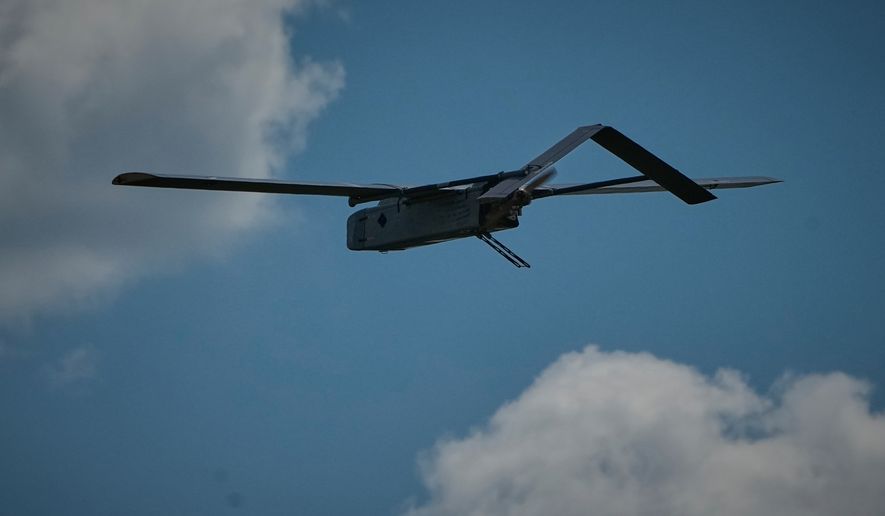

U.S. and allied troops wrapped two weeks of island-hopping war games in Hawaii, testing the Army’s artificial intelligence-enabled battlefield network, its new equipment and its long-range strike power.
Maj. Gen. Jeff VanAntwerp, the commanding general of the 25th Infantry Division at Schofield Barracks, Hawaii, watched as soldiers slowly fell asleep, face down in the red mud after being “killed” during war games.
“On Sunday we finally looked around, and we’re like ‘All right, I think we’re gonna call this,’” Gen. VanAntwerp said during a media roundtable Tuesday, describing how tough the exercise was after winter rains rolled in. “Almost can’t tell the difference between them and the mud because their entire uniform is just caked with red.”
People were interested in these podcasts
Gen. VanAntwerp watched from muddy tents as U.S. Army soldiers and military units from South Korea, Singapore, Japan, New Zealand, France and the Maldives fought their way through jungles and volcanic terrain across multiple island training areas.
The exercise was a major test for his troops in using some of the Army’s newest technology in terrain that mimics the cross-island battlegrounds that would be critical in the Pacific.
The Army’s need to address one of the largest potential great-power conflicts since World War II is pressing in. China has quickly adopted both new drone technology and electronic warfare systems that allow it to detect and destroy nearly anything spread out across the battlefield.
The People’s Liberation Army, or PLA, China’s main fighting force, is following the lessons learned in Ukraine in a similar way to the U.S. A 2025 exercise by one PLA brigade used gear that locates drones by their radio emissions and matches them against a catalog of commercially available models, according to an October report by the Center for Strategic and International Studies.
Similar equipment is being used to identify key command posts and other communications-heavy units across the landscape to mark them for destruction based on the radio, satellite or other signals they emit.
The mock enemy forces in the Hawaii exercise used those tactics to identify different units.
“The idea that it’s a transparent battlefield, that’s not true,” Gen. VanAntwerp said, adding that even with new drone technology constantly threatening overhead, it isn’t ubiquitous. “You can only look at so many things at one time, and it’s a soda straw to a degree. The thing that they can have access to almost all of the time is your signals.”
China is continuing to treat Ukraine as a live warfare test site, much like America’s defense-technology sector is, taking new drone techniques off the battlefield to begin integrating them after just four months.
“The biggest thing that we’ve got to consider now is that our signals are always going to make us observable,” Gen. VanAntwerp said. “We also need to understand their kill chain. How long does it take them to get that information on where you are … and then get that to something that can actually affect you?”
Gen. VanAntwerp described some of the biggest lessons of the exercise as the balance of using new technology and the need to hide in plain sight, with headquarters and other significant units hiding among the electromagnetic “noise” that their entire formation emits.
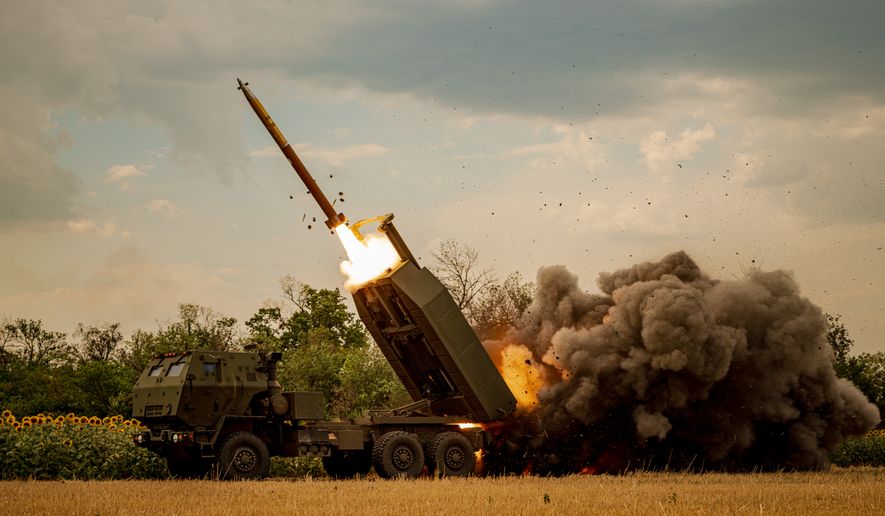
A key operation was a raid, a short, fast troop deployment meant to attack deeper into enemy territory, conducted by High Mobility Artillery Rocket Systems, known as HIMARS.
“The whole goal is to get in, and get out,” Gen. VanAntwerp said. The HIMARS were carried across an ocean expanse by a C-17 military transport aircraft from one island to another.
In less than an hour, two HIMARS were rolled off the back of the aircraft, launched their rockets, reloaded onto the plane and flew away.
A critical development of being able to maintain communications back to headquarters with the rocket trucks inside the aircraft during the flight made the quick turn possible.
“Their kill chain is not going to be fast enough to interdict us or stop us. Like, we’re gone already,” Gen. VanAntwerp said. “They’re gonna wonder where it came from.”
Modernizing efforts
The exercise was a major test for the Army integrating the AI-enabled systems that are part of the Next Generation Command and Control, or NGC2, structure. While NGC2 offers things such as predictive logistics and rapid plans analysis, it also requires new communications suites.
Mesh network radios, new processing hardware and satellite communication tools, such as SpaceX’s Starshield, all have an “electronic fingerprint” of a command post when used together.
“Probably the number one takeaway from the whole exercise is just how much more capable, from a surveillance perspective, both sides are,” Gen. VanAntwerp said. “You have to communicate to be effective.”
The 25th Infantry Division is one of the two units in the Army that are using the new NGC2 equipment and testing to learn how it should be used by the rest of the force.
Lt. Gen. Matthew McFarlane, the commanding general of I Corps and Joint Base Lewis-McChord, is in charge of both divisions saddled with that task.
Gen. McFarlane said that the rollout of the new equipment has to come with engagements with allies. During a briefing in October at the Association of the United States Army’s annual conference, he said that “interoperability with our combined partners is a key aspect” of the NGC2 program.
During the exercise in Hawaii, much of the information shared with other nations had to be removed from classified networks and then shared, posing another hurdle. The Pacific Mission Network, meant to help with that information sharing, is “not part of” NGC2, according to Gen. McFarlane.
There’s also a problem of making new AI-enabled equipment field-capable while not making absolutely everything so heavy that it’s capable of being “dropped or kicked or thrown all over the place,” according to Gen. VanAntwerp.
“You can tell sort of by looking at something when it’s made somewhat all-weather, ruggedized, and when something isn’t,” he said. “We’ve got these edge servers and everything that aren’t currently ruggedized or weatherproof and you’ve got to be super careful when you’ve got those things in the back of a [vehicle] and you’re moving around in the jungle.”
“There’s just these trade-offs,” Gen. VanAntwerp said.
Preparing for China
Overcoming those challenges will be critical to the future of the Army as soldiers implement the recently published strategy by Gen. Christopher LaNeve, the Army’s acting chief of staff, titled “How the Army Fights.”
The document emphasizes how contemporary conflicts, specifically the Russia-Ukraine war, have shown that “the proliferation of sensors challenges a force’s ability to remain concealed.”
It also considers China the “pacing threat” of the U.S. military, specifically calling out the PLA. The strategy says U.S. forces, along with allies and partners, must “organize, train, and equip … with the same institutional focus that the Cold War generations brought to the Soviet Army.”
That emphasis takes shape in what the Army describes as a high-intensity fight in the Pacific and the First Island Chain. Across the Pacific, units such as the 25th Infantry Division are adopting more hardened command posts, building stronger logistics systems and growing munitions reserves.
China’s “rapid deployment capabilities require land power options that do not rely on traditional, lengthy deployment timelines,” according to the strategy document.
Exercises like this set up the Army for the upcoming spring events where the 25th Infantry Division will be in the Philippines. Leadership described parts of the Hawaii exercise as a dress rehearsal for their deployment in March to sit and train directly on the First Island Chain itself.
The multinational troops involved in the Hawaii-based exercise, which numbered close to 10,000, were operating under those principles.
The goal was to push soldiers to “as close as we can get as a division to really testing ourselves, short of combat,” Gen. VanAntwerp said.
Contact the author

Please read our comment policy before commenting.