


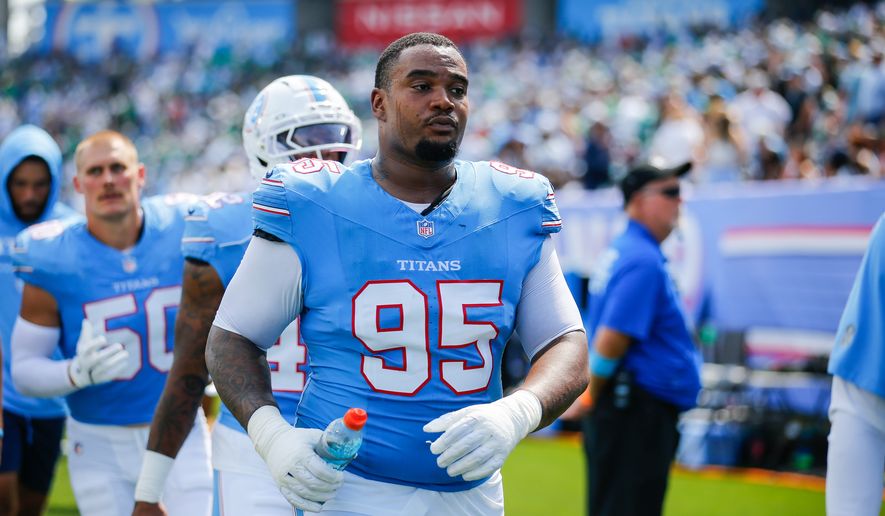

The Tennessee Titans released defensive tackle Jordan Elliott this week after he left the team facility to grab a gun from his car, team officials confirmed Wednesday.
The incident occurred Thursday, and Tennessee released Elliott on Tuesday after reviewing the incident. The defensive tackle reportedly went to his car to retrieve the firearm after a dispute with offensive lineman J.C. Latham.
Multiple reports have indicated that defensive lineman John Franklin-Myers intervened, talking Elliott down to prevent the incident from escalating further. It is still unclear what manner of argument led to the incident.
People were interested in these podcasts
The gun never made it out of Elliott’s parking spot, according to ESPN.
“The first question that I think everyone forgets to ask is ‘Why would a great man, a great father, a man who shows up on time everyday … why did he go off the rails and grab a gun?’” Titans coach Robert Saleh said Wednesday.
Elliott has not publicly commented on the matter. His NFLPA-listed representation did not immediately respond to a request for comment.
The Titans did not allow Elliott to suit up for Sunday’s game against the Indianapolis Colts, which was Tennessee’s first win of the season.
“The organization and the NFL did an outstanding job with regards to pausing, which I think everyone needs to do in this situation, which is just pause, with regards to the news that Jordan had a gun. …” Saleh said Wednesday. “This is a man who’s a father, a great husband, he’s never committed a crime in his entire life and he pulled a gun in the parking lot.”
He continued to praise the NFL and the Titans leadership for not rushing to any conclusions.
“To me, those are small signs of a cry of help. Obviously, there’s something greater happening,” Saleh said. “I thought the team and the NFL did an outstanding of pausing and asking those questions and checking every single box in regards to getting him the help that he needs.”
Tennessee signed the 28-year-old to a two-year, $8 million contract this offseason. He spent the first four years of his career with the Cleveland Browns before a two-season stint with the San Francisco 49ers.
Elliott posted 159 tackles in his career, including 11 prior to his release this season. Saleh described the 315-pound lineman as “a man who shows up on time everyday, who works his a— off everyday, who contributes the way he’s supposed to contribute.”
“In the last year, the NFL has lost two outstanding young men to taking their own lives because they may have been crying for help, and everyone ignored it,” the Titans’ first-year coach said. “I’m not saying that’s where he was, I’m not going to speak on that, but these kids go through a lot.”
The NFL has not publicly commented on the situation. The league’s franchises began implementing enhanced security measures at their practice facilities after a shooting that appeared to target NFL headquarters in August 2025.
Team facilities now feature metal detectors, security screenings and armed guards. Stop-the-bleed kits — armed with tourniquets and bandages in case of shootings or other potential mass-casualty incidents — are now a common sight at stadiums and franchise headquarters.
Players are prohibited from bringing firearms to league facilities under an NFL policy that dates to 1995. Athletes who violate the guidelines are subject to suspension.
Elliott is now a free agent and technically able to sign with any NFL franchise. A suspension would be expected, though.
“My message to 31 other teams would be, if you need a hell of a runstopping tackle that can help you on a playoff run, give me a call and I’ll tell you everything you need to know about him,” Saleh said. “He’s a good man who had a terrible lapse in judgement that I recognize as a call for help more than a criminal act.”
Elliott would not be the first player punished under the league’s strict anti-gun policy. New York Giants wide receiver was suspended four games by the NFL — and sentenced to 2 years in prison for attempted criminal possession of a weapon — after he shot himself in the leg at a nightclub in 2008.
Chicago Bears defensive tackle Tank Johnson was suspended for the first seven games of the 2007 campaign after police found six unregistered firearms during a raid on his home.
Shootings involving players at NFL facilities have remained rare. However, one high-profile incident saw Kansas City Chiefs linebacker Jovan Belcher fatally shoot himself outside the team’s practice facility after killing his girlfriend in November 2012. Belcher was later diagnosed with Chronic Traumatic Encephalopathy, a degenerative brain condition caused by repeated head injuries that is often posthumously diagnosed in football players.
— This article is based in part on wire service reports.
Contact the author

Please read our comment policy before commenting.