


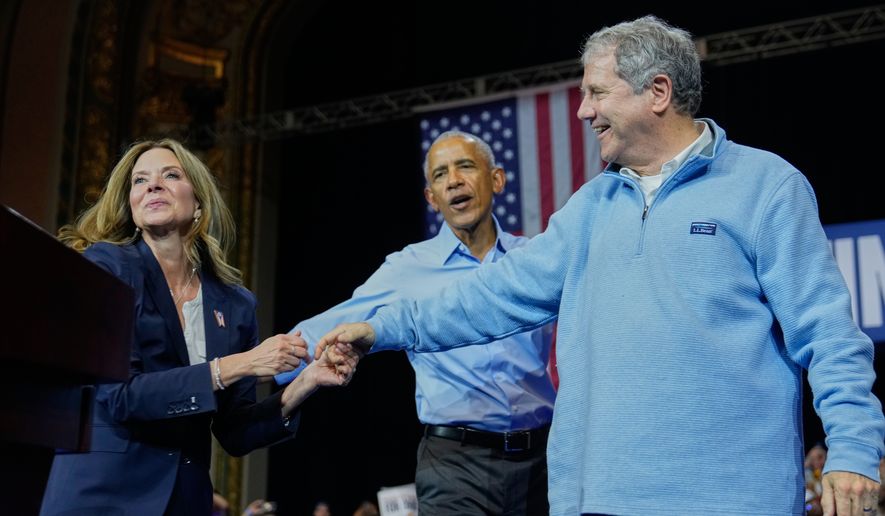

Democrats are closing out some of the country’s most competitive Senate races with a call to arms against the influence of the filthy rich. In their telling, the affordability crisis is really a corruption crisis.
From Ohio to Texas to Michigan, Democratic candidates are casting the election as a fight between ordinary Americans and a billionaire-backed political establishment that is rolling in the dough. They say wealthy donors and corporations bankroll Republican campaigns and get rewarded with policies that help them grow richer while families pay through the nose for groceries, housing and healthcare.
Former Sen. Sherrod Brown has made it the centerpiece of his comeback bid, telling Ohio voters that corporate CEOs making “300 times” more than the average worker is evidence of an economic system tilted toward the wealthy. And he says the wealthy have his rival, Republican Sen. John Husted, in their pocket.
People were interested in these podcasts
“The billionaires, the trillionaires and shady corporations all know John Husted is for sale,” Mr. Brown said at a rally Saturday with President Obama. “He’ll put them before hardworking Ohio families every single time.”
Voters hear the same pitch from Democrats Abdul El-Sayed in Michigan and James Talarico in Texas. The message is central to the Democrats’ closing strategy.
A Sept. 29 memo from Senate Majority PAC, an organization aligned with Senate Minority Leader Charles E. Schumer, New York Democrat, urged candidates to draw a direct connection between political influence and rising household costs, including utility bills, prescription drug prices and groceries.
Democrats increasingly argue that the country’s affordability problems stem from what they describe as a corruption problem: wealthy donors and corporate interests use their influence to shape policies that pad their pockets while life gets more expensive for everyone else.
“Voters know something isn’t right when the president and Republican senators they elected to bring down costs have made millions while families are choosing between a gallon of gas and feeding their family,” said Lauren French, a spokeswoman for the Senate Majority PAC.
Republicans say it is both dishonest and hypocritical because wealthy donors also bankroll Democrats with an agenda, whether it is George and Alex Soros, Michael Bloomberg or venture capitalist Reid Hoffman.
“El-Sayed’s laundry list of Muslim Brotherhood-linked campaign donations, Brown’s lifelong career leeching off Ohio taxpayers, and Talarico’s ’Epstein class’ donor roll disqualify all three from lecturing anyone about ’corruption,’” said Bernadette Breslin, a spokeswoman for the National Republican Senatorial Committee.
In Ohio, Husted spokeswoman Amy Natoce said Mr. Brown’s message is undercut by his own long tenure in Washington and fundraising history.
“Sherrod Brown spent 32 years in Washington literally building the system he now calls ’rigged.’” Ms. Natoce said.
She said that Mr. Brown, over his political career, accepted millions of dollars from Wall Street-linked donors, insurance interests, opioid companies and data-center advocates.
However, the megadonors are decisively breaking toward the Republican this campaign season. Fourteen of the 20 largest donors and donor groups exclusively or nearly exclusively gave to Republican candidates or causes, according to a CNBC analysis.
Democrats also accuse Republicans of turning a blind eye to President Trump’s family business ventures, including cryptocurrency projects.
Those attacks have intensified as Democrats cite reports on Mr. Trump’s growing personal fortune. A recent Forbes analysis estimated that Mr. Trump is $2.7 billion richer than when he won the 2024 election, attributing much of the increase to cryptocurrency ventures and overseas deals. Forbes said no American politician has ever profited more from politics.
Mr. Obama amplified that argument over the weekend, mocking the administration’s promise to “drain the swamp” while arguing that the Trump family has enriched itself in office in so many business deals that “we lost count.”
“The only thing they drained is the reflecting pool on the National Mall,” Mr. Obama said Saturday.
The message is being echoed across the Senate map.
“We have an affordability crisis because we have a corruption crisis,” Mr. Talarico said at a campaign rally in San Antonio on Saturday, pointing to high gas prices, grocery bills and healthcare costs. “I want to be a senator for every Texan who can’t afford one.”
Mr. Talarico has made the $158 million that billionaire Elon Musk has poured into the race a centerpiece of his criticism of Republican Senate nominee Ken Paxton.
“The richest man in the world is almost single-handedly bankrolling this effort to install Ken Paxton in the U.S. Senate,” Mr. Talarico said. “He wants his very own personal United States senator. He is trying to buy Texas. But on Nov. 3, we are going to deliver a crystal clear message to the world’s first trillionaire: Texas is not for sale.”
Mr. Talarico said the first bill he would introduce in the Senate would be an anti-corruption package that bans stock trading by members of Congress, prohibits corporate and super PACs, bans partisan gerrymandering nationwide and imposes term limits.
In Michigan, Mr. El-Sayed made a similar case in his race against Republican Mike Rogers. He said President Trump is the “worst symptom of the disease of our politics” that allows billionaires’ special interests, from big tech to big oil to big pharma, to rig the system.
“It’s why we pay more for all we have to buy, get paid less for the work we do,” Mr. El-Sayed said at a Detroit rally with Mr. Obama on Saturday.
Republican strategist Dave Carney questioned not only the veracity of the Democrats’ message but whether it resonates with the small number of voters who typically decide close elections.
“Campaign finance issues have never been a winning issue for anybody,” he said. “It’s a good talking point. The press loves it, but it doesn’t move voters.”
Please read our comment policy before commenting.