


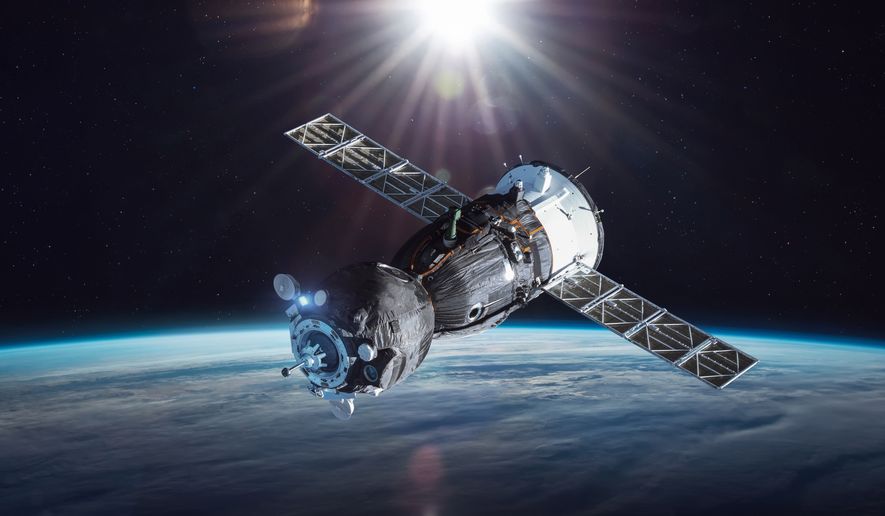

Space analysts and national security insiders say the Russian satellite Cosmos 2612 likely intended to attack a key U.S. radar satellite in what would have been the first instance of warfare in orbit, but that the Kremlin may have called off the operation at the eleventh hour.
Questions were still swirling Monday after the highly dangerous incident in which Cosmos 2612 came within an estimated 85 feet of ICEYE-X36, a Finnish commercial satellite believed to provide high-resolution intelligence to the Ukrainian military.
Specialists say the encounter appears to be intentional on Moscow’s part, the result of months of careful planning and perfectly choreographed movements by the Russian satellite. The operation has fueled speculation that Moscow intended to launch a history-making kinetic attack in space or executed a dress rehearsal for such a mission.
People were interested in these podcasts
Using an orbital weapon would have been an extraordinary step by Russia and would have immediately raised questions about how the U.S. and its allies should respond to actual space combat.
The Russian Embassy in Washington and Roscosmos, Russia’s official space agency, did not respond to repeated written requests for comment from The Washington Times.
Some analysts say the incident is tied directly to the geopolitics surrounding the Russia-Ukraine war and specifically to several recent steps taken by President Trump that some critics view as favorable to Russia.
Mr. Trump recently announced a deal to ease restrictions on Russian diesel exports, a major source of revenue for the Russian economy, and pulled back new U.S. economic sanctions on Moscow that were set to go into effect this week.
“To me, it looks like this: The Russians were poised to take some hostile, perhaps Rubicon-crossing action against a U.S.-registered satellite. Then the U.S. called off several new sanctions,” said Clayton Swope, deputy director of the Aerospace Security Project at the Center for Strategic and International Studies.
“The Russians decided the juice was not worth the squeeze right now and suspended whatever operation they were planning. Or maybe the Russians completed a test run and they got what they wanted,” Mr. Swope told The Times. “But they certainly proved a point — the U.S. may have declared on-orbit space control weapons, but Russia can still threaten satellites in orbit.”
The U.S. Space Force declined to comment on the incident.
In a brief statement, Finland-based company ICEYE suggested that even if its X36 satellite had been compromised by Russia, Ukraine’s military would have retained access to synthetic aperture radar imagery and battlefield intelligence.
“We are aware of the situation and tracking it closely. Our constellation architecture is designed for continuity and resilience,” a company spokesperson told The Times.
Analysts have carefully cataloged every step of Cosmos 2612’s mission, which launched from Russia’s Plesetsk Cosmodrome in April alongside five other satellites, numbered Cosmos 2609 through Cosmos 2614. Although some of those craft came unusually close to commercial satellites, none took direct maneuvers to stay “plane-matched” with the ICEYE asset or any other satellite.
That changed on Sept. 30, analysts say.
Theodore Kruczek, a radar analyst and former U.S. Air Force major, wrote a detailed breakdown of Cosmos 2612’s movements for the open-source 3D satellite tracking platform KeepTrack.space. In his analysis, Mr. Kruczek said the Russian satellite took explicit actions to arrive at a precise moment.
“In two burns the same day … it raised its orbit by 47 kilometers,” he wrote. “In the higher orbit Cosmos 2612 moved more slowly than X36 and slipped back by thousands of kilometers a day. That kind of phasing orbit is how a spacecraft picks its arrival time.
“Russia has done this before, but never this close or against a commercial satellite in low orbit,” Mr. Kruczek wrote. “Whether Cosmos 2612 was imaging, listening, rehearsing or sending a message, the orbital data shows the preparation clearly.”
Questions about the purpose of the Cosmos 2612 satellite have been raised amid broader uncertainty about the space-based assets aiding Ukraine in its fight against Russia. This month, Ukrainian drone operators experienced reduced connection speeds after restrictions were imposed on battlefield use of Space X’s Starshield communication terminals.
In Washington, lawmakers from both parties have questioned whether the Trump administration imposed those restrictions in response to public criticism by Ukrainian President Volodymyr Zelenskyy of the U.S.-Russia diesel deal. The announcement that Mr. Trump would suspend the implementation of new economic sanctions against Russia was made just days after the diesel deal was finalized.
The Trump administration has strongly refuted the idea that it is aiding Russia in any way. Energy Secretary Chris Wright specifically pushed back on the notion that the administration wants to relieve economic pressure on Moscow.
“What the president’s move has done was for diesel fuel, which is what the world is short right now, and Russia exports today zero diesel,” Mr. Wright told ABC’s “This Week” program Sunday. “This is an incentive to Russia, that if they can reduce the conflict with Ukraine, they can get an energy ceasefire or reduce the conflict such that they have diesel to export, we’ll allow it to flow to world markets.”
Publicly available data from the satellite tracking website Orbital Radar showed that Cosmos 2612 came within about 85 feet of ICEYE-X36. Such a close encounter between two satellites is exceedingly rare and highly dangerous. Tracking data indicates that the Russian satellite closed in from more than 200 miles away to within roughly 3 miles in a single day.
America now has assets in place to respond with its own attacks, if it chooses.
Last month, Air Force Secretary Troy Meink revealed for the first time that the U.S. has its own weapon in orbit. He suggested that the weapon is designed to counter attacks by other adversaries targeting satellites or other space-based assets.
“The United States now has on-orbit space control weapons capable of defending the joint force against hostile adversary action,” Mr. Meink said during a Sept. 14 address at the Air, Space and Cyber Conference at the Gaylord National Resort and Convention Center at National Harbor, Maryland.
Contact the author

Please read our comment policy before commenting.