


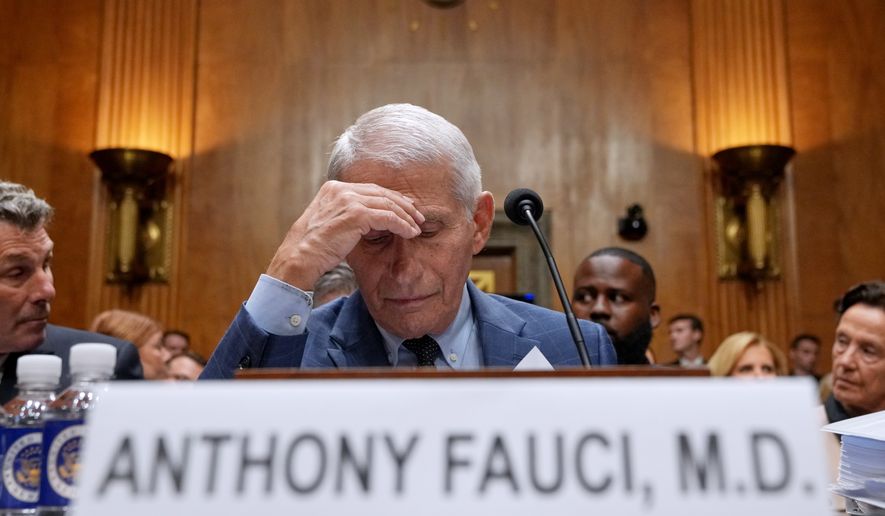

A Senate committee voted Thursday to hold Dr. Anthony Fauci in criminal contempt of Congress for refusing to answer senators’ questions about his decisions and actions during the pandemic.
The 8-5 party-line vote is a stain on the once-unblemished reputation of Dr. Fauci, who for decades ran the infectious diseases division at the National Institutes of Health and became the most visible face of U.S. efforts to grapple with the coronavirus.
In a hearing last week, Dr. Fauci refused to answer any questions, invoking his Fifth Amendment right to remain silent 111 times.
Republicans said that was unacceptable. They characterized Thursday’s vote not as punishment but rather justice as they seek answers on the pandemic’s origins and the government’s decisions to push masks, shutdowns and vaccines.
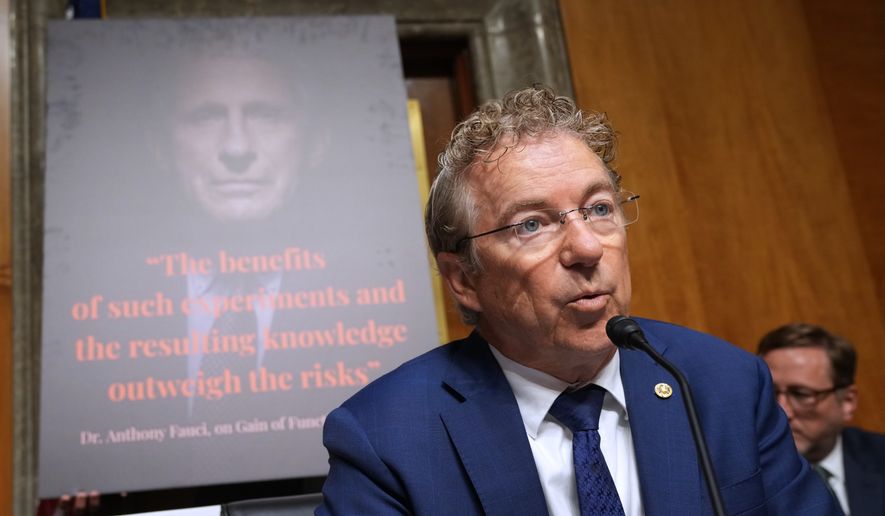
“Many of these questions can be answered only by Dr. Fauci,” said Sen. Rand Paul, chair of the Homeland Security and Governmental Affairs Committee and a trained physician who for years has clashed with Dr. Fauci over his pandemic determinations.
David Schertler, Dr. Fauci’s lawyer, denounced the committee vote as “a crude political stunt” that punished him for exercising a constitutional right.
“Today’s resolution is a continuation of Senator Paul’s personal vendetta against Dr. Fauci, who spent 50 years in public health and has saved countless lives,” the lawyer said in a statement. “It is shameful and wrong that Senator Paul is abusing his power by trying to weaponize the Justice Department against an honorable public servant.”
Normally, a contempt resolution would now move to the full Senate for action — and, in this case, a certain filibuster by Democrats.
But Democrats said they fear Mr. Paul will attempt to bypass the full Senate and send the committee’s resolution to the Justice Department with a request that he be prosecuted.
Mr. Paul, in a fundraising email Thursday, seemed to downplay that idea, telling supporters that the “resolution still has to clear the full Senate.”
Republicans had called Dr. Fauci to the committee last week to answer questions about whether the National Institute of Allergy and Infectious Diseases, which he helmed for decades, had funded risky research at the Wuhan Institute of Virology. That lab is at the center of suspicion over the origin of the coronavirus.
Senators also wanted to know why he told colleagues to delete emails about the pandemic, and what discussions were going on behind the major decisions on masking, shutdowns and vaccines.
Mr. Paul has asked some of those questions of Dr. Fauci in previous hearings, but last week’s appearance was supposed to be the big showdown between the two.
In the run-up to the hearing, Mr. Paul released two years of entries from Dr. Fauci’s personal journal. Embarrassing details included the doctor’s obsession with his fame, his treatment by the press and the adulation he received from entertainment figures such as Julia Roberts.
This week, it was revealed that the committee has obtained a copy of the iPhone Dr. Fauci used while he was at the National Institutes of Health.
Dr. Fauci said Mr. Paul has said he wanted to see him “behind bars,” and given that attitude, he was justified in invoking his Fifth Amendment right against self-incrimination.
Mr. Paul countered that President Biden last year granted Dr. Fauci and extraordinary pardon, effectively erasing any legal jeopardy so long as he told the truth to the committee.
Mr. Paul said Dr. Fauci, in delivering an opening statement denouncing the chairman and the investigation, also waived his Fifth Amendment right.
He rejected the invocation of the Fifth Amendment and ordered the witness to answer.
Dr. Fauci refused, citing advice of his lawyers.
Mr. Paul on Thursday said that was an affront to the Americans who died alone during the pandemic, the workers who lost jobs because they refused vaccines, businesses shuttered during the shutdown and children who lost years of schooling.
“Nothing we do today can undo those losses. But silence does not honor them either. The American people deserve answers,” the Kentucky Republican said.
Democrats complained that Republicans were seeking to punish Dr. Fauci rather than pursue answers to questions.
“This resolution will not provide the committee with any additional information or compel Dr. Fauci to provide answers to our questions,” Michigan Sen. Gary Peters, the top Democrat on the panel, said.
He said going after Dr. Fauci undercuts Congress’ ability to compel testimony from future witnesses because it upsets a careful balance between investigative powers and respect for witnesses’ rights.
Under the law, if the Senate approves a contempt resolution, then it is forwarded to the U.S. attorney in Washington, who is supposed to bring it to a grand jury to see if there are grounds to open a case.
It’s not clear how that process would be affected if Mr. Paul were to refer the matter after just a committee vote, rather than a vote by the whole Senate.
Dr. Fauci invoked his Fifth Amendment right to refuse every question posed — including banal ones, such as what color tie he was wearing.
Sen. Josh Hawley said his refusal to answer that question was proof that Dr. Fauci wasn’t worried about criminal prosecution but was intent on obstruction.
“He’s not going to be prosecuted for the color of his tie,” the Missouri Republican said.
Whatever Dr. Fauci’s worries before the committee last week, his legal exposure increased this week after Florida’s attorney general issued a subpoena for a wide range of documents relating to his activities during the pandemic.
Contact the author

Please read our comment policy before commenting.