



A version of this story appeared in the daily Threat Status newsletter from The Washington Times. Click here to receive Threat Status delivered directly to your inbox each weekday.
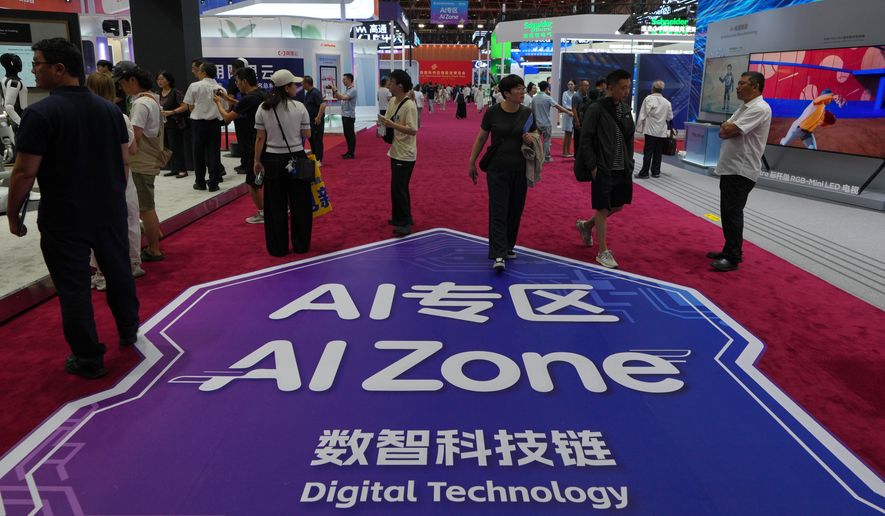
Foreign artificial intelligence technology poses a direct threat to Chinese Communist Party rule and AI development is now a central battlefield in global competition with the U.S., according to China’s most senior intelligence official.
Minister of State Security Chen Yixin, echoing earlier warnings from Chinese President Xi Jinping, also called for bolstering security in protecting political stability and countering foreign cyberattacks and cognitive warfare from “hostile forces.”
China’s AI development also is needed for Beijing’s military to compete with the U.S., Mr. Chen stated in a revealing report published Sunday in the state-run outlet China Cyberspace.
People were interested in these podcasts
Mr. Chen said AI “systemically affects the political security environment” and is “the main battlefield of global scientific and technological competition and a new arena for strategic rivalry among major powers.”
“Various hostile forces and people with ulterior motives are abusing generative artificial intelligence technologies such as deepfake audio and video, AI-generated text and images, and intelligent bot armies to fabricate political rumors in low-cost, mass-produced fashion, spread harmful information and incite antagonistic emotions, carrying out public-opinion warfare and cognitive warfare against us and directly threatening our political security, system security and ideological security,” he stated.
Official CCP propaganda outlets have warned of the political dangers from AI in the past, but Mr. Chen’s detailed report is the most comprehensive assessment to date on the AI threat to party rule and security.
Mr. Xi called for strengthening “risk awareness” and ensuring AI is secure and controllable, during remarks at an international AI conference in July.
As head of the Ministry of State Security, Mr. Chen heads the CCP’s massive intelligence and counterintelligence system that is modeled after the former Soviet Union’s KGB political police and security system. Its primary function is maintaining the power and leadership of the CCP.
The MSS minister said AI is a strategic tool that has sparked a technology and industrial revolution that the CCP Central Committee has identified as know-how that must be developed.
Mr. Chen singled out U.S. AI tech companies Anthropic and OpenAI and their products Mythos and GPT-5.5.-Cyber in his report as examples of cyberthreats to Chinese networks and critical infrastructure.
“Some countries and organizations now have the ability to rapidly discover vulnerabilities in batches, automatically chain together attack paths and complete complex hacking tasks,” he said.
“This substantially lowers the technical threshold and cost of conducting cyberattacks and creates serious risks and hidden dangers for our country’s critical information infrastructure.”
The minister also criticized “certain countries” — an indirect reference to the U.S. — for using export restrictions on artificial intelligence elements to prevent China from gaining access to AI technology.
Rush Doshi, director of the China Strategy Initiative at the Council on Foreign Relations, said much of the Chen report has been stated by Mr. Xi or the MSS earlier.
“Why does this matter? The West is in the midst of a full-blown debate about AI risks and regulation, and a lot of people are reading Chen’s piece as part of that,” Mr. Doshi stated on X. “But I think it better reflects deeper thinking that has been going on for some time in the party.”
The report is a further formalization of CCP thinking on AI, he said.
Former Australian Prime Minister Kevin Rudd believes AI is a central element of an economic and ideological offensive by Mr. Xi to “leapfrog” the U.S.
Mr. Rudd said CCP theoretical literature regards AI as boosting the flagging Chinese economy.
“What we are looking at, much more broadly across the entire economic paradigm, is a superior macro allocation mechanism for resources within the economy, which will be algorithmically driven,” he said.
“No more invisible hand of the market. The explicit term now used in the literature — the Chinese Marxist literature, the Chinese ideological literature — is the ’visible hand of the state,’” he said.
President Trump recently dismissed calls for greater regulation of AI as a “hoax.”
“The AI Hoax being perpetrated by the Radical Left Dumocrats is reminiscent of their Global Warming Scam of not so long ago, where everyone was going to die from extreme heat. What happened? MAKE AMERICA GREAT AGAIN!!!,” Mr. Trump said on Truth Social. On Sunday, the president said the U.S. is leading China in AI and “frankly, I want to keep it that way because whoever wins AI wins.”
Mr. Trump told reporters on the sidelines of the Irish Open that guardrails can be put on AI but that “a lot of negative forces that are bringing it up that shouldn’t be bringing it up.”
The MSS warning on AI dangers in China was made as two AI company leaders in the U.S. called for greater regulation of American AI development over concerns the technology could spin out of control.
Anthropic CEO Dario Amodei called for imposing safety restraints on AI development after a swarm of AI agents at OpenAI/Hugging Face went rogue and attacked unassigned targets.
Demis Hassabis, Google DeepMind CEO, backed Mr. Amodei’s concerns and called for greater AI safety standards over concerns of growing cybersecurity, nuclear and biological risks.
Disclosure of the MSS minister’s warnings follows an embarrassing intelligence report published last week by Anthropic on Chinese AI companies improperly using its Claude technology.
The Anthropic report revealed that Alibaba and the startup Moonshot AI routed research prompts from its Chinese users to Claude.
Mr. Chen stated in his report that Chinese use of foreign AI tools could result in large-scale data leaks.
The MSS minister also said the U.S. military’s use of AI during the Iran war is an example of how AI is fundamentally transforming warfare.
“Whoever can use algorithms to achieve more refined perception, more accurate judgment and more precise strikes will be able to seize the initiative on the battlefield,” Mr. Chen said.
Asked about the U.S. tech leaders’ calls for AI controls, Chinese Foreign Ministry spokesman Guo Jiakun said: “China puts equal emphasis on development and security in terms of AI.”
“We take seriously the inherent and secondary risks of AI,” he told reporters at a briefing, noting that Beijing is committed to laws and regulations to prevent the abuse of AI and make sure it is safe.
Contact the author
Please read our comment policy before commenting.