


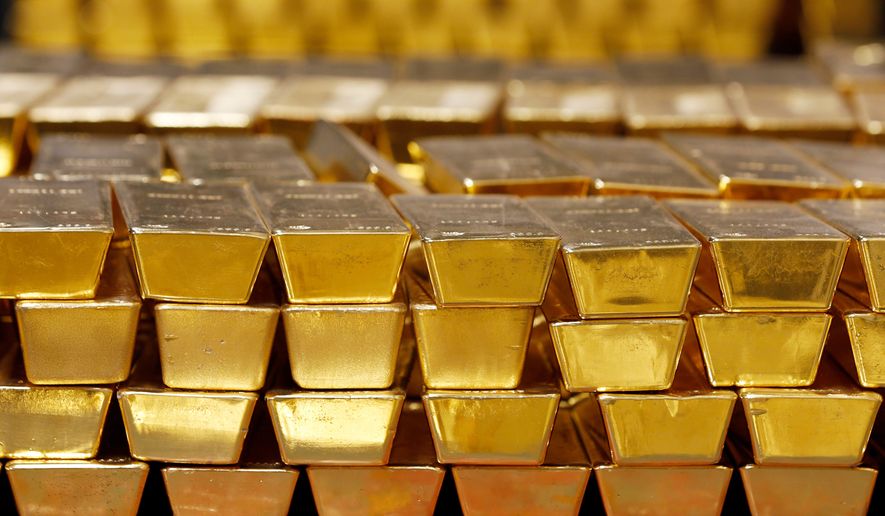

Several foreign central banks are moving their gold reserves out of the United States — primarily from the Federal Reserve Bank of New York. But analysts say the transfers are based more on crisis preparedness and risk management than on an abandonment of the U.S. financial system.
From March to August 2026, the Dutch Central Bank transferred 86 metric tons of gold out of the U.S. and Canada. The relocated gold is now stored at the Bank of England in London. All of France’s strategic gold reserves — about 2,400 tons — are now stored domestically within the vaults of the Banque de France in Paris.
Since 2005, the Bank of France has pursued a policy of having its gold stock conform to the London Bullion Market Association standard of 99.99% gold purity rating. In March 2026, it said 129 tons of its gold located in New York did not meet that standard.
People were interested in these podcasts
“Rather than embarking on a lengthy and risky logistical operation, the simplest solution was to sell this gold and then buy gold in Europe that met the highest standard,” Bank of France officials said in a statement. “The sale of these American bars generated an exceptional capital gain of [$12 billion] for the year 2025.”
Dutch Central Bank officials said gold stored at the Bank of England is widely considered the most easily tradeable gold in the world.
“This makes it the quickest way for [the Dutch Central Bank] to deploy in a crisis situation,” officials said in a statement. “The portion of the gold reserves held in New York and Ottawa is less immediately deployable.”
A number of European politicians have called for their countries’ gold supply to be removed from the U.S. over concerns about the Trump administration’s antipathy toward the European Union and the president’s “unpredictable policymaking,” Germany’s Deutsche Welle TV network.
Italy, which holds the world’s third-largest gold reserve with 2,452 tons, has resisted growing political pressure to repatriate the one-third of its supply stored in New York, while Germany, with the world’s second-largest supply, at 3,352 tons, made moves to bring its gold home during the first Trump term in office.
Germany’s Deutsche Bundesbank finished transferring the last of about 300 tons of gold from New York during U.S. President Trump’s first term in the White House. A year later, it relocated the gold reserves that were in storage in Paris to Frankfurt, officials said.
The U.S., with 8,133 tons, is the world’s largest holder of gold reserves.
Sebastien Tillett, an analyst with the global financial forecasting firm Oxford Economics, told DW that the likelihood of an outright seizure of assets was extremely remote. However, he said there were growing concerns about ease of access in an age of geopolitical uncertainty.
“The more relevant concern is that assets held in another jurisdiction could become temporarily inaccessible in an extreme sanctions, legal, or geopolitical scenario,” Mr. Tillett said.
The U.S. and its allies froze $300 billion in Russian foreign reserves that they were holding. Analysts said it served as a wake-up call for central banks. They realized that assets held by a foreign country, even physical gold, can become inaccessible during severe diplomatic disputes.
“As trust in the rules-based order erodes, relations with the U.S. are deteriorating and the global financial system is fragmenting,” Frederic Schneider, an economic policy analyst at the Middle East Council on Global Affairs in Doha, Qatar, told Global Finance magazine.
Federal Reserve officials said European gold relocations haven’t resulted in a major drop in U.S. dollar holdings.
“They continue to hold most of their [foreign exchange] reserves in U.S. dollar assets without substantial declines in the U.S. dollar share following the shift of their gold reserves out of the U.S.,” they said. “The economic benefits of allocating reserves to U.S. dollar assets appear to outweigh any potential costs.”
Contact the author

Please read our comment policy before commenting.