



A version of this story appeared in the daily Threat Status newsletter from The Washington Times. Click here to receive Threat Status delivered directly to your inbox each weekday.
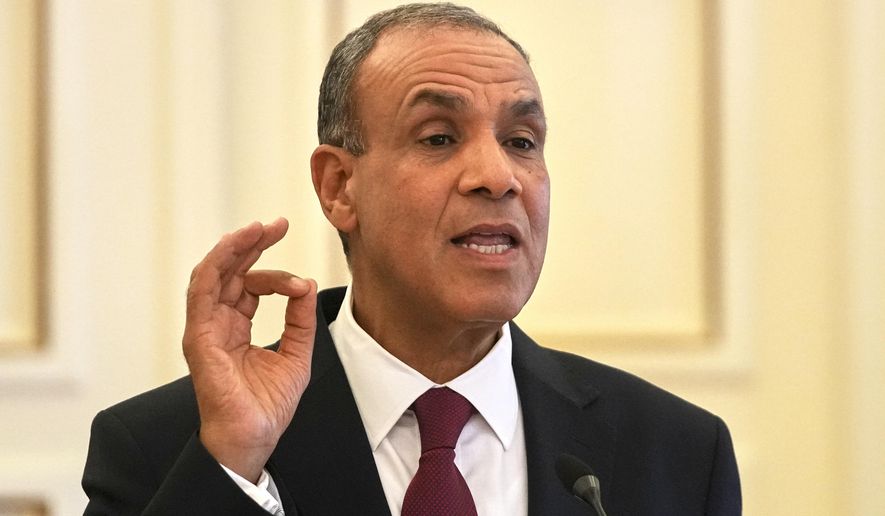
Egypt and its neighbors across the Middle East are paying a heavy economic price for the simmering U.S.-Iran war, Egypt’s top diplomat said in an exclusive interview, urging de-escalation and appealing to President Trump as a “man of peace” capable of ending the conflict.
Egyptian Foreign Minister Badr Abdelatty said his country remains deeply involved in negotiations between Washington and Tehran, which continued in New York this week as the two sides held indirect talks on the sidelines of the U.N. General Assembly meeting. Mr. Abdelatty said his nation views itself as a “main pillar of stability” across the region and is playing a central role — alongside other regional power players such as Oman, Pakistan and Qatar — in trying to facilitate a lasting peace.
“There is only one objective, which is not to resume the military operation because we are suffering, and we are paying a heavy price for that,” the foreign minister told The Washington Times’ Tim Constantine. “We are paying a heavy price. There is a big burden, challenges, because of the escalation, and that’s why we have to work together to de-escalate and alleviate the burden of such challenges and escalation.”
People were interested in these podcasts
Iran’s chokehold on the Strait of Hormuz, a vital regional waterway through which roughly 20% of the world’s oil flows, has had massive ripple effects across the region. Some financial estimates suggest that global economic losses from maritime disruptions through the Strait of Hormuz have topped $700 billion, though pinning down an exact number is difficult.
Across the theater, conflicts and their repercussions have directly impacted Cairo.
Egypt has seen a major influx of refugees fleeing the Gaza Strip, the epicenter of Israel’s military campaign against the Iran-backed Hamas terrorist group.
SEE ALSO: Iran floats seven-day plan to end the war, reopen Strait of Hormuz
Separately, disruptions to commercial ship traffic through the Suez Canal, a key source of revenue for Egypt, are estimated to have cost the country $11.5 billion.
“For a country like Egypt, this is big, big money,” Mr. Abdelatty said.
Mr. Abdelatty said Egypt firmly believes the U.S.-Iran war must end at the negotiating table, not on the battlefield.
“We believe there is no military solution. We have to draw lessons of history,” he said. “Always, military solutions are not bringing enduring and sustainable stability, and that’s why we’re always counting on the leadership of President Trump in order to move forward.”
The U.S. and Israel launched a military campaign against Iran in late February. The Trump administration said its goals were to end Iran’s nuclear program, destroy its ballistic missile capabilities, crush its navy, and stop its support for regional terrorist groups such as Hamas, Hezbollah and others.
But the regime in Tehran is still standing. Iran has demonstrated its capability to target key U.S. military bases across the region. Over the past several weeks, the Iran-backed Houthi rebels have escalated the conflict by targeting key U.S. ally Saudi Arabia.
Mr. Trump has recently teased restarting U.S. airstrikes, perhaps targeting both Iran itself and the Houthis, but so far he has refrained.
Iranian officials want the U.S. to return to the terms outlined in the Islamabad memorandum of understanding, signed in June, which instituted a cease-fire and removed the U.S. blockade on shipments in and out of Iran. The U.S. maintains that Iran violated that agreement by disrupting ship traffic through the Strait of Hormuz.
Still, Mr. Abdelatty said that agreement, despite differing interpretations in Washington and Tehran, remains a viable starting point.
“President Trump is considered as a man of peace,” he said. “He managed to end this war by agreeing to sign the MOU, and this is an excellent step forward, and we have to build on that.”
Mr. Abdelatty also called for a broader “new regional security architecture for the Middle East” open to all nations. But he stressed any comprehensive deal must settle the question of Palestinian statehood.
“Even if we manage to solve all crises without addressing the Palestinian cause, I can assure you there will be no enduring or sustainable peace and stability in the region — and even for Israel,” he said.
Contact the author

Please read our comment policy before commenting.