


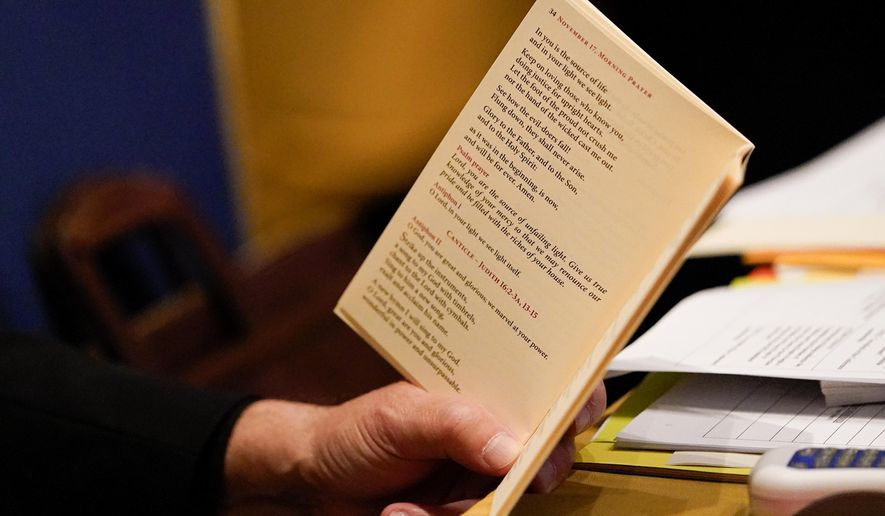

The Archdiocese of Baltimore, one of several Catholic dioceses that downsized parishes after filing for bankruptcy amid sex abuse claims, plans to ordain its largest number of priests in 50 years.
The Catholic Review, the Archdiocese of Baltimore’s official news outlet, reported that Baltimore will ordain 12 men as priests next year, up from five this year and the most since the 1970s.
The number of Baltimore seminarians has grown from 28 in 2007 to 52 in 2020 to 66 this year.
People were interested in these podcasts
The surge follows years of pain for the archdiocese, which serves more than 500,000 Catholics spread over most of Central and Western Maryland. It also reflects a national trend of increasing enrollment in Catholic seminaries.
In 2024, the Archdiocese of Baltimore consolidated 61 parishes into 23, reducing its overall total from 137 to 108. The archdiocese is negotiating in U.S. Bankruptcy Court a settlement with more than 1,000 abuse victims that is expected to run into the hundreds of millions of dollars.
The archdiocese reported in 2023, before the consolidations, that 405 priests served 137 parishes.
The Rev. Steven Roth, vocations director for the Archdiocese of Baltimore, said those experiences paradoxically encouraged more men to seek the priesthood to help heal their communities.
“We’re not just taking men who want to be priests, but men who are capable of living the life,” Father Roth said in a phone interview. “They’re not dissuaded by the stories of past sins, but feel stirred to help those who have been hurt.”
He said an increase in young men converting to Catholicism on college campuses has contributed to the trend. The archdiocese reported receiving nearly 2,000 converts during the latest Easter season, up from 778 people last year.
Nationwide, the same demographic has driven a surge in conversions to Catholicism, but seminary numbers have been more inconsistent.
Hallow, a Catholic prayer and meditation app with more than 15 million registered users, found in a representative survey of 59 universities that converts seeking baptism and confirmation through campus ministries jumped by 87.6% from the 2023-2024 term to the 2024-2025 term.
The app reported in March that 140 of the nation’s 175 dioceses expected a 38% annual surge in people converting through the Order of Christian Initiation of Adults program during this year’s Easter season.
“It’s encouraging to see this revival extending into religious life vocations too,” said Alex Jones, CEO and co-founder of Hallow. “We’ve had two men, even just on our team, leave to enter seminary in the last year.”
The Official Catholic Directory, which surveys the nation’s Roman Catholic dioceses, found the number of men studying for the priesthood in undergraduate and graduate programs increased from 2,980 in 2024 to 3,035 in early 2025, a nearly 2% increase.
Some individual dioceses have reported substantial gains.
The Diocese of Davenport, Iowa, filed for bankruptcy in 2006 and emerged from it in 2012 after finalizing a $37 million settlement distributed among more than 150 abuse survivors. The number of seminarians has increased by nearly 80%, from nine last year to 16 this year.
The St. Paul Seminary School of Divinity in Minnesota reported that 106 seminarians from 17 dioceses and religious orders studied for the priesthood during the 2025-2026 academic year. That was the highest enrollment in more than a decade and the largest since 1979.
However, it is unclear whether the recent increases indicate a broader trend, as seminary numbers have lagged behind conversions.
“Trends in the number of men entering seminaries can be difficult to track,” said Michael New, a professor of social research at the Catholic University of America.
He noted that some seminarians drop out after completing philosophy credits and four-year collegiate programs, leaving them short of the graduate theology degree they require for ordination.
Rebuilding trust
Georgetown University’s Center for Applied Research in the Apostolate reported that graduate-level seminarians alone fell by 8% in fall 2025, dropping to 2,686 from 2,920 in 2024.
The Rev. Thomas Gaunt, a Jesuit priest who leads the center, said seminary numbers “can vary up or down” depending on the year.
He also said it is too early to tell whether Pope Leo XIV, who became the first American pontiff last year, has had any effect on seminary recruitment.
“Any impact from having an American pope will take years to be seen,” Father Gaunt said.
Tricia Bruce, a Catholic sociologist affiliated with multiple institutions, noted that Father Gaunt’s center reported that U.S. dioceses ordained 428 men as priests this year. That was a 6% increase from last year but remained 27% lower than the number ordained in 2017.
“It will take a steady and even more substantial rise to put a dent in the priest shortage the U.S. is experiencing nationwide,” Ms. Bruce said. “But even small increases enable bishops to assign a priest to parishes or ministries that have gone without for years.”
She noted that interviews she conducted with priests for the National Study of the Priesthood, a project of the Catholic University of America’s Catholic Project, found that many men joined because they wanted to “bring back a trustworthy voice and leadership for the church” after years of scandal.
“It’s possible, then, that even public scandal can act as a motivator for Catholic men to enter the priesthood, often as a way to live out faith as an authentic and trustworthy exemplar of how to lead and serve the church,” Ms. Bruce said.
Bill Hambleton, whose allegations of abuse starting at age 16 were acknowledged by the Diocese of Salt Lake City, was ordained a deacon in 2000 but stopped short of the priesthood. He said he still rejoices in the increased vocations that dioceses such as Baltimore are seeing.
“This is a generation that gives us hope for reform,” said Mr. Hambleton, chair of religious studies at Flintridge Sacred Heart Academy in La Canada Flintridge, California. “I think they’ve learned good and bad lessons from how their bishops have handled transparency and accountability, and they want to help.”
Contact the author

Please read our comment policy before commenting.