


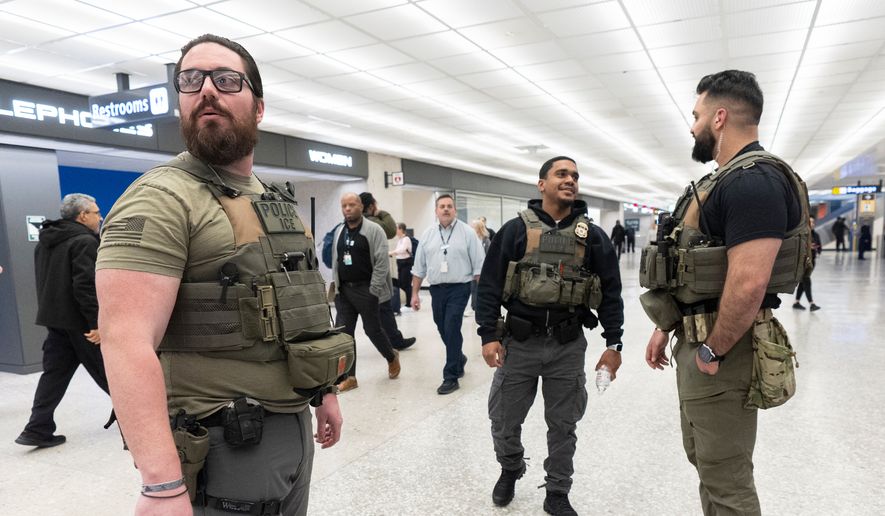

A federal judge has issued an injunction on Virginia’s law that would have prevented counties and cities from entering into cooperative agreements with ICE, saying the state was interfering with national law enforcement priorities.
U.S. District Judge Robert Payne also said the state law meddled with valid contracts between the locals and the feds, and did so without a “legitimate public purpose.”
His injunction came Monday, a day before the law was to take effect, and it preserves all existing cooperative deals, known as 287(g) agreements, between local governments and U.S. Immigration and Customs Enforcement.
People were interested in these podcasts
He did allow the state to bar any new jurisdictions from signing up, saying he wanted to preserve the current situation while he hears more arguments in the case. But his ruling marks the latest in a string of losses for Gov. Abigail Spanberger and the Democrat-controlled assembly, which devoted significant time this year to passing anti-ICE legislation.
Judge Payne, a George H.W. Bush appointee, had previously blocked the state’s new law barring federal immigration officers from wearing masks while on duty in Virginia.
The Trump Justice Department was the challenger in both cases, and Judge Payne said the DOJ had sufficiently proved that it was likely to triumph over the ICE agreement law “for the reason that the Virginia 287(g) law directly regulates the conduct of federal law enforcement in the enforcement of the federal immigration laws, thereby violating the intergovernmental immunity doctrine.”
He also said the law is a “substantial impairment” of the existing contracts.
The Virginia Coalition for Immigrant Rights denounced the decision, saying ICE is “combative and aggressive” in its dealings with the migrant community.
“ICE has repeatedly shown to be an untrustworthy institution. Virginia voters overwhelmingly support the initiative to restrict local law enforcement from collaborating with ICE,” said Monica Sarmiento, the coalition’s executive director.
Some 2,430 jurisdictions across the country have 287(g) agreements. Two dozen of those are in Virginia.
Loudoun County is the largest jurisdiction on the list, which is dominated by relatively small counties scattered in the state’s western regions.
In addition to immigration, Virginia has been losing the legal battle in court over its new gun restrictions.
A state judge issued an injunction preventing authorities from enforcing a ban on sales of so-called “assault firearms” and limits on locations where the weapons can be carried in public.
Judge Payne’s decision on the 287(g) cooperative agreements stands in contrast with other judges who have allowed states to limit them. That includes New York, where U.S. District Judge Mae D’Agostino last month upheld that state’s 287(g) ban.
She said 287(g) agreements are voluntary and the federal government cannot require them — just as states cannot force the feds to comply with anti-mask laws for national law enforcement agencies.
Judge D’Agostino, an Obama appointee, differed from Judge Payne in that she said she did find a “legitimate purpose” in New York’s law, which she said was intended to let the state set its own priorities for how police money should be spent.
“There is no indication that special interests are at play here. Instead, the Termination Act is an exercise of New York’s police powers, aimed at protecting public safety and local law enforcement resources,” she ruled on Aug. 3.
Contact the author

Please read our comment policy before commenting.